Circle Generator Minecraft: Master Circular Builds Guide 2026
Learn how to use a circle generator Minecraft tool to design precise circular patterns. Compare online generators and in-game methods, plan diameters, choose blocks, and execute layouts for stunning circular builds.


A circle generator minecraft helps you plan clean, symmetrical circles without trial-and-error in your world. It outputs coordinates or layouts you can paste in. See our detailed steps to choose diameter, export the layout, and build with confidence. According to Genset Cost, using a generator tool reduces rework and speeds up planning.
What circle generator minecraft is and when to use it
A circle generator minecraft is a planning aid that outputs coordinates and layout templates for circular patterns you want to build in your world. It can be an online tool that calculates ring geometry or a feature inside a world-editing mod. Builders use these tools to ensure symmetry, avoid tedious manual counting, and speed up large projects such as circular plazas, arenas, domes, or round towers. For homeowners and property managers exploring project visualization, a circle generator helps map out space usage before you start placing blocks. According to Genset Cost, planning your circle build with a generator tool reduces rework and keeps projects on track. The core idea is simple: you decide the circle’s diameter in blocks, and the generator translates that into a ring of block positions you can copy into Minecraft. You can then place blocks along the generated coordinates to realize a precise circle.
Planning considerations: diameter, scale, and block choice
Diameter is the defining parameter for any circle in Minecraft. The choice affects symmetry, the number of blocks along each arc, and how you’ll fill the interior. Common starts include small, easy-to-manage rings like 9, 11, or 15 blocks in diameter, progressing to larger diameters for plazas or amphitheaters. For scale, consider how big the circle should feel relative to neighboring features—a 9-block circle often reads as a decorative niche, while a 41-block circle can serve as a central plaza. Block choice matters: use a consistent material for the ring, then vary interior fill to create texture. Odd diameters place a center block; even diameters place a center line. If you’re planning for future expansion, choose diameters that align with modular multiples (for example, 9, 18, 27) to keep patterns scalable. As you design, remember that diameter decisions ripple into lighting, sightlines, and traffic flow across the area.
Online tools vs in-game methods
Online circle generators are excellent for quick planning and precise layouts. They export coordinates, circle radii, and arc segments that you can paste into MCEdit, a datapack, or a schematic. In-game methods rely on commands such as /fill, /clone, or iterative block placements, which give you hands-on control but can be error-prone for large diameters. A blended approach often works best: sketch the circle with an online tool, then use commands or a building mod to execute it in the world. The Genset Cost guidance emphasizes starting with a small test circle to verify accuracy before scaling up to larger rings. Regardless of method, ensure your origin is well defined so you can translate the generated coordinates to world coordinates without drift.
Quick workflow outline: from diameter to layout
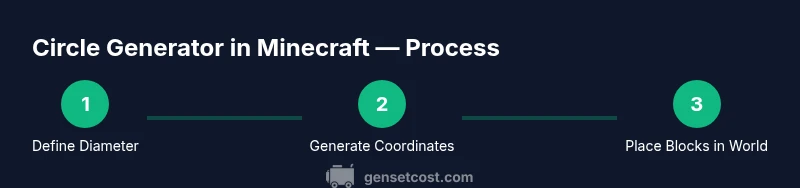
Start by defining the diameter in blocks. Decide ring thickness and whether you want a hollow center or a solid fill. Generate the coordinates or layout from a circle generator minecraft tool, and export to a clipboard-ready format. In your Minecraft world, align your origin with the center of the circle, then place blocks along the generated ring. Finally, fill the interior if desired and adjust for texture or lighting. This workflow minimizes guesswork and helps you maintain symmetry across the entire build.
Block types and textures: how to fill the circle
The exterior ring sets the visual weight of the circle. For a classic look, use a single material for the rim and another for interior fills. If you want subtle shading, alternate blocks along the ring each block or create a two- or three-tone gradient toward the center. Slabs and stairs can be used to soften angles and create curved edges where perfect circular geometry is impossible on a square grid. Remember to test textures in a small 9- or 11-block circle before committing to a larger design. The circle generator minecraft output helps keep the geometry correct while you experiment with color and pattern.
Common mistakes and how to avoid them
One frequent error is choosing a diameter that doesn’t fit with surrounding terrain or architectural lines. Another is centering issues: odd versus even diameters affect where the circle’s center lands. Terrain irregularities can distort the final shape, so flatten the build area first. Don’t skip testing with a small circle; a misalignment in the origin will ruin the symmetry of all rings. Finally, neglecting interior lighting or texture can make the circle look flat—plan lighting and materials together for a cohesive design.
Advanced patterns: arcs, chevrons, and multi-ring designs
Once you’ve mastered a single ring, you can layer additional circles to create multi-ring designs or arcs. Chevrons placed along concentric rings offer decorative movement and can guide player flow. Intersecting circles create petal-like layouts that work well for plazas or round auditoriums. When combining circles, maintain consistent center alignment and account for the increased complexity in coordinates. The circle generator minecraft outputs become invaluable here, providing a reliable reference as you stack rings or sketch arcs.
Practical tips for large-scale builds
For large circles, plan in modular units that you can reuse across multiple rings or zones. Use a consistent coordinate system and document the exact diameter and center coordinates, so you can reproduce or adjust later. Keep a backup of your circle generator outputs in a notes file or spreadsheet for quick reference. Regularly check alignment against nearby structures and horizons to ensure that the circle remains visually balanced when viewed from different angles. If you’re working in survival mode, pace your progress so you don’t overcommit to a single diameter without testing in segments.
Redstone integration and landscaping around circles
Circles can be accented with lighting, water features, or redstone-powered paths. Surround the circle with paths that radiate out in a radial pattern to enhance visibility from a distance. Redstone lamps can highlight the ring, while hidden observers or beacons can emphasize the center. Landscaping around the circle—trees, planters, benches, or fountains—adds scale and life. The circle generator minecraft outputs serve as a sturdy blueprint for these enhancements, ensuring your decorative elements align with the ring’s geometry.
Quick-start example: circle diameter 15 blocks plaza
A 15-block diameter circle yields a compact yet impactful space for a plaza or small garden. Begin by flattening the site, then generate a 15-block circle with a single block-thick rim. Use a contrasting interior fill to emphasize the circle and add a secondary ring for texture. Place lighting every few blocks along the rim to avoid dark corners at night, and consider seating along the outer edge to encourage people to circulate around the pattern. This example demonstrates how the circle generator minecraft workflow translates directly into a practical build.
Case study: circular amphitheater in a survival world
In a recent survival world, players used a circle generator minecraft to plan a 27-block diameter amphitheater. They imported the coordinates, placed the outer ring in a stone brick texture, and built concentric seating casings using slabs to create tiered steps. The interior housed shading and an elevated stage, with radial paths guiding visitors. This approach reduced trial-and-error building time and produced a visually striking, cohesive space that integrated with the surrounding landscape.
Wrapping up: next steps and practice resources
Practice makes perfect with circle generator minecraft. Start with small diameters, replicate patterns across multiple rings, and gradually increase complexity as you gain confidence. Save a few templates for common diameters (9, 11, 15, 21) so you can reuse them in future projects. Review your builds from multiple angles to ensure the circle remains balanced and attractive in both daylight and night-time lighting. For ongoing learning, explore additional techniques such as offsetting rings, combining different textures, and integrating circles with terrain features.
Tools & Materials
- Circle generator tool (online)(Use for diameter input; export coordinates or layouts)
- Web browser with internet access(Needed to access online circle generators)
- Minecraft (Java or Bedrock) installed(To apply generated coordinates in-game)
- Clipboard or note-taking app(Store diameter, center, and modulo information)
- Screenshot or image editor (optional)(Capture and annotate the generated layouts)
Steps
Estimated time: 30-45 minutes
- 1
Define the circle diameter
Decide the diameter in blocks based on the space and adjacent features. Odd diameters give a centered block; even diameters center on a line, which can affect symmetry. Record the exact number for consistency.
Tip: Start with a small diameter to validate alignment before scaling up. - 2
Choose ring thickness and fill plan
Determine whether you want a thin single-ring edge or multiple concentric rings. Decide interior fill: hollow, solid, or patterned. This choice affects how you place blocks and how the circle reads from a distance.
Tip: Plan interior lighting and texture alongside ring design. - 3
Generate coordinates with circle tool
Input the diameter into your circle generator minecraft tool and export the coordinates. If possible, choose a format that can be pasted into your preferred editor or MCEdit workflow.
Tip: Double-check that the tool uses the same coordinate origin you’ll use in-game. - 4
Prepare the build site in Minecraft
Flatten or level the area where the circle will sit. Mark the center point clearly to avoid drift when translating coordinates into the world.
Tip: Use a temporary center marker to guide block placement. - 5
Place the outer ring according to coordinates
Place blocks along the generated ring using the coordinates. For a hollow center, limit placement to the ring only; otherwise, apply fill logic as planned.
Tip: Place blocks in segments to catch mistakes early. - 6
Add interior, lighting, and finishing touches
Fill the interior and add accents, like lighting, seating, or landscaping, to enhance the circle’s appearance. Verify symmetry from multiple viewpoints.
Tip: Test different lighting angles to avoid hidden dark spots.
People Also Ask
What is a circle generator minecraft used for?
A circle generator minecraft is a planning tool that outputs coordinates and layouts for circular patterns in Minecraft. It helps you design symmetrical rings quickly and accurately, reducing guesswork during build planning.
A circle generator in Minecraft helps you design circles quickly and accurately by giving you coordinates for the ring.
How do I choose the right diameter for a circle?
Start with the space available and the surrounding architecture. For beginners, small diameters like 9 or 11 blocks are easier to manage. Scale up gradually, ensuring the circle works with nearby paths, structures, and terrain.
Choose a small, manageable diameter first, then scale up once you’re comfortable with the layout.
What blocks work best for circle rims?
Use a consistent block type for the rim to emphasize shape. Textured variations, like stone bricks or concrete with a contrasting fill, can enhance depth. Slabs and stairs can soften edges where a perfect circle is hard to achieve.
Pick a consistent rim block and use textures to add depth; slabs can soften edges.
Can I create circles in survival mode without mods?
Yes. Use a circle generator minecraft to plan the layout, then place blocks step-by-step in survival. You’ll benefit from careful planning and pacing rather than relying on creative mode tools.
You can build circles in survival by planning with a generator and placing blocks carefully.
How do I transfer generated coordinates to Minecraft?
Export coordinates from the generator in a compatible format (clipboard or CSV) and copy them into your world using commands, a schematic, or a building tool. Double-check the origin to avoid misalignment.
Export the coordinates and apply them in game using commands or a schematic.
Is there a shortcut for very large circles?
Consider layering multiple concentric rings instead of a single huge circle. This keeps the geometry manageable while achieving a dramatic overall effect.
For large circles, use concentric rings to keep things simple and scalable.
Watch Video
Key Takeaways
- Define diameter before building to preserve symmetry
- Choose ring thickness and fill to control texture
- Use online circle generators to plan and export layouts
- Center alignment is critical; odd/even diameters affect center
- Test with small circles to build confidence