How to Use an Exchange Gift Generator: A Step-by-Step Guide
Learn how to plan and run an exchange gift generator for groups of any size. This educational guide covers methods, setup, privacy, and best practices for a fair, fun gift exchange.


This guide helps you set up and run an exchange gift generator, so your group can complete a fair, fun gift exchange quickly. You’ll choose a method (random draw, algorithm-based pairing, or online tool), collect participant details, configure constraints (budgets and wishes), run the assignment, and share results securely.
What is an exchange gift generator?
An exchange gift generator is a tool or method used to assign recipients for a group gift exchange in a structured, private, and fair way. It helps organizers move from paper lists or ad hoc draws to a repeatable process that respects budgets, timing, and participant preferences. Whether you’re coordinating a neighborhood Secret Santa, a workplace holiday swap, or a community group, the generator sets the rules, seeds the randomization (or algorithm), and outputs a secure mapping of giver to recipient. You’ll typically specify constraints such as spending limits, wish lists, and exclusion rules to prevent awkward pairings. By centralizing inputs and outputs, an exchange gift generator reduces confusion and post-draw questions. For homeowners and property managers, this approach scales well to resident associations, HOA events, and amenity committee exchanges where transparency matters.
Throughout this guide, you’ll see practical examples, guardrails to protect privacy, and tips for handling large groups without losing the personal touch that makes gift exchanges enjoyable.
Why teams choose a generator-based approach
People often switch to a generator for three reasons: fairness, efficiency, and privacy. A well-configured tool eliminates duplications, ensures every participant gives and receives, and makes it easy to audit the draw after the event. For property managers, the benefits extend beyond a single meetup: it creates a repeatable process that can be used year after year with minimal reconfiguration. In community settings, residents appreciate the clear rules, scheduled timelines, and the ability to customize budgets and constraints so that gifts feel thoughtful yet affordable. As you consider options, remember that a generator is only as good as the data you feed it and the governance you apply to ensure inclusivity and respect.
Common models you’ll encounter
There are several approaches to running an exchange gift generator:
- Random draw with limited repetition: simple, fast, and suitable for small-to-medium groups.
- Algorithm-based pairing: uses constraints (budget, preferences, and exclusions) to optimize fairness.
- Online tool with host controls: centralized, auditable, and accessible from anywhere. Each model has trade-offs between privacy, ease of use, and control. For most homeowner associations and HOA events, starting with a random draw and gradually adding constraints yields reliable results without overwhelming organizers.
Tools & Materials
- Internet-connected device(Laptop, tablet, or smartphone with a browser)
- Gift exchange rules sheet(Provide guidelines and timing before the draw)
- Notepad or digital spreadsheet(Record assignments securely and privately)
- Privacy considerations checklist(Include instructions for handling participant data)
Steps
Estimated time: 45-60 minutes
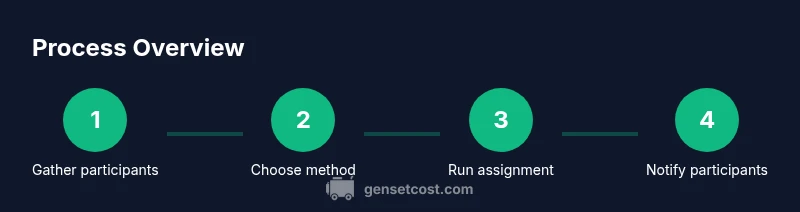
- 1
Gather participant information
Collect names, contact details, and any gift constraints (budget, preferences, allergies) from all participants. Use a secure form or a dedicated spreadsheet to keep data organized and accessible only to the organizer.
Tip: Ask participants to confirm their details before the draw to reduce misrouting. - 2
Choose your assignment method
Decide between a simple random draw, an algorithm-based pairing, or an online tool with host controls. Consider group size, privacy concerns, and whether you need to accommodate exclusions or budgets.
Tip: For mixed groups, start with a random draw and layer in constraints if needed. - 3
Configure constraints and exclusions
Set the spending limit, any wish-list fields, and exclusions (e.g., no self-pairing, no pairing within the same household). Ensure the rules are agreed upon by all participants.
Tip: Document exclusions clearly to avoid disputes during notifications. - 4
Run the assignment
Input data into your chosen method and run the generator. Review outputs for obvious errors or duplicates and adjust as necessary before finalizing.
Tip: Run a quick dry-run with a small subset to validate the process. - 5
Notify participants securely
Share gift recipient results privately with each participant. Provide guidelines for wrapping, labeling, and delivery timing. Avoid public posting of assignments.
Tip: Use a neutral channel (email or a private message) to protect privacy. - 6
Host the exchange and collect feedback
Carry out the gift exchange on schedule and solicit feedback to improve future iterations. A brief survey helps capture what worked and what didn’t.
Tip: Close the loop by publicly acknowledging successful pairings while preserving privacy.
People Also Ask
How does an exchange gift generator ensure fairness?
A well-configured generator applies consistent rules and exclusions, producing a reproducible mapping from giver to recipient. When privacy is preserved and constraints are transparent, participants feel the process is fair.
A well-configured generator uses consistent rules to assign recipients, keeping details private and transparent.
What should I do for large groups?
For large groups, use an online tool or a database-backed approach to handle many participants efficiently. Break the group into smaller cohorts if needed and run separate draws with shared overarching rules to maintain consistency.
For large groups, run organized batches with clear rules to keep things smooth.
Are there privacy concerns with online tools?
Yes. Choose tools that minimize data collection, use encrypted channels for notifications, and restrict access to the assignment data. Always inform participants about how their data will be used and stored.
Check the tool's privacy settings and limit data collection to what is essential.
Can I customize budgets and preferences?
Absolutely. Most generators allow you to set a budget range, add wish-list fields, and implement exclusions. Align these settings with your group’s culture and ensure everyone agrees before drawing.
Yes—budgets and preferences can be tailored to fit your group.
What if someone can’t attend or exchange?
If a participant can’t attend, have a plan to reassign or skip their draw without disrupting others. Document fallback procedures in the rules and communicate them ahead of time.
Create a clear plan for replacements or postponed assignments.
What’s the best way to debrief after the event?
Send a short survey to capture what worked, what didn’t, and suggestions for next time. Use feedback to refine budgets, constraints, and timing for future exchanges.
Ask for quick feedback to improve next year’s setup.
Watch Video
Key Takeaways
- Define participant data upfront to avoid last-minute gaps.
- Choose a method that matches group size and privacy needs.
- Configure constraints clearly and test before going live.
- Communicate rules and timelines transparently.