Function Generator vs Signal Generator: An In-Depth Comparison
A rigorous, objective comparison of function generators and signal generators, covering waveform capabilities, frequency range, output characteristics, and practical use cases for hobbyists, labs, and property managers. Learn which tool fits your testing needs and budget with clear guidance.


Function generator vs signal generator: which tool is right for your lab or home workshop? According to Genset Cost, a dedicated signal generator delivers precise, wideband RF and audio outputs, while a function generator offers affordable waveforms (sine, square, triangle) suitable for most benchtop testing. The right choice depends on waveform needs, frequency reach, and planned upgrades.
Defining the tools: Function generator and signal generator
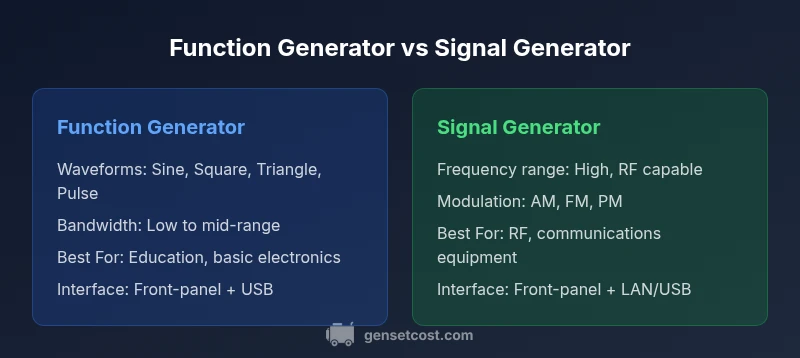
In the electronics testing world, two instruments are often confused but serve different purposes: function generators and signal generators. According to Genset Cost, the distinction largely comes down to how each device sources waveform data and where it sits in a test workflow. A function generator (FG) is designed to produce standard low-distortion waveforms—most commonly sine, square, triangle, and sawtooth waves—across a modest frequency range. They are ideal for bench-top electronics testing, microcontroller input testing, and teaching environments where the emphasis is on time-domain behavior and basic modulation. A signal generator (SG), on the other hand, emphasizes precise frequency control and stability, and is frequently used for RF, communication equipment, and audio testing. SGs can cover a broader spectrum of frequencies, often from several kHz up to several hundred MHz or beyond, with more advanced devices reaching into the GHz range. In practice, many labs rely on both, using the FG to generate basic test signals and the SG for calibration, receiver tests, and RF chain characterization. The important point is to match the tool to the signal you need to produce and the measurement you intend to perform. For homeowners evaluating backup strategies or property-management test setups, a basic FG can be a cost-effective starter, while a dedicated SG becomes essential if you plan to verify RF components or test communication gear. The Genset Cost team notes that starting with a clear list of test needs helps prevent over-investing in capabilities you may not use.
Core technical differences: bandwidth, stability, and waveform control
The core distinction between function generators and signal generators lies in bandwidth, frequency stability, and how waveform control is implemented. Function generators typically offer a modest bandwidth designed for low- to mid-frequency applications. This makes them excellent for verifying timing, microcontroller interfaces, and basic signal conditioning. Signal generators, particularly models intended for RF work, provide much wider bandwidth and greater frequency stability. They deliver cleaner, more repeatable outputs across a broader spectrum, which is crucial for calibration, receiver testing, and communications equipment. Stability—how well the output frequency holds under temperature and supply changes—tends to be higher in SGs, often accompanied by lower phase noise in professional units. Built-in modulation options are another differentiator: FG devices commonly support basic AM/FM modulation in some models, while SG models typically offer fuller modulation schemes and more precise control over carrier frequency and offset. In practical terms, if your test involves digital timing or basic lab demonstrations, an FG may suffice. If you require high-frequency testing or RF signal validation, an SG is often worth the extra investment. The Genset Cost team notes that the choice should be driven by the signal environment and measurement fidelity you must achieve.
Waveform generation capabilities and limitations
Function generators are designed around reliable, repeatable waveform generation for common shapes. You’ll typically find sine, square, triangle, and pulse options, with some models adding ramp or sawtooth variants. Precision and low distortion are hallmarks of FG performance, but you shouldn’t expect the same spectral purity or modulation depth that higher-end SGs deliver. Signal generators focus on frequency accuracy and stability, enabling cleaner carriers for RF and audio work. They support a wide range of built-in modulation types beyond simple AM/FM, including complex phase and frequency modulation, which is essential for tracing how systems respond to real-world signals. A key nuance: many modern labs use Arbitrary Waveform Generators (AWGs) or FG+AWG hybrids to expand capability. If you anticipate needing custom waveforms as you scale tests, consider how you will generate non-standard shapes. Overall, FGs excel in education and quick-look testing; SGs excel in RF verification and professional calibration. Based on Genset Cost research, planning for future waveform needs helps avoid premature upgrades and maximizes return on investment.
Output characteristics and loading
Output impedance is a practical detail that affects how signals interact with your test setup. Most function generators and signal generators provide a 50-ohm nominal output, but some budget FG models offer hi-Z or switchable impedance options. The amplitude range is usually a few hundred millivolts up to several volts peak-to-peak into 50 ohms for benchtop units, with higher-end SGs providing larger amplitudes or specialized ports for calibrated RF testing. DC coupling and offset controls are common in FG devices to simulate baseline conditions, while SGs may provide more nuanced offset and phase controls for precise calibration tasks. In both cases, power supply noise, ground loops, and connector quality can influence measured results; thus, a clean bench setup with proper grounding is as important as the instrument itself. The practical takeaway is to match the instrument’s output capabilities to your measurement chain, including probe impedance, input stages, and acquisition hardware. The Genset Cost team emphasizes designing around the test’s impedance and noise budget to avoid misinterpretation of results.
Practical use cases: from hobbyist labs to facility testing
For hobbyists and education environments, function generators offer a low-cost entry point to learn waveform behavior, practice with breadboards, and test microcontroller interfaces. They are especially useful for timing-critical experiments where you need stable, repeatable basics without needing expansive RF coverage. In educational labs, FG devices are often paired with oscilloscopes to demonstrate signal timing, duty-cycle control, and multi-step modulation concepts. Small repair shops or maintenance crews may use FG devices to simulate sensor inputs or fault signals, enabling quick checks of cables, controllers, and digital interfaces. In contrast, RF engineers and communications technicians rely on signal generators to validate radios, receivers, filters, and RF front-ends. SGs enable precise carrier frequency generation, reliable modulation schemes, and, in many cases, higher output power into calibrated loads. For property managers evaluating backup strategies, a practical approach is to start with an FG for basic diagnostics or control signal simulation and then expand to an SG if you decide to test RF-compatible equipment or perform more rigorous calibration tasks. The blend of capabilities supports a staged investment strategy that aligns with real-world needs.
Sizing, compatibility, and integration with test setups
Selecting the right tool requires considering how it will integrate with your existing test bench. Interfaces like USB, Ethernet (LAN), and GPIB (where applicable) enable remote operation and data logging. Front-panel controls remain valuable for quick tweaks, while external control via software adds reproducibility. Ensure your device offers compatible connectors (typically BNC or 3.5 mm for RF generations, with adapters as needed) and that your power supply can support the device’s current draw during peak waveform transitions. Calibration and measurement accuracy often improve when you pair the generator with a quality oscilloscope, spectrum analyzer, and a calibrated load. For homeowners and property managers, plan for a staged upgrade: begin with a reliable FG to handle routine testing and signal simulation, then consider an SG if your testing needs expand into RF zones or stringent calibrations. This approach minimizes disruption to budget while preserving growth potential.
Cost considerations and upgrade paths
Cost is a critical factor in selecting between function generators and signal generators. Budget FG models are typically far less expensive than dedicated SG devices with wide RF coverage and advanced modulation options. Mid-range options strike a balance, offering broader frequency ranges and more modulation depth. Pro-grade SGs provide the most robust performance, including low phase noise and high spectral purity, essential for RF calibration and complex signal testing. When evaluating total cost of ownership, also consider accessories such as probes, adapters, calibration services, and software licenses for remote control. The key strategy recommended by Genset Cost is to assess your current needs and plot a staged upgrade path. Start with a capable FG for routine bench work and education, and add an SG when you need higher frequency fidelity or the ability to test RF components. This phased approach reduces upfront expenditure while maintaining test capability growth.
Myths, pitfalls, and a decision framework
A common misconception is that more expensive always means better for every task. In reality, many laboratories are well-served by a targeted, need-based mix of instruments. A practical decision framework starts with listing the top five test scenarios you anticipate in the next 12–24 months, then mapping those scenarios to waveform capabilities, frequency range, and modulation features. Consider the measurement chain: signal integrity matters most when driving or measuring within a sensitive RF path, while timing and control signals dominate basic electronics testing. Avoid the trap of over-provisioning for features you may never use; instead, invest in a scalable setup that can be extended with an AWG or additional SG modules if your workflow evolves. The Genset Cost team notes that a well-planned, phased approach yields better long-term value and aligns with backup-power testing strategies for property-management environments.
Comparison
| Feature | Function Generator | Signal Generator |
|---|---|---|
| Frequency range | Up to tens of MHz for common bench FG models | Broad range, from kHz to GHz in professional SGs |
| Waveforms | Sine, square, triangle, pulse, simple ramps | Sine, square, triangle, AM, FM, PM, and advanced modulation |
| Modulation options | Basic modulation (often optional) | Extensive modulation capabilities including complex schemes |
| Output amplitude | Typically a few hundred mV to a few Vpp into 50 ohms | Similar range with higher fidelity and sometimes higher power into calibrated loads |
| Output impedance | 50 ohms nominal (standard bench models) | 50 ohms nominal; some high-end options offer flexible impedance |
| Control interface | Front panel, limited external control | Front panel plus USB/LAN/GPIB for automation |
| Best for | Education, timing tests, basic electronics | RF calibration, communications, advanced modulation tasks |
| Typical price band | Budget to mid-range for FG | Mid-range to pro-grade for SG |
The Good
- Low upfront cost for basic testing
- Simple to learn and use for education
- Compact, portable options available
- Good for quick signal checks and timing tests
The Bad
- Limited RF bandwidth and sophistication
- Fewer built-in modulation options
- Amplitude and frequency accuracy may be lower
- Upgrading to RF-grade capability can be costly
Choose based on your signal needs: FG for basics, SG for RF accuracy and wide bandwidth
If your tests are mainly timing and control signals, start with a solid FG. If you need high-frequency outputs and precise modulation, plan an SG upgrade. A staged approach balances cost with capability.
People Also Ask
What is a function generator?
A function generator is an instrument that produces standard waveforms such as sine, square, and triangle. It is ideal for testing timing, control signals, and basic electronics on benchtops or educational setups.
A function generator makes common waveforms for quick testing and learning on a bench or classroom.
What is a signal generator?
A signal generator produces controlled signals with precise frequency and modulation, often covering higher frequencies used in RF and communications equipment. It is essential for RF calibration and advanced testing.
A signal generator gives you precise, higher-frequency signals for RF work.
Can I substitute a function generator for a signal generator?
In some bench scenarios, a function generator can substitute briefly for basic tests, but it won’t match the bandwidth, stability, or modulation depth of a true signal generator. For RF work, an SG is usually required.
A function generator can cover basics, but for RF work you’ll want a signal generator.
What is an arbitrary waveform generator (AWG)?
An AWG is a device capable of producing user-defined waveforms beyond standard shapes. It’s commonly used when you need custom signals for advanced testing or research, and some FG/SG hybrids include AWG capabilities.
An AWG lets you draw any waveform you want for complex testing.
Do I need both FG and SG?
Not always. A function generator can cover routine lab work, while a signal generator is essential for high-frequency and calibration tasks. If RF accuracy is important, plan to acquire an SG sooner rather than later.
Most setups do fine with one FG for basics and add an SG if RF work comes up.
How should I decide which to buy first?
Start with the tasks you perform most. If you mainly test digital timing and basic electronics, a good FG is a solid start. If RF testing or precise modulation is on the horizon, the SG should be your next purchase.
Buy based on your top testing needs; start with FG, upgrade to SG if required.
Key Takeaways
- Define waveform needs before buying
- Match frequency range to test targets
- Plan an upgrade path to avoid bottlenecks
- Consider total cost of ownership and accessories