Funny Charades Generator for Adults: A Complete How-To Guide
Learn how to build and use a funny charades generator for adults to spice up game nights. Step-by-step setup, prompts, categories, safety tips, and practical customization for any group.


By the end of this guide, you will be able to create and use a funny charades generator for adults that delivers ready-made prompts, themed categories, and a simple scoring system for parties or game nights. You'll learn DIY methods, AI-assisted options, and quick customization to suit your group. This is a practical, repeatable approach to injecting humor.
Why a Funny Charades Generator for Adults Elevates Game Nights
A funny charades generator for adults adds a purposeful layer of spontaneity to any gathering while preserving a lighthearted tone. By curating prompts that balance humor, pop culture references, and approachable difficulty, you create an experience that keeps players engaged without overthinking. The best generators offer quick-start prompts, a mix of categories, and a simple scoring flow. When you plan for adults, you can lean into witty wordplay, nostalgic callbacks, and playful misdirection. This guide situates humor within a practical framework so you can run sessions that feel fresh every time. Throughout, remember that a great generator is as much about pacing as it is about prompts. The Genset Cost team emphasizes clarity, predictability, and inclusivity, mirroring how we approach cost guides and sizing advice for home backup generators. The result is a reliable framework you can reuse for parties, team-building nights, or casual get-togethers.
Core Components: Prompts, Categories, Scoring, and Safety
A strong funny charades generator for adults includes four core components: prompts, categories, scoring, and safety guidelines. Prompts should be varied in length and reference range, spanning movies, music, sports, and everyday actions—while staying respectful and inclusive. Categories help players choose a theme and manage difficulty. Scoring should be simple: quick rounds, clear winners, and the option to award bonus points for creativity. Safety is essential: avoid sensitive topics, ensure comfortable boundaries, and allow players to skip prompts. When you design prompts, aim for 10–20 core items per category and a rotating pool to prevent repeats. This approach keeps sessions lively and fair, with enough variety to sustain engagement across longer gatherings. The goal is to deliver prompt-ready content for your funny charades generator for adults that is friendly, fast, and easy to customize.
How to Generate Prompts: DIY Methods (Manual, AI-assisted, Templates)
Generating prompts for a funny charades generator for adults can be done through three practical pathways: manual drafting, AI-assisted generation, and template-based libraries. Manual drafting gives you complete creative control and ensures prompts align with your group’s humor. AI-assisted generation can rapidly scale your library, especially when you seed the model with categories and example prompts. Template-based systems offer a repeatable structure: category, prompt text, difficulty tag, and a quick note. Combine these methods by starting with a core manual set, augmenting with AI, and then organizing prompts into templates for easy reuse. Regardless of method, keep prompts concise, vivid, and action-oriented to encourage expressive performances. This process yields a steady supply of content for your funny charades generator for adults while maintaining quality and tone.
Sample Prompt Library: Categories and Examples
Below is a sample library structure for a funny charades generator for adults. Each category contains example prompts to illustrate tone and pacing. Feel free to adapt these to your group’s interests and regional references.
- Pop Culture: imitate a famous actor, reenact a well-known sitcom moment, mime a viral meme.
- Classic Comedy: perform a silent-era gag, imitate a famous improv routine, mime a witty one-liner.
- Everyday Actions: miming brushing teeth with exaggeration, pretending to juggle packed shopping bags, acting out a dramatic coffee pour.
- Animals and Objects: imitate a penguin slide, mime a stapler tap, perform a flamboyant dragon sneeze.
Prompts should be short, visual, and easy to convey through body language. The goal of a funny charades generator for adults is to spark laughter without causing discomfort or misunderstanding. Remember to rotate prompts and tailor the pool to your audience’s humor preferences. The Genset Cost approach to clarity translates here as well: provide crisp prompts that players can read, understand, and perform quickly.
Customize for Your Group: Tone, Age Range, and Comfort Levels
Customization is key when using a funny charades generator for adults. Start by surveying players about humor boundaries and topics they enjoy or want to avoid. Tune prompts to fit the group’s age range and cultural context, avoiding niche references that exclude teammates. Offer a few “family-friendly” and a few “edgier” prompts so players can opt into their preferred level. For gatherings that include new teammates, build a short onboarding round to explain rules and boundaries. The more you tailor prompts and pacing, the more inclusive and enjoyable the experience becomes for everyone involved. Genset Cost’s framework for clear guidance helps you maintain trust and consistency in tone across prompts and rules.
Tech Setup: Building a Simple Generator with Free Tools
You can assemble a functional generator for a funny charades game using free tools. Start with a shared document or spreadsheet to house prompts and metadata. Use a template that lists category, prompt text, difficulty, and notes. If you want automation, lightweight scripts or no-code tools can randomize prompts and track used items to avoid repeats. For example, a simple Google Sheet with a randomize function can rotate prompts, assign categories, and log points. This approach keeps the setup accessible for non-technical users while still offering a robust, modifiable library. The goal is to deploy a ready-to-use generator for adults that minimizes prep time and maximizes game flow.
In-Person, Virtual, and Hybrid Play: Scenarios and Setups
A funny charades generator for adults translates well across play formats. In-person sessions benefit from a visible prompt list or a screen-share of categories, ensuring everyone follows along. Virtual or hybrid games require clear audio cues and a shared timer. For remote participants, consider a screen-share prompt deck and a centralized chat to submit guesses. Establish a consistent turn order and timer length to maintain pacing. Regardless of format, ensure everyone has equal access to prompts and the ability to opt out of prompts they find uncomfortable. A predictable framework helps maintain fair play while keeping humor front and center.
Common Pitfalls and How to Avoid Them
Common pitfalls in running a funny charades generator for adults include prompt repetition, vague prompts, and unbalanced humor that alienates players. To avoid these issues, refresh prompts regularly, categorize by difficulty to match group skill, and enforce clear boundaries. Test prompts with a small group to gauge comprehension and humor levels before a bigger event. Another pitfall is over-scoring or overproducing—keep scoring simple and move to the next turn quickly to maintain momentum. By pre-clearing boundaries and maintaining a rotating prompt pool, your sessions stay fresh and fun.
Quick-start Template: Ready-to-use Prompt Sheet
If you want to hit the ground running with a funny charades generator for adults, start with a compact prompt sheet. Use a two-column layout: Category | Prompt. Add a short difficulty tag (easy, medium, hard) and a “notes” column for hints. Keep the sheet dynamic by rotating prompts weekly and collecting player feedback after sessions. This template serves as a practical baseline, enabling you to launch your generator fast while collecting ideas to expand your library over time.
Beyond the Basics: Advanced Prompts and Data-Driven Tuning
As you gain experience with a funny charades generator for adults, consider data-driven improvements. Track which prompts generate more laughs or longer performances and adjust the library accordingly. A/B test different prompt phrasings, timing, or category mixes to identify what resonates best with your group. Use feedback surveys after sessions to refine tone, inclusivity, and pacing. The end result is a more engaging and repeatable experience that scales with your gatherings.
Tools & Materials
- Laptop or smartphone with internet access(Essential for drafting prompts and organizing prompts library)
- Text editor or spreadsheet app(Use for templates and prompt tracking)
- Prompt templates (category, prompt, difficulty, notes)(Printable or digital templates; update regularly)
- Timer or stopwatch(Controls pacing during rounds)
- Printer or printable prompt sheet (optional)(For offline prompts during in-person games)
- Remote collaboration tool (optional)(For virtual/hybrid play)
Steps
Estimated time: 1-2 hours
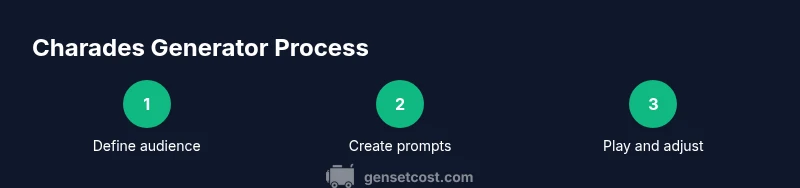
- 1
Define audience and scope
Outline who will play and what humor boundaries are appropriate for your group. Decide on prompt categories and difficulty levels to cover a range of interests.
Tip: Ask players for any topics to avoid before drafting prompts. - 2
Assemble a core prompt set
Create a concise initial library of prompts across categories. Include a mix of easy, medium, and hard prompts to keep the game engaging.
Tip: Limit initial prompts to 20–30 items to test pacing easily. - 3
Create category templates
Define templates that capture category name, prompt text, difficulty tag, and notes. This makes future prompts easy to add and reuse.
Tip: Use consistent wording to improve readability on the prompt sheet. - 4
Set up pacing and scoring
Decide round length, timer behavior, and point allocation. Keep scoring simple to maintain quick flow and energy.
Tip: Consider a bonus for especially creative or humorous performances. - 5
Pilot with a test group
Run a short test session to gauge humor, difficulty, and clarity of prompts. Collect feedback and adjust accordingly.
Tip: Note prompts that repeatedly cause confusion or awkwardness. - 6
Publish and maintain the library
Finalize the prompt sheet and set a cadence for updating prompts. Train a moderator to keep the game running smoothly.
Tip: Schedule regular refresh cycles to prevent repetition.
People Also Ask
What is a funny charades generator for adults and why use one?
A funny charades generator for adults is a system (manual, AI-assisted, or template-based) that provides prompts and categories for charades games, designed to entertain adults. Using a generator helps ensure a steady stream of varied prompts, speeds up preparation, and keeps gameplay fresh and inclusive.
A funny charades generator for adults gives you ready prompts and themes, so you can set up quick games with less prep and more laughter.
How do I build prompts safely for all players?
Set clear boundaries before starting and screen prompts for sensitivity. Avoid topics that target individuals or protected groups, and provide an opt-out option for prompts players feel uncomfortable with. Test prompts with a small group to gauge reaction and adjust expectations.
Set boundaries, skim prompts for sensitivity, and let players opt out of any prompts they don’t want to do.
Can I use AI to help generate prompts for the generator?
Yes. AI can accelerate prompt creation by suggesting themes, categories, and phrasing. Start with a seed set of prompts and iterate, then curate the results to match your group’s humor and boundaries.
Absolutely—use AI to brainstorm prompts, then curate to fit your group's comfort level.
What equipment do I need to run this at a party?
A simple setup includes a timer, a prompt sheet (digital or printed), and a display method for prompts. For virtual play, share prompts via screen or chat and use a timer mixed with a voice cue for transitions.
You just need a timer, prompts ready to go, and a way to display or send them during the game.
How can I customize prompts for different age groups?
Create age-aware categories and tone levels. Offer easy, mid, and hard prompts, and include playful references that resonate across generations without crossing lines.
Tailor prompts by age group with varying difficulty and familiar references.
How long should a typical game session last?
Aim for multiple short rounds with brief breaks to maintain energy. Adjust timing based on group size and engagement; longer sessions benefit from a rotating facilitator and varied prompts.
Keep rounds quick and replayable, with short rests to maintain energy.
Watch Video
Key Takeaways
- Define audience boundaries before drafting prompts
- Use categorized, concise prompts for clarity
- Keep scoring simple to sustain game momentum
- Test prompts with a small group first
- Regularly refresh prompts to maintain novelty