How to Generate an Online Signature in 2026
Learn how to generate a legally compliant online signature using trusted tools, protect your identity, and apply signatures securely across documents, with practical steps, security tips, and real-world cost considerations for homeowners and property managers.


To generate an online signature, start with a trusted e-signature tool, design a unique signature that combines your name and initials, and save it as a reusable graphic or certificate. Choose a service with verified security and legal compliance, then create the signature on your device and export as PNG or SVG for use across documents. Always protect access with two-factor authentication.
What is an online signature and why it's used
An online signature, also called an electronic signature, is a digitized mark you apply to a document to indicate agreement. It can be drawn with a mouse or finger, typed as a name, or embedded as a secure certificate. For homeowners and managers, online signatures speed contracts, leases, and purchase orders without printing. According to Genset Cost, a reputable e-signature workflow reduces turnaround time and preserves an auditable trail. The key is that the signature must be uniquely tied to you and be verifiable by the recipient. You can reuse a signature across documents, provided each recipient can verify its authenticity. This approach supports modern workflows where documents move quickly between people, devices, and jurisdictions while maintaining a clear record of consent.
In practice, your signature is not just a graphic; it is a representation of intent that can be cryptographically protected in some workflows. When selecting a tool, consider how the platform handles identity verification, what metadata is captured (timestamp, device, IP), and how easily you can revoke or rotate signatures if needed. The goal is to balance ease of use with robust integrity so that both parties can trust the signed document without resorting to paper.
Legal validity and standards for online signatures
In the United States, electronic signatures are generally legally binding under the ESIGN Act and UETA, provided the signature is attached to a document with the intent to sign and the signer’s identity can be verified. In the European Union, the eIDAS regulation defines three levels of electronic signatures: simple, advanced, and qualified, with the latter carrying the strongest legal weight and sometimes requiring a secure signature device. Many other jurisdictions have similar frameworks; the common thread is that consent, intent, and integrity are the core pillars. When selecting a tool, look for features such as tamper-evident seals, time stamps, and a clear audit trail showing who signed and when. For homeowners and managers, this means you can negotiate contracts or leases digitally without returning to paper, as long as your workflow is compliant and your recipients trust the process. Always keep a record of the signing events for enforcement and reference.
Security and privacy considerations are essential across jurisdictions. If you work with tenants or vendors in multiple regions, ensure your chosen solution meets local data handling standards and provides transparent documentation of who accessed the document and when.
Methods to generate online signatures
There isn’t a single universal method; most workflows combine several approaches depending on the document type and jurisdiction. The simplest method is to type your name, choose a signature font, and apply it as a rendered image. Another common approach is to draw your signature with a mouse or finger on a touch device, which creates a more personal marker. You can also upload a scanned image of your handwritten signature if you need a familiar look, or use a certificate-based signature that relies on a digital certificate issued by a trusted provider for higher security. Some platforms offer a hybrid: allow customers to type and then convert it into a stylized graphic, preserving both legibility and authenticity. Regardless of method, ensure the final signature is unambiguous, scalable, and compatible with the document formats you frequently use (PDF, Word, Google Docs). It’s wise to test your signature in various environments (printable PDFs, online editors, and cloud storage previews) to confirm there are no surprises when documents are shared with third parties.
Free vs paid tools: what to choose
Free tools are appealing for small, occasional needs, but they often come with limitations such as lower security, fewer audit trails, or watermarked exports. Paid tools usually offer stronger authentication options (including 2FA), more robust audit logs, higher-quality export formats (SVG, PDF), and better integration with document management systems. If you manage multiple properties or handle recurring contracts, a paid plan can reduce risk and save time in the long run. When comparing options, look for: (1) security and encryption standards; (2) verification and identity checks; (3) export formats and watermark policies; (4) API access and templates; (5) customer support and uptime guarantees. If you’re unsure, start with a trial that includes a sample contract and a few test signatures to gauge fit before committing. Remember to review privacy policies to understand data retention and use of your signature data.
Step-by-step (browser-based tool): creating a signature in a few clicks
To illustrate a browser-based workflow, follow these steps with any reputable e-signature service. First, open the signing portal in a trusted browser on a device you control. Then, choose the 'Sign' or 'Create signature' option and select your desired method (draw, type, or upload). Draw your signature with a fingertip or a precise mouse stroke until you’re satisfied with legibility, then confirm. Next, review the preview to ensure the size, alignment, and placement will work in your target documents. If you’re satisfied, export the signature as a PNG or SVG for future reuse and store it securely in a password-protected location. Finally, test the signature by applying it to a sample contract to verify that the signature scales correctly and remains tamper-evident. Pro tip: keep a separate backup copy in an encrypted drive in case your primary storage is compromised.
If you rely on templates, create a small library of signature placements (top-right, bottom of page, and blank signature blocks) to streamline workflow across documents.
Step-by-step (mobile): signature on a smartphone or tablet
Mobile workflows are convenient for on-the-go signing. Start by launching your e-signature app on a trusted device and signing into your account with 2FA. Choose 'Create signature' and decide between drawing with your finger, typing, or importing an image. If you draw, use smooth, continuous strokes to improve readability at small sizes. After you’re happy with the result, save the signature in a secure, encrypted vault or within the app’s protected storage. When ready to apply it to a document, open the file in a compatible viewer (PDF, DOCX) and select 'Sign'. Position the signature where required and confirm. Review the document again to ensure the signature did not alter the content or layout. For frequent use, enable auto-fill templates that insert your signature into recurring documents. Important tip: avoid saving your raw signature image in shared cloud folders; keep it in your personal, encrypted storage. If you’re signing on behalf of a business, coordinate approvals to maintain consistency across signatures and documents.
Security and privacy considerations
Security starts with who can access your signature and where it is stored. Use a tool that offers end-to-end encryption, hardware-backed key storage if available, and strong authentication. Always enable two-factor authentication and, if possible, biometric login for mobile apps. When you export a signature, save it in an encrypted location and restrict permissions so that only authorized users can view or reuse it. Be mindful of metadata around signatures; some tools attach timestamps, IP addresses, or device information that could be sensitive if exposed. Regularly review access logs and revoke permissions for former tenants, vendors, or employees. For long-term storage, consider archiving signatures in a format that preserves the original image and its cryptographic integrity. Finally, comply with local laws and industry standards for digital documents, including data retention and privacy requirements in your jurisdiction.
Common mistakes and how to avoid them
Common mistakes include exporting a signature with full name and date visible, using a low-resolution image that becomes pixelated, or sharing the file over insecure channels. Another pitfall is treating a signature as a general stamp rather than a secure signature asset; this can lead to unauthorized use. People also forget to test signature placement in different documents or fail to update the signature when their name changes or branding updates occur. To avoid these errors, use a reputable tool with robust templates, maintain a single, updated signature asset, and implement an access policy that restricts who can export or modify the signature. Finally, regularly back up the signature file and review your signing workflow for compliance and efficiency. If in doubt, run a small pilot of 5-10 documents to validate that your process preserves legal validity and document integrity.
Real-world use cases and cost considerations
In residential settings, online signatures expedite leases, maintenance agreements, and vendor contracts without printing. Property managers sign service orders, waivers, and consent forms faster, improving tenant satisfaction and cash flow. In commercial environments, teams use signatures for procurement, NDAs, and employment agreements, which reduces admin overhead. Cost considerations depend on volume and required features. Free tiers may suffice for single users or rare signing tasks, while multi-user teams benefit from paid plans with higher limits, more robust audit trails, and integration options. Expect price ranges to vary by provider, with monthly options typically designed for small teams and annual plans offering reduced rates. When evaluating cost, factor in long-term value: faster sign-offs, reduced paper waste, and improved security. The Genset Cost analysis suggests that scalable solutions with templates, role-based access, and automated reminders for completion deliver meaningful efficiency gains while controlling total cost of ownership.
Tools & Materials
- Computer or mobile device with internet access(Desktop or smartphone with up-to-date browser)
- Active email address(For verification and recovery)
- Access to an e-signature service or software(Choose a reputable provider with compliance features)
- Reliable internet connection(Stable connection during signing)
- Optional: digital certificate or identity verification documents(If your workflow supports certificate-based signatures)
Steps
Estimated time: 15-25 minutes
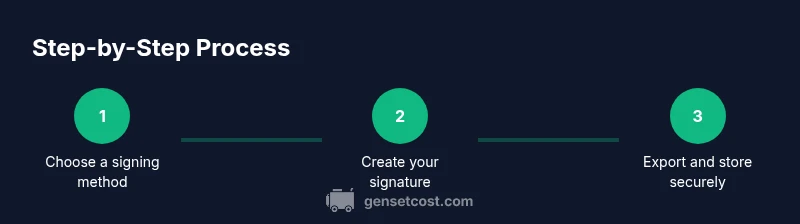
- 1
Choose your signing method
Select whether you will draw, type, or upload a signature image. The method sets how your signature appears in documents and affects compatibility.
Tip: Test each method on a sample document to verify appearance and legibility. - 2
Create the signature
Using the tool, draw your signature with a mouse or finger, or type your name and apply a stylized font. Some tools support handwriting, others allow import.
Tip: Keep the signature legible and remember to avoid overly complex strokes. - 3
Export the signature
Export as a commonly used format (PNG, SVG, or PDF) and save to a secure location. Maintain transparency if you need overlay use.
Tip: Export in multiple sizes for flexible document embedding. - 4
Test on sample documents
Apply the signed signature to a sample contract and a form to ensure alignment, scale, and readability.
Tip: Check that the signature is tamper-evident and cannot be easily edited. - 5
Secure the signature
Enable two-factor authentication for the signing tool and store the signature file in a trusted password manager or encrypted drive.
Tip: Never share the signature file via unsecured channels. - 6
Integrate into workflows
Add the signature asset to commonly used templates and ensure your team knows how to apply it correctly.
Tip: Document the approved use cases and retention policy.
People Also Ask
Are online signatures legally binding?
Yes, electronic signatures are generally legally binding when created with compliant tools and proper authentication in many jurisdictions.
Yes, electronic signatures are generally legally binding when created with compliant tools.
Can I reuse a signature across multiple documents?
Yes, you can reuse a signature across documents as long as each recipient can verify its authenticity and the workflow supports it.
Yes, you can reuse signatures where appropriate and verifiable.
What file formats should I export?
Common formats are PNG and SVG for flexibility, with PDF as an option for embedded signatures in documents.
Export in PNG, SVG, or PDF depending on document needs.
What should I do if I suspect the signature is compromised?
If you suspect compromise, revoke access, rotate the signature asset, and re-issue signed documents.
If compromised, revoke access and reissue signatures.
Do e-signature tools cost money?
Many tools offer free tiers; paid plans typically range modestly based on features and usage.
Prices vary; many tools have free tiers and paid plans.
Watch Video
Key Takeaways
- Define a clear signing method and stick to it.
- Export in multiple formats for flexible use.
- Safeguard your signature with strong authentication.
- Document retention and reuse best practices.