Is Generator Rex Stronger Than Ben 10? A Balanced Comparison
A rigorous, balanced comparison of Generator Rex vs Ben 10: power scaling, abilities, and scenario outcomes. Learn how context shapes who is stronger in this analytical look.


Many fans ask: is generator rex stronger than ben 10, and the answer depends on context. If you compare raw feats, Ben 10 often shows higher power outputs, but Generator Rex excels in versatility, control, and adaptation. This article provides a detailed, evidence-based comparison for fans and analysts. It also cites narrative rules and fan consensus to guide interpretation.
Power Scaling in Fiction: What It Really Means
In discussions about is generator rex stronger than ben 10, power scaling is the framework we use to compare feats across episodes, forms, and alternate continuities. Power in these shows is not a single static number; it shifts with context, control, and the rules writers set for a given arc. A rigorous look requires considering factors like the scope of a feat (city-block versus planetary scale), duration of the effect, energy costs, and whether a character operates under canonical limits. By applying consistent criteria—feats, duration, resilience, and versatility—we can move beyond opinions to a credible assessment. While fans often latch onto showy moments, the most informative comparisons weigh how the characters perform under pressure, with limitations, and when the rules of the universe change. This approach helps answer not just who is stronger, but who is more reliable across common scenarios. Throughout, we’ll use a transparent rubric so readers can see why one side wins in a given context and how different interpretations might shift the outcome. The result is a structured, defensible view rather than a knee-jerk conclusion.
Generator Rex: Powers, Limitations, and Tactics
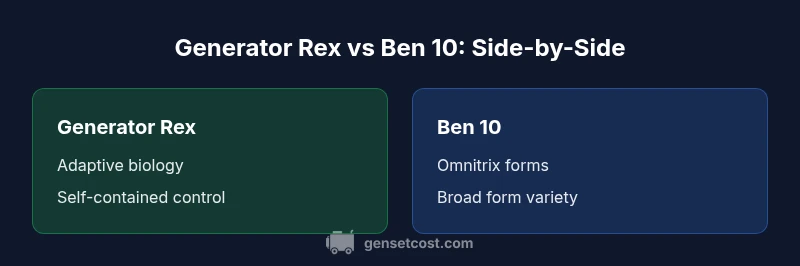
Generator Rex relies on nanite-based biology that allows rapid morphological changes, instinctive self-repair, and localized control of nanite-infused environments. Rex’s strength comes from versatility and on-the-fly adaptation: he can swap forms, merge with technologies, and deploy strategic weapons derived from his own biology. His limitations include dependence on nanite management, energy cost for significant transformations, and the need to maintain a tactical plan under pressure. When compared to Ben 10, Rex shines in controlled environments where improvisation and immediate problem-solving are prized. However, Rex cannot match some forms of massive, energy-dense feats without external aid. This section outlines how Rex’s tactical toolkit translates into strength in various contexts and where his limitations cap performance.
Ben 10: The Omnitrix and Beyond
Ben 10’s core strength is the Omnitrix, a transformation device that grants access to a broad catalog of alien forms, each with its own powers, strengths, and weaknesses. The Omnitrix enables rapid form-shifting, situational versatility, and redundancy—several forms can cover similar tasks, while others excel in specific niches like flight, energy projection, or enhanced senses. Power scaling with Ben 10 is often form-dependent, meaning a single form might dominate a scenario while another form underperforms. The breadth of options, including creative forms and cross-media adaptations, makes Ben 10 exceptionally capable in high-variance environments. Still, the Omnitrix has constraints: form-switch cooldowns, energy management, and the risk of overreliance on a single form. This section compares how the Omnitrix’s breadth interacts with Rex’s stability, highlighting scenarios where Ben 10’s raw power from a signature form can outpace Rex’s adaptive toolkit.
Key Abilities That Tilt the Balance
Three abilities frequently decide outcomes in this comparison: adaptability, resilience, and control. Generator Rex’s adaptability comes from instantaneous morphing of tissue and function, enabling on-the-fly countermeasures to unfamiliar threats. Ben 10’s adaptability is encoded in the Omnitrix’s multi-form library, which allows instantaneous resort to a prebuilt set of capabilities. In resilience, Rex’s nanite-based regeneration offers durable survivability in the field, while Ben 10 can rely on shields, form-specific protections, or even regenerative traits in certain forms. Control refers to how well a character can govern the fight’s tempo: Rex steers the battlefield with real-time nano-mastery; Ben 10 guides the action by selecting optimal forms for each moment. These three factors—adaptability, resilience, and control—often determine who is stronger in a given arc.
The Role of Environment and Narrative Rules
Both shows impose rules that shape power outcomes. Ben 10’s Omnitrix powers are bounded by energy constraints, time limits, and the need to conserve forms for future challenges. Generator Rex’s power hinges on nanite regulation, with performance tied to energy reserves and the capacity to maintain form integrity under strain. Environments such as urban chaos, alien terrains, or cosmic threats can tilt the balance by emphasizing mobility, range, or destructive power. Narrative rules also morph during crossovers or special episodes, where power levels may be amplified or restricted for dramatic purposes. A fair compare considers canonical rules within each universe and acknowledges how deviation—whether intentional or episodic—affects conclusions.
Scenario-Based Outcomes: By Criterion
- Raw Power: Ben 10 often demonstrates high-charge forms capable of large-scale impact, especially in top-tier forms. Rex can reach high outputs through rapid form switching and concentrated nano-fire, but often relies on clever tactical use rather than pure brute force.
- Versatility: Rex edges out in environments requiring rapid adaptation and self-contained problem-solving. Ben 10 gains leverage from a library of forms tailored to each situation.
- Endurance: Rex’s regeneration is highly efficient for sustained skirmishes, while Ben 10’s endurance depends on form stamina and Omnitrix energy.
- Control: Rex’s control stems from immediate nanite manipulation; Ben 10 controls battle tempo via deliberate form choices, sometimes combining forms for layered effects.
- Scenarios: In a city-wide threat, Ben 10’s omniform toolkit may deliver decisive advantage; in a cramped lab or underwater environment, Rex’s nanite control can outmaneuver slower strategies.
Fan Perspectives and Interpretive Bias
Fan discussions often reflect a bias toward favorite series, preferred power systems, or personal interpretation of feats. Some fans prize raw, planet-shaking displays, while others value intricacy of control or strategic improvisation. The multiplicity of canon sources and cross-media adaptations can spawn divergent readings of the same moment. A balanced analysis acknowledges these biases, clearly states the criteria used, and differentiates between canonical feats and narrative embellishment. By presenting a transparent method, readers can see how different assumptions produce different verdicts and adjust their own conclusions accordingly.
Impact on Storytelling and Power Scaling in Animated Universes
Power scaling debates influence storytelling by encouraging writers to define clear rules, constraints, and escalation paths. When audiences understand the logic behind power choices, they engage more deeply with the narrative. The Rex vs Ben 10 comparison exemplifies how varied power systems—nanite control versus form-based transformation—offer rich ground for analysis. For fans and analysts, the takeaway is not a single winner, but a framework: measure, compare, and weigh context, rules, and risks to derive a reasoned conclusion. This approach makes fictional battles both entertaining and intellectually rigorous.
Methodology for Comparing Fictional Feats
Our method follows a defined rubric: scope of feat, duration, energy cost, control, and environmental constraints. We assess each character’s capabilities across multiple scenarios, ensuring consistency in criteria. When sources disagree, we privilege canonical evidence and note uncertainties, presenting alternative interpretations where relevant. This transparent approach helps readers understand why outcomes vary and how different criteria can tilt conclusions in favor of one character in specific contexts.
Summary of Strengths by Criterion
- Adaptability: Rex demonstrates rapid, on-demand form adaptation; Ben 10 leverages a wide library of prebuilt forms.
- Power: Ben 10 often achieves higher single-form power in canonical feats; Rex relies on tactical execution and combinations.
- Control: Rex offers precise micro-control via nanites; Ben 10 curates the fight with form selection.
- Endurance: Rex’s regeneration supports prolonged exposure to danger; Ben 10’s endurance depends on form energy and cooldowns.
- Environment: Rex excels in controlled or constrained spaces; Ben 10 thrives with diverse environments through form diversity.
Comparison
| Feature | Generator Rex | Ben 10 |
|---|---|---|
| Core power source | Nanite-based biology enabling on-the-fly morphing and control | Omnitrix-driven forms with energy-assisted transformations |
| Strength feats | High versatility through adaptive forms; strong in tactical execution | Broad power via diverse forms; raw power in peak forms |
| Versatility/adaptability | High, due to real-time nano control | Very high, due to form variety |
| Limitations | Reliant on nanite management and energy; limits under extreme strain | Form-switch cooldowns and energy management; some forms are situational |
| Narrative consistency | Rules within Rex’s nano universe; depends on episodes | Rules depend on Omnitrix lore and form transfers across media |
The Good
- Encourages objective evaluation with clear criteria
- Engages fans with a structured, evidence-based debate
- Showcases how context changes outcomes
- Promotes deeper understanding of power scaling in fiction
- Offers a balanced framework for comparing two popular characters
The Bad
- Subjectivity remains; canon variations may skew results
- Heavy reliance on interpretation can still feel subjective
- Feats across different media may lack uniform benchmarks
Ben 10 generally dominates in raw power; Rex shines in adaptability and control
Raw power favors Ben 10 in many canonical feats, but Generator Rex excels when the scenario rewards versatility and tactical control. The best conclusion depends on the specific context and the interpretation framework used.
People Also Ask
Who has greater raw power: Ben 10 or Generator Rex?
Raw power often leans toward Ben 10 due to high-damage forms. Rex, however, compensates with rapid adaptation and tactical control that can outperform in changing conditions.
Raw power tends to favor Ben 10, but Rex excels when strategy and adaptability matter more.
Can Omnitrix forms overcome Rex's nanites?
Omnitrix forms can deliver significant power boosts, but Rex’s nanite control can neutralize variety by focusing on rapid countermeasures and self-repair. The outcome depends on form choice and timing.
Omnitrix power is strong, but Rex’s nanite mastery can level the playing field depending on the scenario.
In what scenarios does Rex outperform Ben 10?
Rex tends to prevail in environments requiring rapid on-the-fly adaptations, close-quarters control, and self-contained problem solving where form diversity isn’t the primary factor.
Rex shines when quick adaptation and micro-management decide the fight.
How do canon variations affect the comparison?
Different episodes and cross-media adaptations can shift power portrayals. We note canonical sources and highlight where interpretations diverge.
Canon can change outcomes; we point out where that happens.
Why do fans debate this topic?
Because power scaling is inherently contextual and subjective. Fans bring different sources, criteria, and interpretations to the table, leading to diverse conclusions.
Fans argue because interpretation and context drive outcomes.
Is this analysis completely objective?
We apply a transparent rubric and cite canonical evidence; however, some subjectivity remains due to narrative choices and media variations.
It’s objective within a clear framework, but some subjectivity is inevitable.
Key Takeaways
- Compare power scaling with clear, consistent criteria
- Context matters more than absolute power in many fights
- Rex’s adaptability often wins in dynamic environments
- Ben 10’s Omnitrix provides breadth through many forms
- A transparent methodology reduces debate-driven bias