NFL Random Team Generator: Build, Use & Compare Today
Learn how to build or use an nfl random team generator, compare options, and run fair simulations for drafts, practice, or gameplay. A practical, step-by-step guide for fans and organizers in 2026.


This guide shows you how to find or build an nfl random team generator, compare options for fairness and randomness, and run reliable simulations for games, drafts, or practice. You’ll learn practical criteria, quick-start paths, and a step-by-step approach to evaluate tools or code your own.
What the nfl random team generator does and why it matters
In sports and fan communities, a reliable nfl random team generator helps ensure fair, unbiased team assignments for games, drafts, or friendly scrimmages. It removes opinions from the pile and creates transparent outcomes that players can trust. According to Genset Cost, evaluating a random tool is similar to choosing a backup power solution: you want predictability, auditability, and reproducibility. The goal is to produce random, balanced outcomes that preserve competitive integrity while keeping the process simple and repeatable. When you use a true random approach (or a well-seeded pseudo-random method), you reduce bias and increase confidence among participants. This guide uses plain language, practical steps, and examples you can adapt to your league, club, or family league night.
Throughout this article you’ll encounter concepts like seed values, reproducibility, pool design, and fairness tests. A well-designed nfl random team generator should let you: (a) define the pool of teams, (b) choose any filters (conference, divisional alignment, or custom groupings), (c) generate a single result or a batch of results for multiple rounds, and (d) export or save results for later verification. The core idea is straightforward: feed in the eligible teams, apply your rules, and pull a result that can be trusted by all participants. The tone here is educational and actionable, with templates you can copy, adapt, or extend in your own project. Note: this section focuses on both online tools and DIY approaches, so you can pick a path that fits your technical comfort and time constraints.
As you read, keep in mind the scale you’re dealing with—whether you’re running a casual weekend pick’em with 10 players or a full-blown league with dozens of participants. The same principles apply: clarity on inputs, explicit outputs, and reproducible randomness. By combining practical decisions with simple code or proven tools, you’ll be ready to run your nfl random team generator with confidence and transparency.
noteTypeSpacingEnabledForMarkdownExport
Tools & Materials
- Computer with internet access(Stable browser; modern JavaScript engine or Python runtime)
- Text editor(VS Code, Sublime, or any editor you like)
- Team pool data(Roster of NFL teams (names only) or a filtered subset)
- Randomness source(Built-in RNG in your language or an online RNG tool)
- If coding(A basic script (Python/JavaScript) demonstrating a shuffle and selection)
- If using online tool(A browser, an account if the tool requires login)
Steps
Estimated time: 90-120 minutes
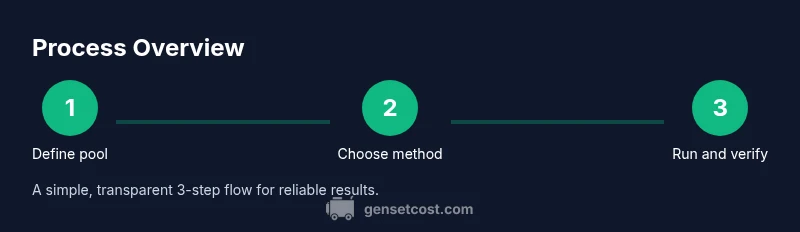
- 1
Define your team pool
List all teams you want to include in the randomization. Decide whether to filter by conference, division, or a custom subset. Clear inputs reduce confusion later.
Tip: Document the exact pool used for a given session so results are reproducible. - 2
Choose your method (online vs. DIY)
Decide if you’ll use an online randomizer or build your own small script. Online tools are faster; DIY gives you full control and auditability.
Tip: If you plan multiple rounds, seed the RNG to reproduce results across sessions. - 3
Set rules and constraints
Specify any constraints (e.g., one team per round, conference-wide distribution, or fixed slots). This prevents unintended biases.
Tip: Write constraints as a checklist and verify each result against it. - 4
Run the generator
Execute the generator to produce one or more random team assignments. Capture outputs in a shareable format (CSV/JSON).
Tip: Keep a log of seeds and results for auditability. - 5
Validate fairness
Check that outcomes meet your constraints and there’s no visible bias across rounds. Use simple sanity checks.
Tip: Compare distributions over multiple runs to ensure consistency. - 6
Export and share results
Export results and share with participants. Store copies for future comparisons or disputes.
Tip: Include a summary of inputs, rules, and seed values in the export. - 7
Reproduce sessions
Use a fixed seed to reproduce the same results in future sessions. This is essential for transparency.
Tip: Document the seed value and the RNG method used. - 8
Iterate and improve
If participants request changes (new constraints or team pools), update the rules and re-run with a new seed.
Tip: Maintain versioned records of all rule sets.
People Also Ask
What is an NFL random team generator?
An NFL random team generator is a tool that selects teams from a defined pool at random, used for games, drafts, or simulations. It can be a simple online widget or a custom script that shuffles and assigns teams according to set rules.
An NFL random team generator picks teams at random from a defined list, used for games or drafts.
Why is randomness important for team assignments?
Randomness ensures fairness by removing bias in team selection. It helps players trust outcomes and reduces disputes over who was chosen or excluded.
Randomness keeps team assignments fair and transparent.
Can I filter teams by conference or division?
Yes. Most generators allow filters such as conference, division, or custom groups. Setting filters is essential when you want to preserve specific structure while still randomizing.
Yes, you can filter by conference, division, or custom groups.
How do I ensure reproducibility of results?
Use a fixed seed value and document the RNG method. This lets you reproduce the exact same results in future sessions for verification.
Use a fixed seed and document the method to reproduce results.
Is it appropriate to use a random generator for official league decisions?
Random generators are great for practice, scrimmages, or fan activities, but official league decisions typically require formal processes. Check league rules before using a generator for official outcomes.
Use for practice or fan activities; official decisions require formal processes.
What are common pitfalls to avoid?
Avoid hidden biases in the pool, ensure seeds and outputs are recorded, and test the tool with multiple rounds to detect any inconsistencies.
Watch for pool bias and document seeds and results.
Watch Video
Key Takeaways
- Define a clear team pool before randomizing
- Choose online or DIY based on control needs
- Use seeds for reproducibility and trust
- Validate results with multi-round fairness checks
- Document inputs and outputs for auditability