Which Code Generator for Twitter: A Practical Comparison
An analytical comparison of AI-assisted vs template-driven code generators for Twitter automation, outlining use cases, risks, and best practices for homeowners, developers, and small teams evaluating automation options.


When deciding which code generator for Twitter to use, start by defining your automation goals, risk tolerance, and team capability. AI-assisted generators offer deep customization and adaptive workflows for complex Twitter automation, while template-driven tools deliver rapid deployment with predictable behavior. This comparison helps you choose based on code quality, control, and long-term maintenance.
Definition and scope: what a code generator for Twitter actually does
A code generator for Twitter is a tool that outputs executable scripts or snippets designed to interact with Twitter's APIs or automation surfaces. For homeowners and property managers, the goal is often to automate safe, compliant posting, engagement, monitoring, or data collection without manual coding from scratch. The phrase which code generator for twitter captures a spectrum of options—from AI-powered assistants that craft code based on user prompts to template-based scaffolds that produce pre-wired modules. The core value proposition is reducing manual coding time while preserving correctness, security, and compliance with platform policies. When evaluating options, you should consider the scope of tasks (posting, polling, analytics), the required integration points (OAuth flows, rate limits, webhooks), and the team’s comfort with code review. Remember that the best answer aligns with your goals and risk profile, not with hype. In practice, you’ll want to map your Twitter automation objectives to a generator’s capabilities and limits.
Why this topic matters for Twitter automation
Twitter automation can unlock efficiency for content calendars, cross-posting, and monitoring trends, but it also carries risk: policy violations, account suspension, and data privacy concerns. A thoughtful approach to selecting a generator helps prevent outages and backlogs. This analysis leans on the practical experience of the Genset Cost team in risk-aware decision-making, applying a framework that centers on maintainability, observability, and governance—not just raw speed. By understanding the trade-offs, property managers and homeowners can implement automation that scales with their outreach while staying within acceptable risk boundaries. The goal is to achieve reliable automation that saves time without compromising compliance or user trust.
Key decision criteria: what matters most
The most important factors include: (1) scope of automation (posting cadence, engagement, analytics), (2) code quality and maintainability, (3) security and credential handling, (4) adaptability to platform policy updates, and (5) total cost of ownership. For homeowners and property managers, the ability to test and revert changes quickly is essential. You should also consider the learning curve for your team and whether you need built-in tests or simulators. In short, pick a generator that matches your risk appetite and your operational tempo.
How AI-assisted code generators differ from template-driven ones
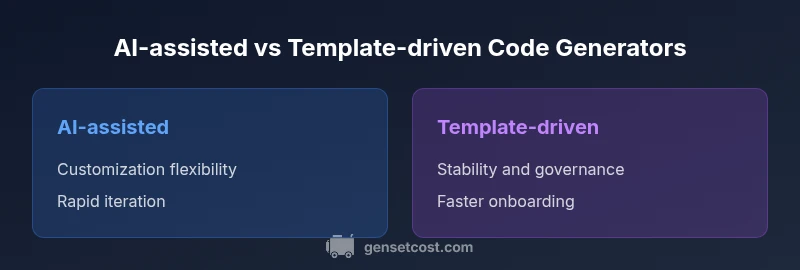
AI-assisted code generators reply to natural language prompts, infer intent, and produce customized code with minimal boilerplate. They excel when you need nuanced logic, conditional flows, or dynamic tweet content. Template-driven generators, by contrast, offer stable, auditable patterns and repeatable outputs with less variability. They’re ideal when your requirements are well-defined and you want predictable, review-friendly code. The choice hinges on whether you prioritize customization speed (AI-assisted) or reliability and governance (templates).
When to favor AI-assisted tools for Twitter
If your automation involves personalized content, dynamic decision-making, or evolving engagement strategies, AI-assisted generators can reduce development time and adapt to new scenarios. They shine when your team has experience with code review and you can implement guardrails to prevent policy breaches. Remember to integrate automated tests, logging, and alerting to detect unexpected behaviors early. In environments where content quality must adapt to audience feedback, AI-assisted approaches often offer the most value.
When to favor template-driven generators for Twitter
Template-driven approaches excel when your requirements are stable and well-understood, such as a fixed posting cadence, standard replies, or consistent monitoring scripts. They provide stronger audit trails and easier compliance checks, which is critical in regulated environments or when multiple stakeholders must review outputs. You’ll benefit from faster onboarding, fewer surprises, and straightforward maintenance—provided you limit scope creep and keep templates up to date with platform policy changes.
Practical evaluation steps you can take today
Begin with a small, representative use case (for example, posting a weekly update and tracking basic engagement). Compare two options using: (a) code quality and readability, (b) ease of updating when Twitter’s API changes, (c) the effort needed to implement tests and rollback plans, (d) security controls over credentials, and (e) the total cost of ownership over a defined period. Document results in a simple rubric so stakeholders can review objectively. This approach aligns with the Genset Cost guidance on rigorous evaluation before large-scale investment.
Security, compliance, and best practices
Regardless of the generator type, secure handling of API keys, tokens, and secrets is non-negotiable. Use environment-based credentials, rotate keys, and implement least-privilege access. Audit trails, alerting for anomalous activity, and rate-limit awareness should be built into your code generator outputs. Regular policy reviews are essential to prevent violations that could lead to account restrictions. The combination of secure patterns and disciplined governance helps prevent expensive surprises down the line.
Real-world workflow examples: from idea to implementation
Example 1: You want to auto-post a weekly update and respond to common questions with templated replies. A template-driven generator could scaffold the code, while AI-assisted prompts fine-tune content. Example 2: A monitoring script detects sentiment around a topic and triggers a follow-up thread. An AI-assisted approach can craft conditional logic, but you’ll want rigorous testing to avoid misinterpretation. In both cases, you’ll benefit from modular design, clear interfaces, and versioned templates or prompts.
Measuring success and impact
Success metrics vary by goal but typically include reliability (uptime of posting), consistency (timely postings), engagement quality (reply relevance), and cost efficiency (man-hours saved). Establish baseline metrics before deployment and track improvements over time. If you’re evaluating two options, set a shared rubric and measure against it for the defined evaluation window. The outcome informs next steps and helps justify ongoing investments in automation.
Getting started: a practical plan
Start with a one-page requirements brief: what to automate, expected frequency, and risk tolerance. Select two candidate approaches (AI-assisted and template-driven) and build a small proof of concept for each. Use a shared rubric to compare outcomes, update the plan based on findings, and scale gradually. Ensure you have governance, testing, and rollback mechanisms before moving beyond the pilot. The result is a disciplined path to automation rather than a rushed implementation.
Comparison
| Feature | AI-assisted code generator | Template-driven code generator |
|---|---|---|
| Setup time to first working script | Shorter with natural-language prompts in initial phase | Longer upfront due to scaffolding but quicker to stabilize later |
| Customization and adaptability | High customization using prompts and iterative refinement | Limited customization constrained by templates |
| Learning curve | Moderate to high depending on prompts experience | Low to moderate if templates are well-documented |
| Maintenance and governance | Requires strong governance; prompts and outputs should be reviewed | Easier audit with templated outputs and clear patterns |
| Security and credentials handling | Can implement robust patterns but requires careful prompt design | Templates often include standard security scaffolds |
| Best for | Teams needing flexible, evolving logic and content | Projects with stable workflows and strict compliance needs |
The Good
- Faster time-to-value when starting custom Twitter automation
- Better ability to tailor behaviors to audience and scenarios
- Scales with team expertise and evolving requirements
- Prompts and templates can be versioned for traceability
The Bad
- AI-generated code may require more review and guardrails
- Templates can be inflexible if requirements shift
- Complex setups demand disciplined testing and governance
AI-assisted generators win on customization; templates win on stability
Choose AI-assisted for evolving, personalized Twitter automation; choose templates for stable, auditable workflows with easier compliance.
People Also Ask
What is a code generator for Twitter?
A code generator for Twitter outputs scripts or modules that automate posting, engagement, or analytics against Twitter’s API. It can be AI-driven or template-based, aiming to reduce manual coding while maintaining safety and compliance.
A Twitter code generator outputs ready-to-run scripts to automate posting and analytics while following platform rules. You can choose AI-driven or template-based approaches depending on your needs.
What distinguishes AI-assisted generators from templates?
AI-assisted generators produce code from prompts and can adapt to new scenarios, offering high customization. Template-driven generators rely on predefined patterns, signaling stronger consistency, easier auditing, and quicker maintenance for stable workflows.
AI generators customize on the fly, while templates provide stable, auditable patterns.
Is one option better for beginners?
Templates are generally easier for beginners due to structured outputs and predictable behavior. AI-assisted tools require some familiarity with prompts, outputs, and guardrails to avoid unsafe results.
Templates are usually easier for beginners; AI tools need careful prompts and checks.
What security concerns should I consider?
Credential handling, secret rotation, and access controls are critical regardless of the generator type. Implement environment-based keys, least privilege, and robust logging to detect anomalies early.
Secure credentials, rotate keys, and monitor activity to prevent misuse.
Can I mix AI and templates in one workflow?
Yes. A hybrid approach can combine AI for flexible parts of the workflow with templates for stable, auditable components, enabling both adaptability and governance.
You can mix AI and templates to get flexibility plus governance.
How should I evaluate cost and ROI?
Define clear success metrics, run a pilot, compare time-to-value and maintenance effort, and estimate ongoing costs. ROI improves when automation is aligned with business goals and governance is in place.
Set clear metrics, run pilots, and compare ongoing costs to measure ROI.
Key Takeaways
- Define your Twitter automation goals before selecting a tool
- Balance customization needs with governance and testing
- Prioritize secure handling of credentials and observability
- Pilot both approaches to gather objective data
- Plan for ongoing maintenance and policy updates