How to Use a YouTube Transcript Generator: A Complete How-To Guide
A comprehensive, step-by-step guide to using a YouTube transcript generator for transcripts, captions, and SEO benefits. Learn features, preparation, editing workflows, and best practices for accessibility and efficiency.


A YouTube transcript generator converts spoken content in videos into text, producing transcripts, captions, and searchable text. It speeds up content repurposing for tutorials, captions for accessibility, and SEO optimization by making transcripts indexable. This guide walks you through choosing a generator, comparing features, and using it effectively across different video lengths and languages.
What a YouTube transcript generator is and why it matters
A YouTube transcript generator is a tool that converts spoken content from videos into written text. It creates transcripts and may produce time-stamped captions in formats such as SRT or VTT. For homeowners and property managers, transcripts can simplify the creation of how-to guides, safety checklists, and maintenance tutorials that accompany video content. When accessibility and searchability matter—whether you’re hosting a repair demo or an insulation upgrade video—a transcript helps reach more people and preserves information even if a viewer can’t play audio. According to Genset Cost, as video content grows, accessible transcripts become essential for sharing maintenance guidance and other important information across platforms. The transcript generator can handle languages with auto-detection in some tools, tighten punctuation, and align words to video timelines, making it easier to skim sections and locate key moments. Using a generator also reduces manual typing time, letting you focus on accuracy and readability.
Core features to prioritize in a YouTube transcript generator
When evaluating tools, look for accuracy, speed, and export flexibility. Core features include automatic speech recognition with low word error rate, robust speaker labeling, and precise timestamping that makes it easy to jump to a scene. Export formats matter: SRT, VTT, and plain TXT are common, and some tools export to JSON or CSV for programmatic use. Language support is critical if you publish multilingual content or need to analyze transcripts in different markets. Punctuation handling, capitalization, and paragraph breaks affect readability, so choose tools that preserve natural phrasing. Accessibility-friendly options, such as closed captions and high-contrast subtitle styling, add value for viewers with hearing loss. Finally, consider workflow integrations—API access or browser extensions can make the generator fit into your existing content pipeline and save time for homeowners who produce regular maintenance videos.
How accuracy and timing affect transcripts
Accuracy matters more than you might think. A high word error rate can misinterpret safety instructions or product names, leading to confusion or even damage. Timely timestamps help viewers locate sections like shut-off valve or controller wiring quickly. Some tools offer speaker diarization to separate voices, which is essential for tutorials with multiple people. If a video includes background noise, choose a tool with noise suppression or the ability to customize the acoustic model. For best results, upload the highest quality audio available and verify the transcript against the video to catch misheard terms. Remember that automatic transcripts are a starting point—human review remains the gold standard for critical content.
Privacy, licensing, and compliance to consider
Before transcription, review the platform’s privacy policy and data handling practices. Some services store and reuse audio to improve models; others delete uploads after processing. If you plan to publish transcripts publicly, check licensing terms—some providers allow free personal use but require attribution or licensing for commercial use. For homeowners sharing maintenance procedures, ensure your use complies with your organization’s guidelines and any applicable privacy rules. If your video contains sensitive information or proprietary details, consider using local software that runs offline to minimize data exposure. Finally, always respect copyright and data rights when transcribing third-party content.
Preparing your video for transcription
Clear audio is the foundation of a good transcript. Start with a high-quality recording: minimize background noise, reduce echo, and use a decent microphone if you’re recording new footage. When possible, supply a clean audio track or isolated dialogue clips. If your video contains music or non-speech sounds, some tools can ignore or label them separately, but turning off ambient noise helps recognition. Ensure the spoken language is set correctly in the tool, and provide context when names or technical terms might be misheard. After uploading, review the auto-generated draft to catch mispronunciations and misheard product names, then adjust timestamps to align with your video’s pacing.
Step-by-step: generate transcripts, review, and export (overview)
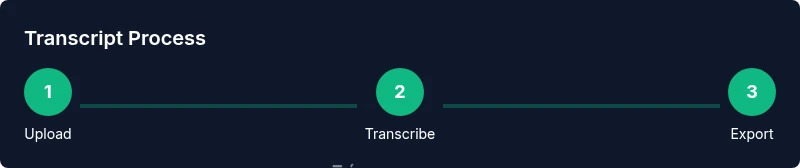
Creating transcripts is a multi-stage process. First, choose your video and target language. Second, run the transcription to generate an initial draft. Third, skim for obvious errors and adjust punctuation and capitalization. Fourth, verify timecodes and speaker labels, if available. Fifth, export in your preferred format (SRT, VTT, or TXT) and test by playing the video with the transcript. Finally, store a master copy in your project library. This overview aligns with the broader step-by-step guide in the dedicated section and helps you grasp the workflow quickly.
Editing workflows: cleaning up drafts for readability
Auto transcripts are rarely perfect, so plan a concise editing pass. Correct misspellings, fix homophones, and standardize terminology (like product names and model numbers). Break long paragraphs into readable chunks and insert punctuation that reflects natural speech while remaining faithful to the original meaning. If your video features multiple speakers, ensure consistent labeling (Speaker A, Speaker B) and insert timestamps at logical breaks. Tools with built-in editor features enable you to jump between segments and test alignment. After edits, recheck the flow by watching the video alongside the transcript.
Export formats and practical usage
Most creators export SRT for captions, VTT for web video players, and TXT for quick references. You can also export JSON for data analysis or indexing in a content management system. For homeowners, transcripts support accessibility compliance and help you create searchable documentation for quick repairs. If you publish on a website, embed the transcript as well as captions to improve SEO and user experience. When combining transcripts with show notes or maintenance schedules, ensure sections are clearly labeled and hyperlinks are included where applicable.
Use transcripts for accessibility and SEO: practical tips
Transcripts improve accessibility and can boost search presence by providing keyword-rich, indexable text. Add time-based headings to help search engines identify content sections. Use the transcript to create show notes, checklists, and FAQ pages that link back to the video. For property managers, transcripts simplify training materials and onboarding for maintenance teams. Reuse content by turning transcripts into blog posts, PDFs, or slides for training sessions. Keep your transcripts updated when videos are revised to reflect new procedures or safety guidelines.
Common pitfalls and how to avoid them
- Inaccurate names or numbers: verify technical terms against official manuals. - Missing timecodes: ensure important moments are annotated for quick navigation. - Over-automation: human review is essential for safety-critical content. - Inconsistent speaker labels: maintain clear attribution throughout. - Ignore updates: re-transcribe when you update the video or guidelines. Pro-tip: keep a simple review checklist to catch common errors during the proofreading pass.
AUTHORITY SOURCES
- https://www.loc.gov
- https://www.nih.gov
- https://www.copyright.gov
Note: For best practices in transcription and accessibility, refer to established guidelines from these sources. This section consolidates credible references to support the content.
Tools & Materials
- Stable internet-connected device (computer or mobile)(Reliable connection helps upload/download large transcripts)
- Video URL or local video file(Source material to transcribe)
- Transcript generator tool (web-based or desktop)(Choose tool with support for SRT/VTT)
- Text editor or caption editor(For post-processing and timing adjustments)
- Optional: offline transcription software(Useful for privacy or large files)
Steps
Estimated time: 60-120 minutes
- 1
Copy video URL and open tool
Copy the exact YouTube video URL and open your chosen transcript generator. This ensures the correct video is transcribed and reduces errors from incorrect links.
Tip: Double-check the video URL and ensure the video is accessible without geo restrictions. - 2
Choose language and output format
Select the video language and the desired export formats (SRT, VTT, TXT). Correct language improves transcription accuracy and downstream usability.
Tip: If the video has multiple speakers, enable speaker labeling if available. - 3
Run transcription to draft
Run the transcription to generate an initial draft. This may take a few minutes depending on video length and tool efficiency.
Tip: Start with shorter clips first to validate settings before processing long videos. - 4
Review for obvious errors
Skim the transcript to catch obvious mistakes in names, numbers, or technical terms and adjust as needed.
Tip: Turn on time stamps while reviewing to keep alignment consistent. - 5
Edit timing and punctuation
Correct punctuation and adjust timecodes so that captions align with spoken words and natural pauses.
Tip: Break long sentences into readable caption lengths to improve viewer experience. - 6
Export to preferred formats
Export the final transcript in SRT, VTT, or TXT. If needed, generate a backup in JSON for indexing or CMS import.
Tip: Keep the master draft stored in your project library for future updates. - 7
Publish or attach to video
Attach captions to the video or upload to your CMS and reference materials. Verify that captions display correctly on multiple devices.
Tip: Test the video with captions on desktop and mobile to ensure compatibility.
People Also Ask
What is a YouTube transcript generator?
A YouTube transcript generator converts spoken content from a video into text, producing transcripts and captions for editing, accessibility, and search optimization.
A tool that turns video speech into text for transcripts and captions.
Are transcripts always accurate?
Automatic transcripts are a starting point. Accuracy depends on audio quality, language, and the tool's algorithms; always review for critical content.
They're a helpful draft, but review for important details.
Which formats should I export to?
Common exports include SRT for captions, VTT for web players, and TXT for quick references. Some workflows also use JSON for indexing.
SRT, VTT, or TXT are the usual choices.
Do transcript generators respect privacy?
Privacy depends on the service. Review the provider’s policy and whether uploads are stored or deleted after processing.
Check the policy; privacy varies by tool.
Can I label multiple speakers?
Some tools offer speaker labeling or diarization to distinguish voices; this improves readability in tutorials with more than one person.
Yes, many tools can label speakers.
Is there a cost to use transcript generators?
There are free and paid options. Free plans often have limits on length or features, while paid plans unlock higher limits and advanced tools.
There are both free and paid options with varying limits.
How long does transcription take?
Turnaround depends on video length and tool speed; drafts may take a few minutes to install and run, with longer videos taking longer.
It varies, but longer videos take more time.
Watch Video
Key Takeaways
- Understand the core function of a transcript generator
- Prioritize accuracy, timestamps, and export formats
- Prepare audio quality and language settings before transcription
- Edit and verify transcripts for safety-critical content
- Use transcripts to boost accessibility and SEO