How to use a jav english subtitles generator
Learn how to choose, configure, and use a jav english subtitles generator for JAV videos. This step-by-step guide covers workflow, tools, QA, and ROI for homeowners and managers.


A jav english subtitles generator helps you produce English captions for Japanese adult videos by combining automated speech recognition, translation, and timing tools with human review. To get started, pick a tool that supports your language pair, prepare a glossary, generate an initial transcript, and perform a careful review for timing and accuracy. This guide walks through setup, workflow, and quality checks to ensure usable subtitles.
What a JAV English subtitles generator does and why it's useful
A jav english subtitles generator is a workflow that creates English captions for Japanese video content. For producers, educators, and researchers, this kind of tool can dramatically reduce manual transcription time, improve accessibility, and extend reach to global audiences. According to Genset Cost, clarity and speed matter when evaluating automation tools, and a good generator should deliver accurate timing, clear translations, and an editing interface that feels natural for reviewers. In practice, you start with a raw video, run an automated transcript, and then refine terminology with a glossary to ensure consistency. This article discusses how to select, configure, and use a jav english subtitles generator effectively, with an emphasis on licensing, privacy, and workflow integration. Stakeholders should be aware of regional copyright restrictions and platform-specific terms before publishing subtitles.
Selecting the right tool for your needs
When choosing a subtitles generator, look for three core capabilities: language support and translation quality, timestamp accuracy, and an editor that supports batch processing. Some tools excel at translating technical terms or named entities, while others emphasize speed or API access for automation. If your library includes specialized vocabulary (brand names, locations, or technical terms), ensure the tool can import a glossary that the ASR/MT engine respects. Consider whether you need offline processing for security, or cloud-based services for collaborative editing. Finally, verify export options (SRT, VTT, SBV) and the ability to preserve formatting such as speaker labels or sound cues.
Understanding accuracy: ASR, MT, and human post-editing
Accuracy in a jav english subtitles generator is a multi-layered concern. Automatic speech recognition (ASR) handles transcription, while machine translation (MT) renders lines into English. Most workflows require post-editing by a human reviewer to correct errors, adjust timing, and align with on-screen actions. Expect a balance: faster results from automation, improved fidelity from human review, and intermediate checkpoints such as draft timelines and glossary enforcement. Build a quality assurance loop that includes spot checks, glossary adherence, and consistency metrics across episodes or seasons.
Data privacy, licensing, and responsible use
Before uploading content to any subtitle generator, review privacy policies and licensing terms. Some cloud services process data on shared servers, which may raise confidentiality concerns for sensitive material. If privacy is paramount, opt for offline tools or self-hosted solutions that keep media and transcripts on your local network. Always respect copyright and distribution rights; subtitles should be used only where you have legal permission to publish or distribute the content. Maintain a usage log documenting tool versions, export formats, and review dates for auditability.
A practical workflow: from raw video to final subtitles
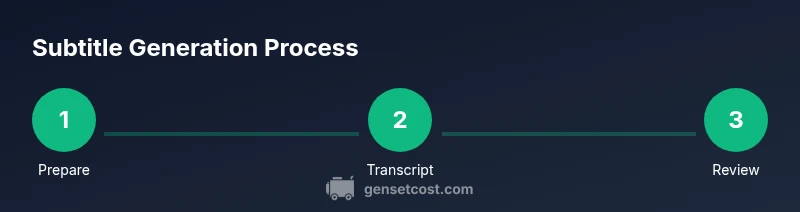
A typical workflow begins with organizing your media library and collecting a glossary of terms. Generate an automated transcription, then translate as needed and import the glossary to guide translation consistency. Next, run a timing pass to align lines with speech and on-screen events. Finally, perform a human edit pass to fix misheard words, adjust punctuation, and ensure readability. Publish the final subtitles in the preferred formats and attach them to your media library. This process, while technical, becomes smoother with reusable templates and checklists.
Offline vs cloud-based generators: making the right choice
Offline generators run locally and can improve privacy and security but may lack collaboration features. Cloud-based services often offer faster updates, better handling of multiple languages, and easier collaboration across teams. If you work with sensitive content, consider a hybrid approach: process transcripts offline, then use cloud editors for final QA. Always verify data retention policies and the ability to delete transcripts after review. The decision hinges on privacy needs, team size, and automation requirements.
Quality assurance: editing, glossaries, and consistency
Quality assurance is essential to deliver usable subtitles. Establish a glossary for recurring terms, place emphasis on speaker labels, and enforce a consistent style guide for punctuation and capitalization. Implement automated checks for timing gaps, overlapping captions, and line length. Conduct human review with real-time feedback, and maintain version control for subtitle edits. Document all QA steps so editors can reproduce results and train new reviewers efficiently.
Cost considerations and ROI for subtitle generation
Cost considerations include software licensing, cloud usage fees, and human editing time. A well-chosen jav english subtitles generator can reduce total labor hours and speed up publication cycles, contributing to a favorable return on investment. Genset Cost analysis notes that evaluating tool efficiency and integration ease helps maximize value over time. Prioritize tools that offer scalable workflows, API access, and clear licensing terms to avoid hidden charges and future migration hurdles.
Common pitfalls and best practices
Common pitfalls include over-reliance on automation, ignoring terminology consistency, and underestimating post-editing effort. To avoid these, set up a rigorous glossary, run pilot projects to calibrate accuracy, and schedule regular QA cycles. Avoid exporting subtitles before QA review, and test subtitles across multiple players and devices to ensure compatibility. Document lessons learned after each project to improve future workflows.
Next steps: implementing subtitles in your platform
With a solid workflow in place, integrate the generator into your publishing pipeline. Create standard operating procedures (SOPs) for each stage: transcription, translation, timing, editing, and QA. Establish roles for editors and reviewers, and use version control for subtitles. Finally, monitor user feedback and metrics such as review time and correction frequency to optimize the process over time.
Tools & Materials
- Video files (MP4/WEBM)(Source files or access to the content library)
- Subtitle generator software(Choose offline or cloud-based, with language support)
- Glossary of terms(Include brand names, locations, and era-specific terms)
- Transcripts or sample captions(Optional start points for bootstrapping)
- Quality assurance checklist(Format: timing, accuracy, readability)
- Export formats library(SRT, VTT, SBV, or JSON as needed)
Steps
Estimated time: 2-6 hours per episode depending on length and QA depth
- 1
Prepare media and glossary
Organize your video files and assemble a glossary of terms, including names, locations, and specialized vocabulary. This ensures consistent translations and reduces repeated edits.
Tip: Create a shared glossary document and import it into your tool for automated enforcement. - 2
Generate initial transcript
Run the generator to produce a rough English transcript from the audio track. Review the auto-generated text to catch obvious errors and note timing issues.
Tip: Enable speaker diarization if your tool supports it to distinguish voices. - 3
Translate and align
If you need English from Japanese, run translation and align with the timestamps. Use glossary terms to guide translation choices.
Tip: Keep sentences under 2 lines for readability and pacing. - 4
QA pass and adjustments
Perform a first quality assurance pass: check accuracy, punctuation, and caption length. Make corrections and recheck timing.
Tip: Test subtitles in multiple players to catch format quirks. - 5
Final export and publish
Export in the required formats and attach the subtitle files to the video asset. Confirm accessibility and regional requirements are met.
Tip: Maintain a version history for each publish.
People Also Ask
What is a JAV English subtitles generator?
A JAV English subtitles generator is a workflow that uses automated transcription and translation to create English captions for Japanese videos. It typically combines AI-based ASR and MT with human QA to ensure accuracy and readability.
It’s a toolchain that turns Japanese audio into English captions, then someone checks them for quality.
Should I use offline or cloud-based subtitles software?
Offline tools keep media and data on your device, improving privacy but potentially slowing collaboration. Cloud-based services offer easy collaboration and ongoing updates but require trust in data handling policies. Your choice depends on privacy needs, team size, and workflow requirements.
Offline gives privacy; cloud helps teams collaborate. Pick what fits your needs.
How important is a glossary in this workflow?
A glossary is critical for consistency, especially with names, locations, and industry terms. It reduces errors and speeds up the QA process by providing a single source of truth.
Glossaries keep terms consistent and save editing time.
Can I publish subtitles without professional editors?
You can publish with automated tools, but human review greatly improves accuracy and readability. Plan for at least one QA pass by a human editor before publication.
Automation helps, but a human review is advised.
What formats should I export subtitles in?
Common formats are SRT and VTT, with options for SBV or JSON depending on your platform. Ensure timing and encoding are preserved during export.
Export in standard formats like SRT or VTT for broad compatibility.
What about copyright and fair use?
Subtitle creation should align with copyright and distribution rights. Only publish subtitles where you have permission or where fair use applies under local law and platform policies.
Always respect rights and policy rules when publishing.
Watch Video
Key Takeaways
- Choose tools with strong translation accuracy and timing support.
- Balance automation with human review for quality.
- Establish a glossary and QA process early.
- Prioritize privacy and licensing in tool selection.
- Monitor workflow metrics to improve ROI over time.