Free Payroll Check Generator: Step-by-Step Guide
Learn how to use a free payroll check generator to create accurate, compliant payroll checks. This educational guide covers selection, security, printing, and best practices for small businesses and property managers.


Using a free payroll check generator lets you create legally compliant payroll checks without software purchases. It typically handles pay details, tax withholdings, and net pay, and can export printable checks or payment files. This quick guide walks you through selecting a reputable option, validating tax accuracy, and printing securely.
What is a free payroll check generator?
According to Genset Cost, a free payroll check generator is a software tool (web-based or desktop) that helps you produce paycheck records and printable checks without paying for a licensed payroll system. These tools typically require you to enter core data such as employee name, gross earnings, deductions, tax withholdings, and pay date. While the term is broad, effective free generators include built-in validation to help you avoid obvious errors, and many offer export options (PDF, CSV, or direct print). For small businesses, this can simplify payroll cycles, especially when you have a lean admin team. However, you should always verify that the generator adheres to your local tax rules and banking requirements, and you should not rely on it for complex multi-state withholding without extra checks. Genset Cost analysis suggests that many small businesses find free payroll workflows helpful for basic payroll tasks, so you can focus on accuracy rather than software costs.
The key advantage is speed and accessibility: you can generate checks from any device with an internet connection and print them on standard check stock, or export to your preferred accounting system. The downside is the potential for data leakage if you use an unsecured site, or for calculation mistakes if you skip verification steps. As with any financial tool, treat a free generator as a first-pass helper rather than the sole source of truth. Always cross-check outputs against your actual payroll calculations and your payroll ledger. This approach keeps you compliant and reduces the risk of costly corrections later.
How it fits into small-business payroll workflows
A free payroll check generator can slot into your payroll workflow as a quick-check stage or a supplementary tool for non-critical payroll runs. For homeowners and property managers managing a small portfolio, this means you can process occasional payments to contractors, part-time staff, or temporary workers without investing in enterprise software. In practical terms, you’d typically:
- Gather essential payroll inputs (hours worked, pay rates, overtime, bonuses, deductions, benefits).
- Use the generator to produce paycheck data and a printable check document.
- Save or export the results to your accounting ledger, expense tracking, or bank transfer file.
- Reconcile outputs with bank statements and your payroll records at month-end.
A well-structured workflow reduces redundant data entry and helps you spot discrepancies early. The benefit is not a replacement for your full-payroll system; it’s a lightweight aid that keeps you moving when resources are tight. If you use a free generator regularly, consider building a simple checklist to ensure consistency across payroll cycles. This reduces the chance of human errors and improves audit readiness.
From a cost perspective, a free generator can lower the barrier to payroll processing. However, always compare the time saved against any risk of miscalculation or data exposure, and keep your sensitive payroll data on devices and networks you control. For many users, the value comes from convenience and speed rather than eliminating a dedicated payroll solution altogether.
Important features to look for
When evaluating a free payroll check generator, prioritize features that directly affect accuracy, security, and ease of use. Look for:
- Data validation: Built-in checks for math and required fields to catch obvious mistakes before you print.
- Tax and withholding support: Clear guidance on federal/state rules, with the ability to adjust withholding tables as needed.
- Output options: PDF export, CSV/Excel export, and printable check stock compatibility.
- Audit trail: Logs or history that show who generated which checks and when.
- Security controls: Encrypted data transmission, secure storage, and reliable login methods.
- Compatibility: Ability to integrate with your existing accounting or payroll records, or at least export data in formats you can import elsewhere.
A robust feature set reduces manual rework, enhances accuracy, and helps you stay compliant with payroll reporting requirements. If you’re evaluating multiple free options, create a short matrix to compare these features side by side, and prioritize tools that offer secure data handling and clear validation messages. Remember that free tools may lack premium support or advanced compliance features, so plan accordingly.
For property managers, additional considerations include batch processing (handling multiple workers in a single run), recurring pay cycles, and the ability to store contractor information securely. In many cases, you’ll want a generator that’s simple to audit and easy to backup in case of staff turnover.
Compliance and risk considerations
Compliance with payroll laws and banking standards is essential when generating checks. Free payroll check generators may simplify basic tasks, but you should verify:
- Tax withholding accuracy: Ensure the tool uses up-to-date withholding tables and applies them correctly to each employee.
- State-specific requirements: Some states have unique rules for tax withholding, unemployment insurance, and wage reporting.
- Data privacy and security: Use generators hosted on reputable domains, with HTTPS, and avoid entering sensitive information on unsecured sites.
- Check stock compatibility: If you print checks, make sure the stock aligns with your printer and the bank’s requirements for routing/transit numbers.
- Reconciliation readiness: Keep a clear record of gross pay, deductions, and net pay to reconcile with bank deposits and payroll records.
The Genset Cost team recommends conducting a quick risk assessment before entering employee data into any free tool. If your payroll volume grows or you must comply with strict internal controls, consider upgrading to a paid, fully-featured payroll solution that offers formal security, audit trails, and support. For now, treat the free generator as a convenience feature rather than a replacement for your core payroll process.
Finally, ensure you maintain backups of all payroll data. A routine backup plan minimizes data loss in the event of a generator outage or data corruption. Strong internal controls—such as access limitations, password hygiene, and regular reviews—keep payroll data safer and more auditable.
Step-by-step: using a free payroll check generator
Using a free payroll check generator requires a clear, repeatable workflow. While the exact interface varies by tool, the general steps are the same:
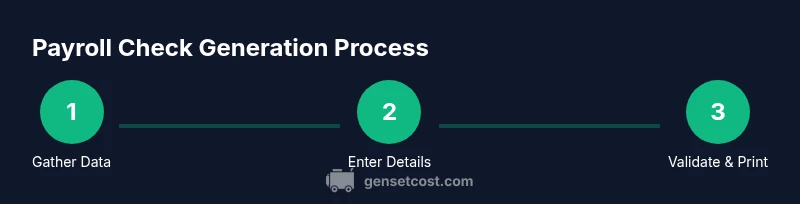
- Collect data: Gather hours, pay rates, deductions, benefits, and tax information for each employee. Ensure you have up-to-date withholding allowances.
- Set up the run: Open the generator, select the correct pay period, and enter each employee’s details. Double-check that you’ve chosen the right state and tax settings.
- Validate totals: Review gross pay, deductions, and net pay for each line item. Use any built-in validation to catch discrepancies.
- Preview and export: Generate a preview of checks or pay stubs. Export to PDF or your preferred format for printing or recording.
- Print or distribute: Print checks on compatible stock or save as digital records for electronic payments, if supported by the tool.
- Reconcile: Compare the generator results against your accounting ledger and bank statements to ensure consistency.
- Archive: Save a copy of the generated payroll in a secure location and log the run for future audits.
As you get comfortable with the process, you’ll refine data collection, improve input accuracy, and develop a repeatable routine that minimizes last-minute changes. The key is to maintain discipline around data integrity and secure handling of payroll information.
Printing and post-processing payroll checks
Printing payroll checks requires alignment accuracy and high-quality stock. Ensure your printer is calibrated and you’re using the correct check stock with proper pre-printed security features if required by your bank. Before printing a full batch:
- Do a test print on a blank page to confirm margins and alignment.
- Use a single-feed path and a reliable printer to avoid skewed checks.
- Verify the routing and account numbers are correct and legible.
- Keep physical checks in a secure location until they’re deposited or handed to employees.
After printing, file the check stubs or distribute them to employees and contractors. If you store check images or PDFs, use encrypted storage and controlled access. For electronic payments, ensure your bank’s secure channels are used and that you have appropriate authorizations in place. A well-managed post-processing workflow reduces the risk of lost or misrouted payments and simplifies audits.
If you print checks regularly, consider establishing a standard operating procedure (SOP) that documents who can generate checks, where prints are stored, and how exceptions are handled. This creates a predictable, auditable process that supports ongoing compliance.
Security and data privacy considerations
Payroll data is highly sensitive. When using a free payroll check generator, prioritize data privacy and security:
- Use reputable tools with strong authentication and encryption in transit and at rest.
- Avoid entering social security numbers or other extremely sensitive data unless strictly necessary and permitted.
- Restrict access to the generator to authorized personnel only.
- Store outputs securely, with access controls and routine backups.
- Keep software up to date and patch security vulnerabilities promptly.
If you are handling significant payroll volumes or sensitive data, a paid solution with enterprise-grade security and vendor assurances may provide better protection and support. Always review the service’s privacy policy and data handling practices before submitting payroll information. Implement a basic risk assessment checklist to ensure you understand where your data lives and how it could be exposed. The goal is to minimize risk while retaining ease of use.
For property managers handling multiple units, consider segregating payroll data by property and limiting access to payroll files to a small, trusted team. This reduces the risk of cross-property data exposure and helps maintain compliance with data protection regulations.
Ultimately, security is a shared responsibility between you and the tool provider. Be proactive, monitor for any anomalies, and have a response plan in place for suspicious activity or data breaches.
Common mistakes and how to avoid them
Free payroll check generators can save time, but they also invite common pitfalls. Here are recurring issues and practical fixes:
- Mistyped hours or wrong deductions: Always validate input data in a test run and use the tool’s validation prompts.
- Outdated tax tables: Regularly check for updates to tax withholding rules and adjust settings as needed.
- Printing errors: Run a test print first and use proper check stock aligned to your printer.
- Data leakage risk: Use secure connections and avoid saving sensitive data in shared locations.
- Incomplete records: Reconcile every run with your ledger and bank statements; keep copies for audits.
By building a small, repeatable process and keeping good records, you reduce the likelihood of payroll errors and security incidents. If you see patterns of mistakes, address the root cause—whether it’s data entry errors, outdated tax tables, or improper check stock usage. A disciplined approach pays off in reduced corrections and improved payroll reliability.
In practice, many users find that pairing a free generator with a simple, documented SOP delivers the best balance of cost savings and accuracy. The goal is to use the generator to support a compliant workflow, not to replace established payroll controls.
For homeowners and property managers, this means using the tool for straightforward payments and maintaining clear records. If you expand to more complex payroll scenarios, consider migrating to a more robust payroll system that supports tighter controls and multi-unit reporting.
Alternatives to free generators and evaluation criteria
If you anticipate growing payroll needs or require stronger compliance, compare free options with paid platforms. Consider the following evaluation criteria:
- Compliance coverage: Does the tool support state-specific rules and multi-state withholding if needed?
- Security and privacy: What encryption, access control, and data policies are offered?
- Auditability: Are there logs, change histories, and export options for reconciliation?
- Ease of use: Is the interface intuitive, with helpful prompts and validation?
- Support and updates: Is there accessible help and ongoing updates for tax changes?
- Cost considerations: Even free tools can require paid add-ons; assess the total cost of ownership over time.
For many small landlords or property managers, a hybrid approach works well: use a free generator for light, occasional payroll and rely on a paid solution for regular, high-volume runs. This reduces risk while maintaining cost efficiency. When evaluating options, request a trial or sandbox environment to test real data without affecting your live payroll.
As a practical tip, maintain a short comparison sheet comparing at least three tools on the above criteria. Include notes on data security, user permissions, and export formats. A structured approach helps you pick the tool that aligns with your workflow and data protection requirements.
Finally, remember that even the best generator won’t eliminate the need for careful record-keeping. Retain copies of payroll outputs, reconcile with your accounting system, and perform periodic internal audits to ensure ongoing accuracy and compliance.
A practical checklist for small businesses
To keep your payroll checks accurate and compliant when using a free generator, use this compact checklist:
- [ ] Collect complete employee data and current tax settings.
- [ ] Use validation prompts and perform a test run before printing.
- [ ] Confirm that check stock matches printer and bank requirements.
- [ ] Export or archive payroll outputs securely.
- [ ] Reconcile totals with your accounting ledger and bank statements.
- [ ] Securely store access credentials and limit user permissions.
- [ ] Review annually for tax rule updates and process changes.
This checklist is intentionally lightweight but effective for small operations. Adjust it to reflect your property management portfolio and any multi-unit complexities. A consistent routine supports smoother payroll cycles and fewer errors year over year.
Resources and next steps
If you want to dive deeper, start with reputable government and educational resources on payroll compliance, tax withholding, and secure data handling. Always verify that any generator you use aligns with current regulations and banking standards. After you’ve established a stable workflow, you can consider upgrading to a more robust solution that offers enhanced security, better audit trails, and dedicated support. The key is to balance cost savings with risk management while keeping employees paid accurately and on time.
Tools & Materials
- Internet-enabled device (computer, tablet, or smartphone)(Needed to access the generator.)
- Secure internet connection(Important to protect data during transmission.)
- Free payroll check generator tool(Choose a reputable source; avoid shady sites.)
- Printer(Laser printer recommended for crisp check printing.)
- Bank-compatible check stock(If printing checks, use correct stock and printer alignment.)
- Payroll records ledger(For reconciliation and auditing.)
- Scanner or digital storage(Helpful for archiving outputs securely.)
Steps
Estimated time: 15-30 minutes
- 1
Prepare payroll data
Collect hours, rates, deductions, and tax details for each employee. Confirm state-specific withholding where applicable. Ensure data accuracy before entering it into the generator.
Tip: Double-check hours and rates against your timesheets to prevent payroll discrepancies. - 2
Choose a trusted generator
Select a reputable free payroll check generator and review its data protection practices. Confirm that the tool supports your state and basic payroll needs. Create a quick local backup plan in case of data loss.
Tip: Prefer tools with clear privacy policies and audit trails. - 3
Enter employee data
Input each employee’s details into the generator, including gross pay, deductions, and net pay. Use dropdowns or validation prompts if available to minimize input errors.
Tip: Run a test with dummy data to verify input paths before handling live payroll. - 4
Validate calculations
Review gross pay, deductions, taxes, and net pay for all entries. Use the tool’s built-in validation and perform spot checks against your payroll ledger.
Tip: Cross-check the sums with a manual calculation for a small sample first. - 5
Print or export outputs
Preview the checks or pay stubs, then print on proper stock or export to a compatible format (PDF/CSV). Save outputs securely.
Tip: Print a single test check to confirm alignment before running a full batch. - 6
Reconcile and archive
Match generator results with your accounting entries and bank deposits. Archive copies securely for audits and future reference.
Tip: Maintain a simple log that notes the run date, employees processed, and any adjustments. - 7
Review and improve
Periodically assess the generator workflow, update tax settings, and refine data collection to reduce future effort.
Tip: Schedule quarterly reviews to stay aligned with regulatory changes.
People Also Ask
What does a free payroll check generator do?
A free payroll check generator helps you create paycheck data and printable checks with basic validation, reducing manual data entry for simple payroll tasks. It’s best used for straightforward payments and should not replace a full payroll system for complex needs.
A free payroll tool creates paycheck data and printable checks for simple payroll tasks, but it isn’t a full replacement for a complete payroll system.
Is it safe to print payroll checks from a free generator?
Printing payroll checks from a free generator can be safe if you use reputable tools, secure connections, and proper check stock. Always protect the data, back up outputs, and reconcile with your records.
Yes, if you choose a reputable tool, use secure connections, and back up your data, you can print payroll checks safely.
Can a generator handle multi-state tax withholdings?
Some free generators offer basic multi-state support, but many are limited. If you have employees in multiple states, verify that the tool supports the necessary withholding rules or plan for manual adjustments.
Some tools support multiple states, but check the options carefully because many free generators are limited.
Do I need to buy software after using a free generator?
For growing payroll needs or complex rules, upgrading to a paid solution with stronger compliance features and support is common. Use the free generator as a supplementary tool for simple tasks.
As your needs grow, you may upgrade to a paid solution, but use the free tool for basic tasks for now.
What are the risks of using free payroll check generators?
Risks include data privacy concerns, potential calculation errors, and limited compliance features. Mitigate by using trusted tools, validating data, and maintaining strong records and backups.
Risks include data privacy concerns and potential miscalculations; mitigate with trusted tools and careful validation.
How do I choose the right generator for my property-management needs?
Assess security, data handling, ease of use, export formats, and whether the tool can integrate with your accounting systems. Start with a trial and compare against a list of must-have features.
Look for security, compatibility with your accounting, and a straightforward interface; try a few options before deciding.
Watch Video
Key Takeaways
- Verify data before printing to avoid errors.
- Choose generators with solid security and validation.
- Keep payroll records securely and auditable.
- Balance cost savings with compliance and data protection.