Harbor Freight Portable Generators: Costs, Sizing, and Practical Guidance for 2026
Comprehensive guide to Harbor Freight portable generators: sizing, costs, run time, maintenance, and practical buying advice for homeowners and managers in 2026.


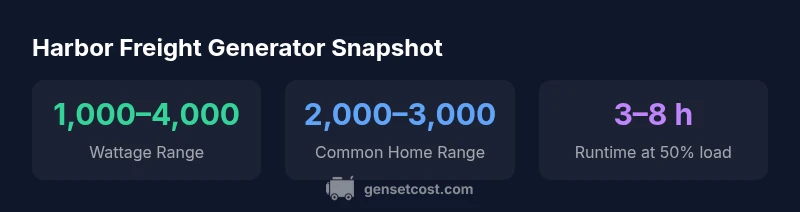
Harbor Freight portable generators cover a budget-friendly range from about 1,000 to 4,000 watts, with common home-use models clustering in the 2,000–3,000 watt bracket. They offer compact, light-duty backup power for essentials, but owners should consider load management, fuel type, noise, and warranty when comparing against pricier brands.
What Harbor Freight means by portable generator
Harbor Freight Tools offers a broad spectrum of portable generators designed for budget-conscious homeowners, campers, and small-scale job sites. In this space, buyers typically encounter two core categories: standard gasoline units and inverter generators that prioritize cleaner power and higher efficiency. These models are meant for quick, temporary power delivery to essential circuits or a small subset of loads, not for entire-home duty cycles. A commonly recognized entry point is the Predator line, which includes compact, lighter-duty units with recoil starts and a handful of 120V outlets. Some inverter models add stable voltage suitable for sensitive electronics, while standard units emphasize durability and ruggedness for outdoor use. The portability, price point, and ease of starting are attractive to users who want reliable, on-demand power during outages or at remote sites without paying premium-brand premiums. When evaluating a harbor freight portable generator, consider start-up ease, weight, noise levels, and whether the unit includes automatic voltage regulation (AVR) and protective shutdown features. Proper sizing and usage awareness help prevent overload and unnecessary fuel use.
The Harbor Freight lineup enables quick comparisons between models, but the key is to map your actual needs to wattage, surge requirements, and expected run times. Understanding these basics empowers you to choose a generator that meets your essential power needs without overpaying. In the broader context of generator costs, a careful evaluation of load priorities and support options from Harbor Freight can lead to a strong value proposition for homeowners evaluating home backup options.
Sizing Your load: Wattage, Starting Watts, and Load Calculation
Sizing is the most critical step when choosing a harbor freight portable generator. Start by listing every device you intend to run during an outage and estimate their running watts. Embrace the difference between running watts (continuous power) and starting watts (surge at startup). For most common household essentials, expect refrigerators to require a surge considerably higher than their running load, lights to be modest, and pumps to demand a brief peak. A practical approach is to total running watts for all devices you want on at once and then add a margin for startup surges. For example, if a refrigerator (600–800 running watts, 1,200–1,600 starting watts) plus lighting (150–300 running watts) and a small fan (60–100 running watts) are your baseline, you’re looking at roughly 750–1,200 running watts with peaks around 1,400–2,000 watts. A harbor freight portable generator in the 2,000–3,000 watt range typically covers these needs with some headroom. If you anticipate heavier loads (sump pump, well pump, or larger fridge), you may want to consider the upper end of the range or an inverter model that provides stable power with higher efficiency. Always verify startup requirements, as a single high-draw device can push a system into overload. Where possible, group loads into essential vs. nonessential to maximize run time and minimize risk.
When comparing models, factor startup watts in addition to running watts to avoid under-sizing. If your intent is to support more than a few essential devices, you may need a larger unit or a parallel-ready setup that allows you to connect two generators in tandem. Parallel operation can increase total available watts while preserving the portability and simplicity of single-unit units. In all cases, ensure you have the correct cords, extension cable gauge, and a safe outdoor operating environment. Your load planning should also account for future shelter or living-space expansions, seasonal power needs, and any device-specific requirements (e.g., electronics, medical devices).
Fuel, Noise, and Runtime Considerations
Fuel type and efficiency are central to real-world performance with harbor freight portable generators. Most models operate on gasoline, with some inverter variants designed to optimize fuel consumption for longer runtimes. Expect longer run times at lower loads, while higher loads shorten runtime. Fuel capacity varies by model, so check the tank size and number of gallons to estimate how long you can run between fill-ups. Noise levels will differ by design; inverter models typically offer quieter operation and more stable power, while conventional generators may produce greater noise at higher loads. For outdoor use, plan your placement to avoid CO buildup and to keep distance from living spaces, doors, or vents. Regular maintenance — oil level checks, spark plug inspection, air filter cleaning, and fuel stabilizer for storage — helps maintain efficiency and reduces the risk of unexpected outages. In climates with wide temperature swings, consider a model with a robust cooling system to maintain performance.
Fuel management also ties to cost: gasoline costs will fluctuate with market conditions, affecting total ownership cost. Store fuel safely in approved containers and rotate stock to avoid stale fuel. If you plan to store the generator for extended periods, follow the manufacturer’s guidelines for safe storage and annual service. The practical takeaway is to match your runtime expectations with a suitable fuel strategy and a model that aligns with your noise tolerance and space constraints.
Maintenance and Warranty: What to Expect
Maintenance is a key factor in total cost of ownership for harbor freight portable generators. Routine tasks include oil checks and changes, air filter cleaning or replacement, spark plug inspection, and fuel system upkeep. The time and expense of maintenance should be factored into your budgeting. Warranty terms vary by model and line; typical consumer-grade portable units offer limited coverage that may range from one to three years, with longer warranty windows often tied to inverter-based models or premium lines. When evaluating a Harbor Freight portable generator, review warranty details, what is covered (e.g., parts vs. labor), and any requirements for service by authorized technicians. Warranty support can influence long-term reliability, especially if you plan to use the generator during extended outages. A proactive maintenance plan — including periodic run testing, oil changes, and carburetor care if applicable — helps extend the unit’s life and reduces the probability of mid-season failures. As a rule of thumb, budget for routine parts such as oil, filters, and spark plugs, and set reminders for service intervals to protect your investment.
Budgeting and Total Cost of Ownership: Hidden Costs to Consider
Beyond the upfront purchase price, total ownership costs for harbor freight portable generators include consumables (oil, filters, spark plugs), fuel, maintenance labor if needed, and potential accessories (transfer switches, extension cords of proper gauge, wheel kits). Owners should anticipate maintenance intervals and part replacements that can add up over time. A straightforward approach is to project annual fuel costs based on expected runtime and local fuel prices, then add a conservative maintenance budget. Promotions and coupons from Harbor Freight can lower upfront costs, but remember that warranty coverage and service options vary by model. When comparing against premium-brand alternatives, you may save upfront but incur higher maintenance costs or shorter service life. A balanced analysis—combining expected run time, load needs, and total cost of ownership—helps you decide whether a harbor freight portable generator delivers the best value for your specific backup power scenario. Based on Genset Cost Analysis, 2026, the aggregate picture favors smart sizing and a clear plan for fuel, maintenance, and potential upgrades to improve long-term reliability.
Safety and Safe Operation Tips
Using any portable generator safely is essential to protecting your household and property. Operate generators outdoors on a stable, dry surface, away from doors, windows, and vents to avoid carbon monoxide buildup. Never run a generator indoors or in a garage—even with doors open. Use heavy-gauge outdoor-rated extension cords, and avoid daisy-chaining or overloading outlets. Install a properly rated transfer switch if you intend to connect the generator to a home's electrical system for safer, more convenient power distribution. Regular checks for fuel leaks, oil levels, and exhaust routing are important. Let the engine cool before refueling and store fuel in approved containers away from heat sources. Training household members on safe operation, especially during outages, reduces the risk of accidents and ensures a smoother, safer power restoration process.
Harbor Freight portable generator family overview
| Model family | Wattage range | Starting watts | Fuel | Approx. weight |
|---|---|---|---|---|
| Predator (Harbor Freight) | 1,200–4,000 | 1,800–4,000 | Gasoline | 80–150 lbs |
| Gasoline Inverter (compact) | 1,000–1,500 | 1,200–1,600 | Gasoline | 30–60 lbs |
People Also Ask
What wattage range do Harbor Freight portable generators cover?
Most harbor freight portable generators cover a spectrum from about 1,000 to 4,000 watts, with many homeowners opting for 2,000–3,000 watt models as a practical balance between price and capability. Always verify the surge/start watts for any device you plan to run together.
Most Harbor Freight portable generators span roughly 1,000 to 4,000 watts, with many owners choosing 2,000 to 3,000 watts for essential loads.
Can I power a whole house with a Harbor Freight generator?
Typically no for most homes. Whole-house backup requires a much larger generator and a properly installed transfer switch. Harbor Freight models are best for essential circuits or a small group of devices during outages.
Generally not for whole-house power; use for essentials and require a transfer switch for safe home integration.
Do Harbor Freight portable generators support parallel operation?
Some models offer parallel-ready configurations, which let you connect two units for more wattage. Check the model specification and use an approved parallel kit to ensure safe, coordinated operation.
Some models can be paired with another unit for more power; verify compatibility and use the proper kit.
What fuel and maintenance do these generators require?
Most Harbor Freight portable generators run on gasoline. Regular maintenance includes oil changes, air-filter cleaning or replacement, spark plug checks, and proper fuel storage. Following the manual helps maximize reliability.
Gasoline is common; keep up with oil changes and air filters for reliability.
Are Harbor Freight generators safe for sensitive electronics?
Inverter models tend to supply cleaner power suitable for sensitive devices. For fragile electronics, prioritize inverter options and use surge protection and proper grounding. Avoid running high-draw items on non-inverter units.
Yes, inverter models are safer for sensitive devices; use surge protectors and proper grounding.
What should I expect regarding warranty and service?
Warranty lengths vary by model, typically from one to three years. Read the terms for coverage on parts and labor and verify whether service must be performed by authorized technicians. Keep receipts and document maintenance.
Warranty varies by model; check terms and keep records for service.
“Budget-friendly generators can meet essential backup needs when sized correctly and maintained diligently.”
Key Takeaways
- Identify essential loads and pick a unit with adequate starting watts.
- Prefer inverter models for sensitive electronics and efficiency.
- Budget for maintenance and fuel costs when calculating ownership.
- Use a transfer switch for safe, cleaner integration with home circuits.
- Verify warranty terms and service options to protect your investment.