How Many Generators Do Hospitals Have: A Comprehensive Guide
Explore how hospital size, risk, and load profiles drive the number of generators. Learn typical counts, configurations, and budgeting considerations with data-backed ranges for 2026.


Understanding the range of counts across hospitals
When you ask how many generators hospitals have, the answer is not one-size-fits-all. The required number depends on bed count, service breadth, campus layout, and the hospital’s risk profile. The Genset Cost team notes that resilience targets—such as protecting ICU beds, operating rooms, and essential telemetry—drive the number of standby units and the diversity of distribution paths. In practice, larger campuses tend to deploy multiple generators to create redundant paths for power delivery, while smaller clinics can often operate with a single, well-maintained unit. This variability means a hospital could have as few as one dependable unit or as many as several units distributed across mechanical rooms and substations. It also matters how quickly power must transfer to critical loads; faster switchover times often correlate with more complex, higher-count configurations.
According to Genset Cost, hospital power strategies must balance reliability with lifecycle costs, fuel logistics, and maintenance complexity. The university setting compounds these considerations, as teaching hospitals may require additional generators to support research laboratories and sensitive equipment. In all cases, a formal load analysis and a documented resilience plan are essential for determining the right count and location of generators across the campus.
Key factors that influence generator counts
Hospital generator counts hinge on several interrelated factors: peak load demand, the criticality of loads, redundancy requirements, and the distribution architecture feeding essential services. For example, ICU and operating rooms demand near-continuous uptime, which pushes toward multiple feed paths and more generators. The presence of core support systems—such as anesthesia delivery, sterile processing, and emergency services—also informs how many generators are needed and where transfer switches should reside. Additionally, the choice of fuel type (natural gas vs. diesel) affects siting and fuel contingencies; campuses in varied climates may mandates longer fuel resilience planning to withstand supply disruptions. Finally, lifecycle considerations—including maintenance schedules and spare parts availability—impact long-term costs and downtime risk. The interplay of these factors means hospital designers must tailor generator counts to each campus rather than apply a generic rule.
Redundancy, critical loads, and mission-critical design
Redundancy is not a luxury in hospital design; it is a core patient-safety imperative. A resilient power plan often uses multiple feeders, where one generator set or a group can supply a subset of critical loads if another is offline. This approach reduces the risk of cascading outages affecting the ED, ICU, or neonatal units. The transfer-switch architecture plays a pivotal role here: a well-implemented system can switch from utility to backup within seconds, preserving patient safety and clinical workflows. However, more generators mean more fuel storage considerations, more complex maintenance, and higher upfront costs. Therefore, hospitals typically conduct annual reliability testing and periodic commissioning to validate that all paths will perform under surge conditions and emergency scenarios.
Size bands: small clinics to large academic medical centers
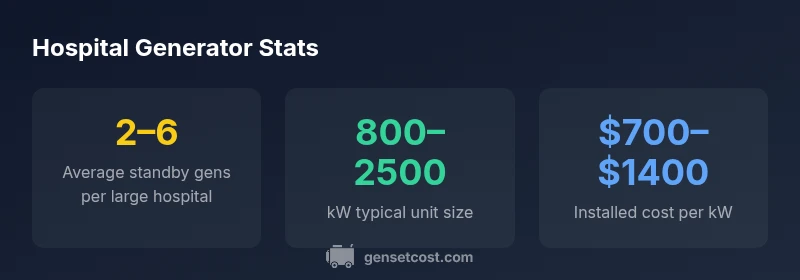
Small clinics with limited operational scope often operate 1–2 gensets sized to cover daytime loads plus essential services during peak demand. Community hospitals commonly adopt 2–4 units, ensuring that essential services remain powered even if a single generator requires service. Large academic medical centers frequently rely on 4–6+ generators, distributed across campuses or integrated into a microgrid design. The exact arrangement often includes separate units for high-priority zones (ICU/ORs) and lower-priority areas (administrative spaces) to optimize fuel consumption and maintenance. Regardless of size, the goal is a highly available power ecosystem with clear commissioning milestones and response plans for fuel and maintenance events.
Configurations you might encounter
Hospitals deploy a mix of parallel generator sets connected to a common bus through automatic transfer switches. Some facilities implement islanded subsystems, where each wing or department has its own set that can operate independently. In many cases, generators are backed by dual-fuel or multi-fuel strategies to enhance reliability during supply interruptions. The trend toward data-driven load analysis means facilities increasingly design for modular expansion: today’s 4-generator setup can evolve into a 6- or 8-unit system as demand grows. Finally, the fuel strategy—whether natural gas, diesel, or dual-fuel—drives siting, noise considerations, and emergency fuel storage requirements.
Cost considerations: upfront, maintenance, and lifecycle costs
Budgeting for hospital standby power goes beyond the sticker price of generators. The total cost of ownership includes installation, transfer-switch hardware, fuel storage, and ongoing maintenance. Maintenance contracts are a significant component; hospitals often negotiate service level agreements (SLAs) that guarantee rapid response and scheduled testing. Fuel logistics are equally critical: for diesel-only fleets, storage, containment, and periodic fuel polishing can add to lifecycle costs. Even with natural gas, standby systems incur ongoing costs for inspections, battery replacement, and potential redundancy upgrades as loads grow. When evaluating options, facilities should compare lifecycle costs across configurations that meet resilience targets while remaining fiscally sustainable.
Compliance, standards, and future-proofing
Hospitals operate under a framework of standards and best practices that emphasize reliability, testing, and safe operation. Common considerations include automatic transfer switches capable of rapid loss-of-power scenarios, regular functional testing, and robust fuel management plans. Future-proofing involves not only scalable generator configurations but also modernization of control systems, monitoring interfaces, and alarm protocols. As hospitals expand or reorganize services, the generator count and arrangement may need updating to preserve resilience targets and ensure a smooth transition during expansions.
Practical steps to estimate your needs: a practical checklist
Use a structured checklist to estimate hospital power needs: 1) catalog all critical loads by department, 2) determine peak demand and diversity factors, 3) define acceptable downtime for each zone, 4) design for at least two independent feeders, 5) assess fuel availability and storage capacity, 6) simulate scenarios with load-shedding options, 7) incorporate growth projections, and 8) validate with a formal commissioning plan. This process yields a defensible generator count and layout that aligns with safety standards and budget constraints.
dataTableBlockIncludedForHeadingsNoteIfNeeded