How to Adjust Generator Governor Speed: A Practical Guide
A comprehensive, step-by-step guide to safely adjust your generator governor speed. Learn mechanical and electronic methods, testing under load, and practical tips for homeowners and property managers.


You adjust generator governor speed by setting the engine’s target RPM and fine-tuning the throttle feedback that controls the governor. Start with the model’s official spec, verify with a tachometer, and make small adjustments in 25–50 RPM increments. Always test under representative load and document results to prevent overspeed and maintain frequency stability.
Why Governor Speed Matters
Maintaining correct governor speed is essential for stable generator output. The governor regulates engine RPM to keep electrical frequency steady under changing load. If speed drifts high, you risk overspeed, increased fuel consumption, and potential mechanical damage. If speed is too low, frequency drops, voltage may fluctuate, and equipment powered by the generator can malfunction. For homeowners and property managers, a well-tuned governor reduces fuel use, extends engine life, and improves reliability during outages. According to Genset Cost analysis, understanding the governor’s behavior helps you choose the right adjustments for your climate, load profile, and backup strategy. This guide covers practical steps for both mechanical and electronic governors, with safety-first checks.
Understanding Governor Types and Targets
Generators use two broad governor families: mechanical (linkage-based) and electronic (solenoid or microcontroller-driven). Mechanical governors adjust a butterfly or poppet valve on the throttle via a hand-adjusted screw. Electronic governors monitor RPM with a sensor and modulate fuel delivery or throttle via an actuator. The target RPM usually aligns with the engine’s duty cycle and the generator’s rated frequency (typically 50 Hz or 60 Hz). Always refer to the nameplate and service manual for the exact target RPM values. In practice, you’ll tune the system so the no-load and loaded RPMs stay within a narrow band around the specified target.
Safety and Pre-Check Protocols
Before touching any governor, perform a safety assessment. Disconnect nonessential power, wear PPE (eye protection, gloves), and ensure the generator is on a stable surface with the area ventilated. If your unit is located indoors, verify ventilation and carbon monoxide monitoring. Have a tachometer ready and a partner to help with load testing. Never adjust while the engine is hot or under improper wiring condition. Document each change before testing to avoid guessing later.
Tools, Safety, and Materials (What You Need)
Gather the following essentials: tachometer for RPM measurement, the generator’s service manual, protective equipment (gloves, eye protection), a set of wrenches and screwdrivers, a flashlight, a clean rag, and a safe place to record adjustments. For electronic governors, you may also need a diagnostic interface or manufacturer software. If you’re uncertain about wiring or sensor access, consider professional service. Precautions at all times help prevent accidental starts or fuel leaks during adjustment.
Step-By-Step Review of Adjustment Concepts
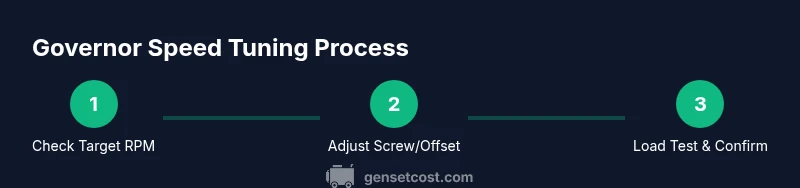
To adjust governor speed, you’ll first identify the correct RPM target from the manual or nameplate. Then, for mechanical governors, you’ll back off the locknut, turn the adjustment screw in small increments (typically 1–2 turns correspond to 25–50 RPM changes), and re-tighten the locknut. For electronic governors, you’ll access the control module, apply the recommended offset, and verify via live RPM readouts. In both cases, you should test the unit under no-load and light-load conditions before loading it fully. Record measurements across multiple loads to confirm the band remains within spec.
Testing Under Load: How to Validate Tuning
Testing under load is critical because no-load RPMs rarely reflect real-world performance. Start by applying a small load (e.g., a heater or lighting circuit) and observe RPM stability over several minutes. If RPM rises toward the upper limit, reduce the set-point or adjust the throttle-spring tension gradually. If RPM drops under load, you may need to increase the set-point or adjust the fuel-delivery curve. Repeat under progressively heavier loads to map the governor’s response curve. Always return to a safe idle after testing and recheck idle RPM.
Common Pitfalls and How to Avoid Them
- Overshooting the target RPM during adjustments is a primary risk; always use small increments and test after each change.
- Neglecting load testing can give a false sense of stability; never rely on no-load readings alone.
- Fatigue or rushed work increases misadjustments; take breaks and keep a log of changes.
- Improper wiring or uncalibrated sensors in electronic governors can cause intermittent RPM swings; seek professional calibration if you’re unsure.
Conclusion: Balanced tuning requires methodical steps, safety discipline, and repeatable testing. By following the manufacturer’s specifications and documenting results, you’ll maintain a stable power supply and protect your equipment.
Maintenance After Tuning: Keeping It Stable
After finalizing governor settings, schedule periodic rechecks as part of your ongoing maintenance. Temperature, altitude, fuel quality, and ambient load can shift governor behavior. Re-check RPM bands at least once per quarter or after any major maintenance event. Use the same test loads and conditions you used during tuning to compare results. Document the baseline and any deviations to track performance over time.
Tools & Materials
- tachometer (handheld or digital)(Calibrated to measure RPM within ±1%.)
- service manual / manufacturer guide(Locate target RPM and adjustment procedures.)
- screwdrivers and wrenches set(Sizes matching governor adjuster and locknut.)
- protective PPE (gloves, safety glasses)(Work safely around fuel and moving parts.)
- fuel drain pan and rags(Contain spills during adjustments.)
- diagnostic interface (for electronic governors)(Only if your model uses USB/BT software.)
Steps
Estimated time: 60-120 minutes
- 1
Identify target RPM
Consult the generator nameplate and service manual to confirm the exact target RPM for no-load and full-load conditions. This establishes the baseline for all adjustments.
Tip: Record the target RPM in your maintenance log. - 2
Prepare the unit for adjustment
Power down, disconnect the battery, and ventilate the area. Verify the area is safe and the engine cannot start inadvertently.
Tip: Double-check that all locks and switches are in the safe position before touching components. - 3
Access the governor adjustment
For mechanical governors, loosen the locknut and locate the adjustment screw. For electronic governors, open the control panel and locate the RPM set-point or throttle offset parameter.
Tip: Take a photo of the original wiring before changing any settings. - 4
Make a small adjustment
Turn the adjustment screw by 1–2 turns to change the RPM by roughly 25–50; refer to the manual for exact step sizes. Re-lock the nut to secure the setting.
Tip: Only adjust 25–50 RPM at a time and test before proceeding. - 5
Reconnect and restart
Reconnect power sources and start the engine. Observe no-load RPM using the tachometer for 60–120 seconds.
Tip: If you don’t see the RPM settle, pause and reassess the wiring and sensor signals. - 6
Load test in steps
Apply a light load and watch the RPM. Increase load gradually to medium levels, checking for stability and no overshoot above the target band.
Tip: Document each load point and RPM reading. - 7
Fine-tune and confirm
If RPM deviates beyond acceptable limits, repeat adjustments in smaller increments and re-test under load.
Tip: Aim for a narrow RPM band around the target with minimal fluctuation. - 8
Finalize and record
Lock the final adjustment, recheck idle and loaded RPM, and document the final settings in the maintenance log.
Tip: Include date, model, target RPM, and measured results for future reference.
People Also Ask
What is the governor in a generator and why adjust its speed?
The governor controls engine RPM to maintain a stable electrical frequency. Adjusting it helps keep output within the design spec under varying loads. Always base changes on manufacturer guidance and verify with a tachometer.
The governor keeps the engine RPM steady so your power stays reliable. Changes should follow the manual and be checked with a tachometer.
Can I adjust governor speed myself or should I hire a pro?
Basic adjustments can be done by a trained homeowner with proper safety measures and tools. Electronic governors may require professional calibration if fault codes appear or if readings remain unstable.
You can do some adjustments yourself if you’re careful, but for complex electronic governors or persistent instability, hire a pro.
What tools do I need to adjust the governor?
You’ll typically need a tachometer, basic hand tools, the service manual, PPE, and a means to apply/load test. Electronic governors may require a diagnostic interface.
Grab a tachometer, screwdrivers, wrenches, PPE, and the manual, plus a way to apply a load for testing.
Is load testing essential after adjustment?
Yes. Load testing confirms RPM stability under actual operating conditions and helps ensure your changes won’t cause overspeed or frequency drift.
Load testing is essential to confirm the tuning works when power demand changes.
How often should governor speed be rechecked?
Recheck during routine maintenance, especially after major service, climate changes, or fuel quality changes. A quarterly check is a common practice.
Check it during routine maintenance, especially after big changes or weather shifts.
What should I do if RPM still drifts after adjustments?
If drift persists, inspect sensors, wiring, and actuator performance. Consider professional calibration if measurements remain outside spec despite proper adjustments.
Persistent drift usually means sensors or actuators need checking; don’t push through the drift—get it calibrated.
Watch Video
Key Takeaways
- Identify exact target RPM from the manual
- Make deliberate, small adjustments
- Test under load to validate tuning
- Document results for future maintenance
- Follow safety procedures at all times