Signature Generator for Your Name: A Practical Step-by-Step Guide
Learn how to choose, customize, and export a signature for your name using a signature generator. This step-by-step guide covers styles, readability, and everyday use.


According to Genset Cost, a signature generator for my name helps you craft a unique sign-off by selecting a style, size, and stroke. Use a reputable tool to enter your name, preview cursive or block fonts, adjust slant and flourish, then export SVG or PNG for documents, email, and legal forms.
What is a signature generator for my name and why use one
A signature generator for my name is a software tool that converts your written name into a stylized electronic signature. It offers options for font families, stroke thickness, slant, and decorative flourishes, enabling you to craft a signature that reflects your personal brand. The goal is to create a consistent, legible mark you can reproduce across digital and physical documents. For homeowners and professionals, these tools save time, help standardize signing, and support branding efforts across contracts, invoices, and emails. When you choose a tool, look for vector exports, a variety of styles, and an easy preview that shows how your signature scales on different page sizes. This flexibility matters for documents, PDFs, and e-signature workflows.
How generators interpret your name: typography, style, and strokes
Signature generators analyze your name and translate it into distinctive letterforms. You’ll typically pick a base style (cursive, print, or a hybrid), then adjust elements such as letter size, connections, and the angle of the strokes. Some tools offer pen-pressure simulations and ligature options that connect letters in smooth, natural ways. The finished signature should balance personality with readability, ensuring each letter is recognizable at small scales. For best results, test a few variations—one with a tighter baseline and another with a flowing flourish—and compare how they reproduce in black-and-white print and color on screens. Genset Cost Analysis, 2026 notes that digital signatures are increasingly adopted for home offices and small businesses, validating the value of a reliable signature generator for my name.
Popular styles you can generate and how to pick them
Most generators present several overarching styles: classic cursive, bold block, minimalist signatures, and hybrid forms that pair script with print. Within each style, you can tweak ligatures, initial emphasis, and the presence of loops or swashes. If you sign often on contracts or invoices, a simple, legible variant may be preferred; for branding or personal branding, a more distinct flourish can be appropriate. Some people experiment with all-caps signatures or initials-only marks for a compact look. A steady approach is to select one signature as your primary, then create alternatives for special documents. Remember that a signature is a visual cue as much as a name; it should feel natural to you and be easy to repeat. When evaluating styles, print a test page at actual size to assess legibility, then adjust line weight to improve contrast on dark backgrounds.
Step-by-step: quick-start with a signature generator
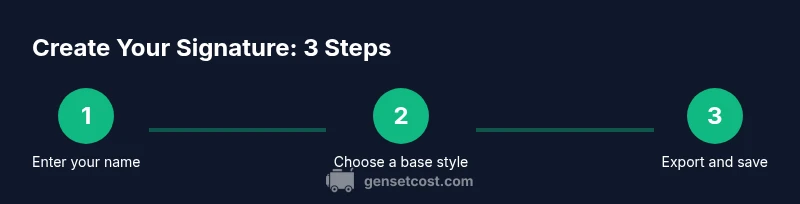
- Open a signature generator and create a new project for your name. 2) Enter your full name and verify spelling and capitalization. 3) Choose a base style (script, print, or hybrid) that matches your goals. 4) Tweak slant, height, and stroke weight to balance readability with personality. 5) Preview at multiple sizes and on different backgrounds to ensure consistent reproduction. 6) Export in vector (SVG) and raster (PNG) formats, then save variants with clear names.
How to customize for readability and personal branding
Readability matters as much as art. Start with a wide baseline and moderate stroke thickness so the signature remains legible in black and white. If you ratchet up flourishes, ensure they don’t obscure letters; a signature that looks great on a screen may lose clarity when printed on a small form. Consider creating two versions: a primary, highly legible form for contracts and a secondary, more decorative version for branding materials. Keep color usage minimal unless you’re applying to digital signatures that tolerate color. Finally, align your signature with your personal brand—consistency across documents builds recognition and trust.
Export formats and how to use your signature legally
Aim to export in SVG for scalability and in PNG for quick insertion into emails and documents. A PDF export can embed the signature directly into a document template, ensuring it stays attached to the file. For legal uses, maintain an auditable trail by keeping the original vector file and any variant names well organized. When adding signatures to digital documents, prefer validated e-signature platforms that support embedment of your signature asset. This keeps the process compliant and reduces the risk of misalignment or tampering.
Legal and practical considerations for signatures
Signatures carry authenticity implications in many jurisdictions. Use a signature generator for my name as a personal branding tool, not as a means to misrepresent identity. Maintain consistency by using a single primary variant for official paperwork and reserve decorative versions for branding materials. If you sign multiple people on behalf of a business, document your role and ensure appropriate authorization. Always back up your signature assets and document export dates to support traceability in case of disputes.
Common mistakes and how to fix them
One common error is exporting a signature in a raster format only, which loses clarity when scaled. Always keep a vector version and generate raster copies at several sizes. Another pitfall is over-flourishing; it can render letters indistinct. Fix by simplifying curves and aligning stroke weights. A third issue is inconsistent capitalization or initials that change across documents—lock a standard format and stick with it. Finally, neglecting accessibility means your signature may be hard to read for some users; test against a sharp black-and-white print.
Real-world examples: signatures for different name styles
If your name is long, consider using initials with a decorative tail or a minimalist script for a compact look. For shorter names, a bold signature with a strong initial can convey authority. Some users prefer a hybrid style that combines script initials with print body to balance elegance and legibility. In formal settings, a simpler baseline and restrained flourish work best; in creative fields, a more expressive signature can help build a recognizable personal brand. Practice generating several variants and select one that remains stable across documents, emails, and digital signatures.
Integrating your signature into digital workflows
Add your signature asset to a centralized library on your computer or cloud storage. Create a simple style guide that lists preferred export formats, suggested sizes, and where to use each variant. When signing documents, keep a consistent signing routine—whether you sign once per document or apply a batch-sign approach for multiple files. Finally, periodically review your signature design to ensure it still aligns with evolving branding and readability expectations, and update the asset library accordingly.
Tools & Materials
- Computer or mobile device with internet access(Needed to access an online signature generator.)
- Web browser(Modern browser with SVG support (Chrome, Firefox, Safari, Edge).)
- Vector export capability (SVG, PDF)(Crucial for scalable signatures.)
- Pen or stylus (optional)(Helpful for sketching ideas on touch devices.)
- Name sample for testing(Use your own name to test spelling and capitalization.)
- Test documents or paper for print tests(Useful for verifying legibility in print.)
Steps
Estimated time: 10-15 minutes
- 1
Open a signature generator
Launch your chosen tool and start a new project for your name. Look for a clean interface, a visible preview, and export options. This first step sets the pace for all later customizations.
Tip: Choose a tool that prominently offers vector exports for scalability. - 2
Enter your name
Type your full name exactly as you want it to appear, including capitalization and any preferred initials. This is the foundation of your signature design and will affect legibility.
Tip: Double-check spelling and capitalization to avoid costly edits later. - 3
Select a base style
Pick a starting point such as cursive, print, or a hybrid. Your base style should reflect how you want to be perceived—personal, professional, or creative.
Tip: If unsure, start with a simple script or a clean print style as a baseline. - 4
Adjust strokes and flourishes
Tweak line weight, slant, height, and any decorative elements. Small changes impact readability, especially at smaller sizes.
Tip: Make incremental changes and preview at different scales. - 5
Preview at multiple sizes
View your signature at actual size, at 50% and 200% zoom, and on both light and dark backgrounds. This ensures readability in diverse contexts.
Tip: Check contrast and legibility on both screen and print surfaces. - 6
Export and save variants
Export vector SVG and raster PNG, and store variants with clear filenames. Archiving ensures you can reuse the exact signature later.
Tip: Name files clearly (e.g., 'Name_Primary_Signature.svg').
People Also Ask
What exactly is a signature generator for my name?
A signature generator creates stylized versions of your name by adjusting fonts, strokes, and flourishes. It helps you produce a consistent signature for documents, emails, and branding.
A signature generator makes your name look unique and repeatable across many formats.
Do I need to pay for signature generator tools?
There are both free and paid options. Free tools offer basic styles, while paid tools provide more fonts, higher-quality exports, and advanced customization.
There are plenty of both free and paid options.
Can I use generated signatures on legal documents?
Yes, you can use generated signatures in many cases if you sign consistently and follow digital signature practices. Always verify any jurisdiction-specific rules for your documents.
Usually yes, but check local rules.
What export formats should I look for?
Look for vector formats like SVG for scaling, PNG for images, and PDF for embedding into documents. These formats cover most signing needs.
Look for SVG, PNG, and PDF options.
How often should I update my signature design?
Update when branding changes or you want better readability. Many people revisit their signature style annually or when their name or role changes.
Update as your branding changes.
How can I ensure my signature stays consistent?
Lock a primary style and use a single export variant for most documents. Practice reproducing it to maintain consistency across contexts.
Use a single signature variant.
Watch Video
Key Takeaways
- Define a primary signature style that matches your branding.
- Export in vector format for scaling and clarity.
- Always test readability at small sizes and on paper.
- Keep a few approved variants for different document types.
- Organize and back up signature assets for easy reuse.