How Do Generators Run? A Practical Homeowner's Guide
Explore how generators run from engine to electricity, covering fuel types, sizing, ATS, and maintenance—essential guidance for homeowners evaluating backup power options.


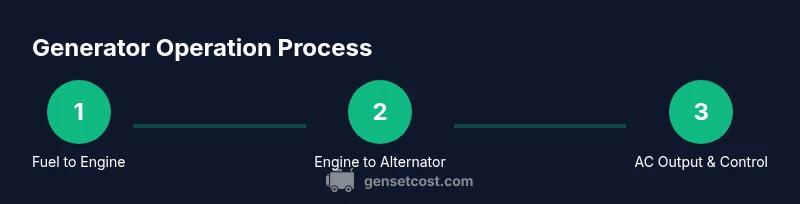
How do generators run? At a high level, a generator mimics a power plant in miniature: an internal combustion engine drives an alternator that converts mechanical energy into electrical energy. According to Genset Cost, understanding this core flow helps homeowners and property managers choose the right size and maintain reliable backup power. The sequence begins with fuel energy igniting a piston-driven cycle, which turns a rotor inside the alternator. The rotor's magnetic field induces electricity in the stator windings, producing alternating current (AC) power that can be used in a home or fed into a transfer switch. The output is then regulated, conditioned, and routed through protective devices to ensure safe, stable voltage. Heating, lubrication, cooling, and exhaust all play supporting roles to keep the engine and alternator balanced under load. In practice, the most critical decisions buyers face are sizing for expected loads, choosing a fuel type, and ensuring proper installation with a transfer switch that isolates the generator from the grid when in use. With these pieces in place, you get dependable power during outages.
How Do Generators Run: Core Concept
How do generators run? At a high level, a generator mimics a power plant in miniature: an internal combustion engine drives an alternator that converts mechanical energy into electrical energy. According to Genset Cost, understanding this core flow helps homeowners and property managers choose the right size and maintain reliable backup power. The sequence begins with fuel energy igniting a piston-driven cycle, which turns a rotor inside the alternator. The rotor's magnetic field induces electricity in the stator windings, producing alternating current (AC) power that can be used in a home or fed into a transfer switch. The output is then regulated, conditioned, and routed through protective devices to ensure safe, stable voltage. Heating, lubrication, cooling, and exhaust all play supporting roles to keep the engine and alternator balanced under load. In practice, the most critical decisions buyers face are sizing for expected loads, choosing a fuel type, and ensuring proper installation with a transfer switch that isolates the generator from the grid when in use. With these pieces in place, you get dependable power during outages.
Tools & Materials
- Wrench set (including socket wrench)(Sizes 10-15 mm commonly used)
- Screwdriver set(Phillips and flathead incl. magnetic bit holder)
- Multimeter(For voltage, continuity, and load checks)
- Oil and fuel stabilizer(Useful for long-term storage and maintenance)
- Owner’s manual(Keep for reference and maintenance schedules)
Steps
Estimated time: 2-4 hours
- 1
Assess your loads
Identify essential circuits and appliances you want to power during an outage. List lighting, refrigeration, heating controls, and critical outlets, and estimate their running watts. This helps establish a realistic minimum generator capacity and avoids over- or under-sizing. Before you begin, ensure you have a copy of your electrical panel diagram for reference.
Tip: Keep a running log of typical daily loads to compare against generator specs. - 2
Select capacity and fuel type
Choose a generator size that comfortably covers your calculated running watts plus a safety margin for startup surges. Decide on a fuel type based on availability, storage, and emissions tolerance—gasoline, propane, natural gas, or diesel have distinct trade-offs.
Tip: Favor models with efficient fuel systems and good cold-start performance in your climate. - 3
Plan electrical connections and ATS
Decide whether you’ll use a manual or automatic transfer switch (ATS) and confirm compatibility with your panel. The ATS isolates your home from the grid and routes power to the generator when needed. This step prevents backfeed and protects appliances.
Tip: Have a licensed electrician review panel compatibility and code compliance. - 4
Prepare installation location
Choose an outdoor, well-ventilated, level site away from doors, windows, and intake vents. Ensure adequate clearance for maintenance and exhaust; consider a weatherproof enclosure if needed. Plan for a stable pad and proper drainage.
Tip: Install weatherproof covers and secure the generator against wind or tampering. - 5
Install generator connections
Mount the unit, connect fuel supply lines or storage, and make electrical connections to the ATS and main panel. Follow the manufacturer’s wiring diagram and local electrical codes. Use protective cords and weather-rated cables built for outdoor use.
Tip: Do not rush electrical connections; loose wiring is a common failure point. - 6
Ground, test, and calibrate
Ground the system per local codes and perform initial safety tests. Start the generator, verify voltage and frequency at the outlets, and confirm the ATS transfers cleanly under load. Document results for future reference.
Tip: Check for exhaust leaks and verify carbon monoxide clearance in the outdoor area. - 7
Schedule maintenance and review
Set a maintenance cadence: oil changes, filter replacements, and battery checks. Run periodic tests to keep seals flexible and ensure ready-to-run status. Update your records with service dates and any parts replaced.
Tip: Keep a maintenance diary to track last service and upcoming intervals.
People Also Ask
What is the main function of a generator?
A generator converts mechanical energy from an engine into electrical energy via an alternator. It provides AC power that can be used to run appliances during outages, with safety features like transfer switches to prevent backfeed.
A generator turns fuel into electricity through an engine and alternator, paired with safety devices for reliable backup power.
What fuels can be used with generators?
Common fuels include gasoline, propane, natural gas, and diesel. Each fuel type affects availability, storage, emissions, and run-time, so choose based on your local resources and needs.
Generators can run on gasoline, propane, natural gas, or diesel, each with its own pros and cons.
What is an automatic transfer switch (ATS) and why is it important?
An ATS detects outages and automatically switches power from the grid to the generator, then back when power is restored. It prevents backfeed and keeps appliances safe.
An ATS automatically shifts power to the generator during outages and back when grid power returns.
How often should a generator be serviced?
Regular maintenance includes oil changes, filter replacement, battery checks, and running tests. Follow the manufacturer’s schedule and document all service events.
Keep up with oil changes, filters, and battery checks on a routine schedule to ensure reliability.
Can I install a generator myself?
Installing a generator involves electrical work and code requirements. Many jurisdictions require a licensed electrician for safety and compliance.
Some aspects require a professional; check local rules and consider an electrician for safety and code compliance.
What safety concerns should I not ignore?
Never operate indoors or in enclosed spaces. Ensure proper ventilation, secure fuel storage, and use carbon monoxide detectors. Follow all manufacturer safety instructions.
Always vent outdoors, store fuel safely, and follow the manual to stay safe.
Watch Video
Key Takeaways
- Size to cover essential loads with a safety margin
- Use an ATS for seamless, safe transfer of power
- Schedule regular maintenance to protect longevity
- Place and vent the unit safely to protect occupants and neighbors