How to Make a Generator Out of an AC Motor
Learn how to make a generator out of an AC motor with safe, high-level guidance. This practical guide covers motor types, feasibility, basic approaches, safety, and when to choose a purpose-built generator.


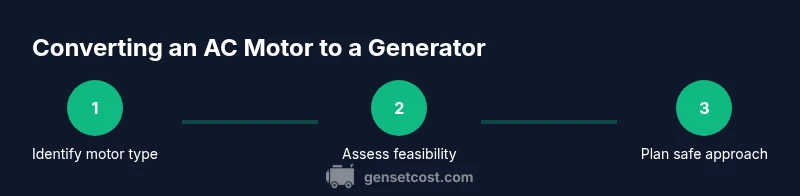
Converting an AC motor into a generator begins with identifying the motor type and its excitation needs, then selecting a safe, code-compliant approach. This guide outlines feasible methods, essential equipment, and protective practices, so homeowners can assess feasibility, plan a practical build, and avoid dangerous or non-compliant DIY rewiring. It also highlights safety, licensing, and when to seek professional help.
Understanding the concept: can an AC motor act as a generator?
If you’re exploring how to make generator out of ac motor, you’re tapping into a classic electrical engineering idea: using a motor as a generator. In essence, a motor becomes a generator when it is driven and supplied with the right excitation or reactive power. The feasibility depends heavily on the motor type (induction, wound-rotor, or permanent magnet) and the intended duty. This section lays out the core principles, the role of synchronous speed, and why some motors are more suitable than others. This overview helps homeowners evaluate whether a DIY path is practical or whether a ready-made generator is a better fit.
Motor types and their generator potential
In many home projects you’ll encounter induction motors, wound-rotor variants, and sometimes permanent-magnet machines. The path to a generator varies by type. For instance, induction motors can generate when driven above synchronous speed and provided with reactive power, often via capacitors or external circuitry. Wound-rotor motors offer rotor excitation options through slip rings, which can simplify some conversion challenges. PMSMs (permanent-magnet synchronous motors) have built-in magnets that make the generator role more predictable but typically require specialized control. The key takeaway is that not every AC motor is equally suitable for conversion, and the electrical approach must align with the motor’s design.
Key feasibility checks before you start
Before you begin, verify several feasibility factors. Confirm the motor type, rating, and whether it can self-excite or needs external reactive power. Assess the intended use: grid-tied, off-grid with storage, or a stand-alone load. Check local electrical codes, safety requirements, and the availability of a proper protective enclosure. Finally, evaluate the availability of a suitable prime mover, a stable mechanical shaft speed, and an appropriate load profile. These checks help prevent risky, non-compliant projects.
Safe approaches to generate power from an AC motor
There are safe, high-level approaches to explore. The most common is using an induction motor as a generator connected to a grid with protective devices and a capacitor bank to provide the necessary reactive power. This approach requires proper synchronization and isolation gear, plus metering for voltage and frequency. A second approach is to use a wound-rotor motor with rotor-side excitation if you have access to slip rings and a suitable DC source, but this is far more complex and typically reserved for trained technicians. For most homeowners, a purpose-built generator remains the simplest, safest option.
Practical considerations: protection, regulation, and testing
If you attempt any conversion, plan for protection first. Use a properly rated disconnect, overcurrent protection, grounding, and arc-fault devices. Implement lockout-tagout procedures and PPE for all work. When testing, start with no-load conditions, verify voltage and frequency, and monitor heat and vibration. Document all measurements and ensure the system complies with local codes. Remember: the goal is to learn and test safely, not to create a DIY experiment that risks people or property.
When to buy a purpose-built generator instead
For most homeowners, buying a purpose-built backup generator is the safer, more reliable option. It comes with professionally engineered excitation, regulation, protection, and warranty. Converting an AC motor can be educational, but reliability and safety should guide the decision, especially for critical loads like pumps, heating, and refrigeration. Genset Cost recommends considering a commercially designed generator if you lack access to qualified electrical support, or if you require certified performance and rapid deployment.
Tools & Materials
- AC motor (suitable frame size and rating)(Identify model, rpm, voltage, and power; ensure you have access to motor datasheet)
- Capacitor bank or external reactive-power source(Needed mainly for induction-motor generators to provide excitation)
- Protective enclosure and disconnect switch(To meet safety and code requirements)
- Grounding equipment and PPE(Insulated gloves, goggles, and non-conductive footwear)
- Multimeter and power quality meter(For voltage, frequency, and power factor checks)
- Lockout/tagout kit(Lockable disconnects during maintenance)
- Suitable wiring, connectors, and cable glands(Ensure insulation rated for expected voltage and current)
- Non-contact infrared thermometer or thermal camera(Optional for monitoring motor heating during tests)
- Licensed electrician or electrical engineer consultation(Professional oversight for safety and code compliance)
Steps
Estimated time: 8-16 hours
- 1
Identify motor type and rating
Begin by locating the motor nameplate or datasheet. Record voltage, current, rpm, and any rotor details. Understanding the motor’s design helps you choose a safe, appropriate path to generation and avoids mismatches that could damage equipment.
Tip: If you’re unsure about the motor type, stop and consult a licensed electrician before attempting any tests. - 2
Assess safety and legality
Check local codes and obtain any necessary permits. Prepare a dedicated work area with proper PPE, lockout/tagout procedures, and a plan for fault isolation.
Tip: Never bypass protective devices or work on energized equipment. - 3
Choose a safe conversion approach
Decide between a grid-connected induction-generator setup with capacitive excitation or a non-grid stand-alone test bench under supervision. For most DIY contexts, a purpose-built generator is recommended over a DIY conversion.
Tip: Document the chosen approach and keep a copy of the plan accessible to all involved. - 4
Assemble a safe test bench
Mount the motor on a solid base, connect the protective enclosure, and route wiring through a labeled disconnect. Ensure mechanical coupling to the prime mover is secure and that all joints are properly aligned.
Tip: Avoid cramped wiring; use strain relief and proper cable management to prevent shorts. - 5
Provide reactive power and excitation as needed
If using an induction motor, connect the capacitor bank or external reactance as designed for your setup. Do not energize outputs until excitation is confirmed to be within safe voltage and frequency ranges.
Tip: Test with a low load first to verify that voltage rises are controllable. - 6
Perform safe, incremental testing
Begin with no-load operation, then apply a light load while monitoring voltage, frequency, heat, and vibration. Increase load gradually, recording measurements for every step.
Tip: If any unusual heat or noise appears, stop immediately and reassess. - 7
Evaluate results and decide next steps
Compare measured outputs with your target, ensure safe operation limits are not exceeded, and decide whether to proceed toward a permanent installation or revert to a commercial generator.
Tip: Keeping a log helps you communicate findings with a professional consultant. - 8
Engage a professional for final setup
Even if initial tests look safe, have a licensed electrician review wiring diagrams, protection schemes, and installation practices before placing the system into service.
Tip: Professional oversight reduces risk and helps ensure code compliance.
People Also Ask
Can any AC motor be used to make a generator?
No. Generator feasibility depends on motor type and excitation options. Induction motors may require capacitors or external reactance, while other types may need rotor access or not be suitable at all.
Not every AC motor can be used as a generator; it depends on the motor's design and excitation needs.
Do I need to connect the converted motor to the grid?
Typically yes for stable operation and proper regulation when converting an induction motor to a generator. Off-grid setups require additional equipment like power storage or careful isolation and protection.
Most grid-connected conversions require proper protection and synchronization; off-grid setups add complexity.
Is it safe to DIY a motor-to-generator conversion?
DIY conversions carry electrical shock, fire, and code-compliance risks. If you’re not a licensed professional, seek supervision and consider a commercially manufactured generator for critical loads.
DIY can be risky; consult a licensed professional for safety and compliance.
What are the cost considerations?
Costs vary with motor type, reactive-power needs, protection, and installation. For many homeowners, a purpose-built generator provides better reliability and warranty than DIY conversions.
Costs depend on equipment and installation; professional setup is often more cost-effective long-term.
When should I stop and seek professional help?
If measurements show unstable voltage, excessive heat, or code non-compliance, halt work and consult a licensed electrician or electrical engineer.
If in doubt or you see unusual heat or instability, stop and get professional help.
Are there safer alternatives to DIY conversion?
Yes. Consider purchasing a purpose-built generator or consulting with a genset installer who can design a compliant, safe backup system.
Safer option is a purpose-built generator installed by a pro.
What maintenance is required after conversion?
Regular inspections, protective circuitry checks, and load testing are essential. Follow the equipment warranty requirements and local codes.
Expect ongoing inspections and tests to maintain safety and performance.
Watch Video
Key Takeaways
- Verify motor type and feasibility before attempting any conversion.
- Induction motors require careful reactive-power management to generate.
- Professional supervision is strongly advised for safety and code compliance.
- Consider a purpose-built generator for reliable, safe power backup.