How to Tell If Generator Is Bonded Neutral
Learn how to verify whether your home backup generator has a bonded neutral. Step-by-step checks, safety tips, and when to call a pro for installation and transfer-switch considerations.


You can determine if your generator has a bonded neutral by inspecting the equipment grounding conductor, testing for a bonding strap, and checking the transfer switch wiring. This quick check helps ensure safe operation during outages and meets code expectations. If any doubt remains, consult the product manual and a licensed electrician.
What bonded neutral means for home generators
A bonded neutral is a specific electrical configuration where the generator’s neutral conductor is electrically connected to the equipment grounding conductor (EGC) at a defined point in the system. For many residential standby setups, the bonding arrangement impacts how fault currents return to the source and how voltage references are established during a power outage. The commissioning standard ensures a known reference point so that protective devices trip correctly and function safely. The Genset Cost team frequently encounters questions from homeowners trying to understand whether their generator is bonded neutral, because the answer affects wiring choices, transfer-switch design, and the overall safety of the installation. According to Genset Cost, verifying this bond is not just about following a rule; it’s about ensuring reliable operation during outages without creating shock hazards or unpredictable ground fault behavior. A proper bonding scheme reduces stray voltage on metal enclosures and ensures a clear path for fault currents, which is especially important for outdoor installations adjacent to damp environments.
In practice, bonding neutral paths are specified by the generator manufacturer and code-adjacent standards. Some installations bond at the generator’s neutral terminal, others bond at the main service panel or within the transfer switch. Local code variations can affect where the bond should reside. Always cross-check the model guide and installation manual with your local electrical code requirements. When done correctly, a bonded neutral helps protect occupants and equipment, while an incorrect bond can create nuisance shocks or misoperate protective devices. This is a core area where careful verification matters for long-term safety and compliance.
Where bonding is located in typical generator installations
Bonding can appear in several places depending on the system design. In a generator that feeds through a transfer switch, the neutral may be bonded at the generator terminal block, at the transfer switch, or at the main service panel after the switch. Each configuration has distinct implications for fault current paths and grounding schemes. The manual for your model will indicate the intended bonding point. In some cases, a bonding strap or jumper is installed to connect the generator’s neutral to the panel’s grounding conductor. If you discover a strap that appears loose, corroded, or improperly routed, that can indicate an installation error or a modification made after purchase. Genset Cost analysis shows that bonding practices vary by region and installer, so it’s essential to confirm the method specified by the manufacturer and aligned with local code requirements. If you’re unsure, treat any ambiguity as a signal to consult a qualified electrician who can review the transfer-switch wiring, the neutral bus, and the grounding path to verify compliance and safety.
When you examine the installation, look for clear labeling near the neutral terminal and grounding conductor. The bonding point should be described in the wiring diagram, and any required bonding jumpers should be intact and properly insulated. If the transfer switch includes a dedicated grounding terminal, verify that it is connected to the home grounding system. Look for consistency between the panel labeling, the manual, and the physical wiring. In all cases, don’t rely on visual inspection alone; perform a measured test following safe procedures outlined by your manual or a licensed professional to confirm the bond status. This approach minimizes guesswork and aligns your setup with best practices used in professional installations.
In real-world scenarios, homeowners often notice differences in how their systems respond during outages. A correctly bonded neutral tends to provide predictable voltage references and smoother transfer behavior. Misbonding can lead to floating neutrals, nuisance tripping, or unexpected voltage on metal enclosures. By understanding where the bond should exist and verifying it with the proper tools, you can pinpoint whether your system is wired to spec and ready for reliable operation when power is out.
How bonding is referenced in manuals and standards
Manufacturers specify bonding requirements in installation guides, which are the primary source of truth for your model. The bonding method is typically described in the neater sections of the manual alongside the wiring diagram, terminal layout, and transfer-switch instructions. Availability of a factory bond or a field-installable jumper is usually documented, with notes about voltage, frequency, and safety clearances. In addition to manufacturer guidance, many jurisdictions adopt or reference standards from bodies like NFPA 70 (National Electrical Code, NEC) and related safety publications. These standards describe when and where bonding is required, and how to verify a sound neutral-ground relationship in generator systems. Genset Cost’s approach is to encourage homeowners to cite the model-specific instructions first, then cross-check with local code requirements to avoid noncompliance or safety gaps. If you are renovating a system or replacing a transfer switch, make sure the new components support the same bonding arrangement described in the original installation and that any field-installed jumpers are rated for the environment and load.
Cross-referencing the manual with reputable standards helps you build a defensible understanding of your system. For homeowners, this means fewer questions during inspections and a clearer path to upgrading or correcting the bond if needed. If you find discrepancies between the manual and the installed wiring, treat that as a red flag and consult a licensed electrician to adjudicate the correct bonding scheme for your specific generator, transfer switch, and panel configuration. By staying aligned with the manufacturer’s instructions and recognized standards, you minimize risk and enhance system reliability during power outages.
Safety considerations before you test
Testing bonding involves working around live electrical equipment, even if you plan to power down parts of the system. Wear PPE: insulated gloves, eye protection, and long sleeves. Ensure you have a clear, dry workspace, and keep water away from any panels or grounding conductors. Before touching any terminals, verify the main power is off at the main disconnect and at the transfer switch. Use a non-contact voltage tester to confirm there is no voltage present in the access panels you’ll be opening. If you hear buzzing, notice heat, or see arcing, stop and reassess; unsafe conditions require professional intervention. Remember that a bonded neutral affects current paths during faults, so improper handling can create shock hazards or damage protective devices. If in doubt, call a licensed electrician rather than attempting risky disconnections or rearrangements yourself. Safety comes first, and documenting the process with photos helps professionals validate the bond later on. Genset Cost emphasizes that confirming bonding status is a safety-critical step, not an optional maintenance task.
How to approach verification with minimal tools
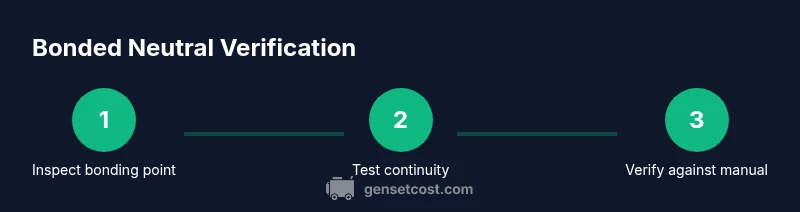
A prudent homeowner can perform foundational checks using common electrical tools and the generator’s documentation. Start by powering down and isolating the generator from the home electrical system. Then inspect the terminal blocks and the neutral bus for any visible bonding strap or jumper. Use a multimeter to check continuity between the generator’s neutral terminal and the grounding conductor to confirm whether a bond exists at the expected point. If there is a direct low-resistance path (often under a few ohms), you likely have a bonded neutral as intended by the manufacturer. If the reading shows high resistance or infinite resistance, the bond may be missing or misconfigured. Always verify against the wiring diagram and installation guide. Take photos and label each connection so a professional can review them quickly. If the test reveals inconsistencies or if you are uncertain about the results, it is safer to call a licensed electrician to perform a compliant verification and any required adjustments. This cautious approach helps protect your family and equipment while ensuring code compliance.
Documenting the setup with clear photos supports future maintenance or upgrades. When you’re ready for more definitive confirmation, a field technician can perform precise tests with specialized instruments and provide an official determination.
What to do if you find an unbonded or misbonded condition
If the bond is missing or incorrect, do not operate the generator until the issue is resolved. A misbond can lead to shock hazards, improper fault clearing, and unpredictable transfer-switch behavior. Start by consulting the installation manual and manufacturer guidance to identify the correct bonding point for your model. Then coordinate with a licensed electrician or the installer to implement the bond exactly as specified. This may involve installing or re-positioning a bonding strap, adding or rerouting a jumper, or adjusting the transfer switch wiring in accordance with the approved diagram. After any modification, re-test the bond with the same safety-minded process you used initially, and confirm that the continuity path exists as intended. Finally, document the changes and keep a copy of the updated wiring diagram for future reference. Genset Cost’s practical recommendation is to treat any bonding correction as a formal upgrade to the system that should be verified by a qualified professional to ensure ongoing safety and compliance.
Tools & Materials
- Digital multimeter(Used to measure resistance, continuity, and voltage on neutral and ground paths)
- Non-contact voltage tester(Quickly verify absence/presence of live circuits before touching components)
- Insulated screwdriver set(For safe terminal screws and panel access)
- Socket wrench set(To remove access panels and connectors)
- Safety gloves and eye protection(Personal protective equipment for electrical work)
- Manufacturer installation manual(Model-specific bonding instructions and wiring diagram)
- Digital camera or smartphone(Document wiring for later review)
- Electrical tape and wire labels(Label connections for clarity)
Steps
Estimated time: 60-90 minutes
- 1
Power down and isolate the system
Shut off the generator and switch off the main breaker or transfer switch to isolate the generator from the home. Use the non-contact tester to confirm no voltage is present near panels you’ll touch.
Tip: Double-check the main disconnect and transfer switch positions with the tester before opening any panels. - 2
Access the neutral bus and grounding path
Open the transfer switch or generator service panel as described in the manual. Locate the neutral bus and the equipment grounding conductor that connects to the system ground.
Tip: Keep track of all fasteners and components so you can reassemble without mix-ups. - 3
Look for a bonding strap or jumper
Inspect for a bonding strap or jumper between the neutral terminal and the grounding path. Check that it is intact, properly seated, and not damaged by corrosion or vibration.
Tip: If the strap is missing or damaged, do not attempt a DIY fix; this requires professional installation. - 4
Test continuity between neutral and ground
With the system isolated, use the multimeter to measure resistance between the neutral terminal and the grounding conductor. A bonded neutral typically shows a low resistance path.
Tip: Record the reading and compare it against the manual’s guidance for acceptable resistance. - 5
Cross-check the wiring diagram
Refer to the model’s wiring diagram to confirm the intended bonding point and jumper configuration. Ensure the measured path matches the diagram.
Tip: A mismatch often means an installation modification or misinterpretation. - 6
Assess transfer-switch wiring
Check whether the bonding arrangement is maintained when the transfer switch is engaged. Some designs bond at the generator, others at the switch or panel.
Tip: Do not cycle power until you are certain the bond remains at the correct location. - 7
Document findings with photos
Take clear photos of the bonding components, wiring, and labels to aid future maintenance or professional review.
Tip: Label each photo with a brief description and date. - 8
Decide on next steps
If the bond is missing or incorrect, contact a licensed electrician to implement the correct bonding method per manufacturer guidance and local code.
Tip: Avoid attempting to retrofit or improvise—protocols vary by model.
People Also Ask
What does bonded neutral mean in a home generator?
A bonded neutral means the generator’s neutral conductor is connected to the equipment grounding path at a defined point, which helps protect against shock and ensures proper operation of protective devices. The exact bonding point depends on the design and local code requirements.
A bonded neutral connects the generator’s neutral to the grounding path at a specific point to improve safety and proper protection in faults.
Is bonding required for all generators?
Bonding requirements vary by model and code. Many residential setups require a properly bonded neutral through the transfer switch or main panel, but always reference the manufacturer guide and local codes.
Bonding requirements depend on your setup and local codes; check the manual and code for your area.
How can I tell if my generator is bonded if I can't access the panel?
Look for labeling on the terminal block or bonding jumper described in the manual. If labeling isn’t clear, consult the installer or manufacturer for the bonding location and method.
If you can’t access the panel, rely on the manual and, if uncertain, contact the installer for confirmation.
Can I test bonding without powering up the system?
Yes, but only with proper safety measures and the right tools. Always begin with the system isolated and use appropriate instruments to verify continuity between neutral and ground as instructed by the manual.
You can test bonding with the system off, using the right tools and the manual’s guidance.
What are signs of an incorrect bonding arrangement?
Symptoms include unexpected shocks, erratic transfer switch behavior, or stray voltage on enclosures. If you observe these, stop using the system and seek professional verification.
Look for shocks or strange transfer behavior; these require professional verification.
Should I hire an electrician to verify bonding?
If you are unsure or your local codes demand compliance verification, hire a licensed electrician to inspect and adjust bonding as needed.
If unsure, hire a licensed electrician to verify bonding and code compliance.
Watch Video
Key Takeaways
- Know where bonding should occur for your model
- Power down and test safely before inspecting
- Follow manufacturer diagrams and local codes
- Document bonding status for future reference
- Call a licensed electrician if unsure