Which video generator AI is free? A practical guide for decision-makers
Explore free video generator AI options, what free plans include, how to compare features, limitations, privacy, and practical tips for homeowners and creators evaluating free tools.


Which video generator ai is free? There isn’t a single universally free option. As of 2026, most services offer free tiers or trial periods rather than truly free pipelines, with limits on length, export formats, resolution, watermarking, or API access. The Genset Cost team notes that you typically get value by combining free plans with careful feature prioritization and clear usage goals.
What free means in video generator AI
In the context of video generator AI, "free" typically means a free plan or a no-cost trial rather than an unlimited, unrestricted service. The landscape in 2026 shows multiple providers offering entry-level access, but with constraints like watermarking, limited export formats, capped video lengths, reduced resolution, or restricted API usage. According to Genset Cost, this tiered approach lets users evaluate capability before committing to paid plans, while keeping expectations aligned with the underlying business model. When you ask, 'which video generator ai is free,' you’re really asking which tools offer usable, no-cost options today, and under what limitations those options operate.
For decision-makers, the key takeaway is that true, unlimited free access is rare. Instead, look for tools that give you enough creative freedom to prototype your project without paying, while clearly signaling what isn’t included in the free tier.
How free tiers differ across providers
Free offerings vary widely, even among competitors with similar promises. Some providers emphasize export flexibility, others prioritize AI-driven features like automatic captioning or color grading, and others still focus on rapid rendering. In practice, you’ll see four common models:
- Free forever with strict limits (video length, formats, and watermarking)
- Free trial periods (time-bound access to premium features)
- Free tier with chargeable add-ons (core features + paid upgrades per asset)
- Freemium bundles tied to usage quotas (credits or minutes per month)
The upshot is that you should map your project goals to the provider’s limits. If your project requires long-form videos or high-resolution exports, free tiers may not suffice.
Common features and limitations of free video generators
Typical free tiers share several constraints:
- Watermarked outputs or restricted resolutions
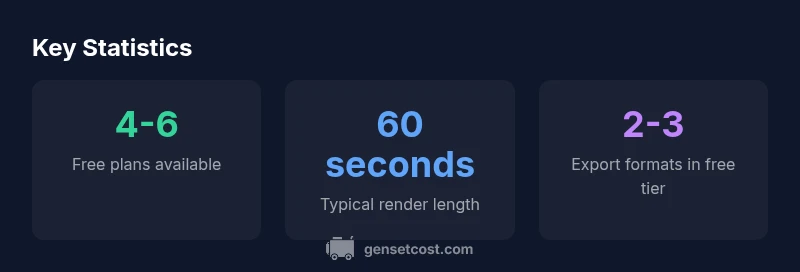
- Short maximum video durations per render (often 30–60 seconds)
- Limited export formats (commonly MP4; sometimes WebM or GIF)
- Few or no API access and fewer automation options
- Limited templates or stock assets
These trade-offs are intentional: they let you test core capabilities without incurring costs, while nudging you toward paid tiers for production-scale work. If you value speed and privacy, verify whether the tool processes data locally or in the cloud, and review the privacy policy.
A practical evaluation checklist for free options
To compare free options effectively, use a simple checklist:
- Define the minimum viable output (length, format, resolution).
- Check watermark and branding requirements.
- Confirm export formats and framerate support.
- Assess ease of use and learning curve.
- Review data handling, privacy, and terms of service.
- Test reliability and render speed with a small project.
- Consider upgrade costs and value if you anticipate growth.
A structured test run using a short clip can reveal whether the free tier is sufficient for your needs or if you should allocate resources to a paid plan. The Genset Cost team emphasizes documenting the outcome of your free-tier test to inform budgeting decisions.
Privacy, data handling, and terms to watch for
Free tools often come with looser data controls than paid options. Pay attention to:
- Data retention and usage rights for your uploaded videos
- Whether the service stores and uses your content for model training
- Clear deletion policies and data ownership
- Third-party integrations and telemetry sharing
- Terms of service that specify permitted use cases
If you’re handling sensitive or proprietary material, prioritize providers with explicit privacy guarantees and opt-out options for data sharing. Always review the privacy policy and terms before uploading client work or personal footage.
Real-world scenarios: when free is enough vs when to pay
For personal passion projects, exploring free tiers often suffices: you can prototype story ideas, test editing styles, and generate short social videos without incurring costs. For client work or brand campaigns requiring consistent output, higher resolution, multiple formats, and branded templates, paid plans typically deliver reliability and scalability. If you expect frequent production, consider a blended approach: begin with free trials to scope requirements, then invest in a paid plan that aligns with your workflow and budget.
Tips to maximize value from free tiers
- Use multiple free tools to cover different formats and styles.
- Plan outputs in small batches to stay within per-render limits.
- Combine free tools with your existing editing software for final polish.
- Track your time and export counts to quantify when a paid plan becomes cost-effective.
- Stay updated on policy changes; free plans can shift features at renewal.
By systematically testing and combining tools, you can extract meaningful value from free tiers while staying prepared to upgrade when scale or quality demands rise.
What it costs to upgrade: decoding paid plans without specific prices
Prices for paid plans vary by feature set, usage limits, and support levels. Expect tiered options that unlock longer video lengths, higher resolutions, more export formats, API access, and access to premium templates. Because prices change and promotions occur, always verify current pricing on the official page and compare against your project needs. A practical approach is to estimate the monthly usage you anticipate and weigh it against the perceived value of the features in paid tiers.
Final decision framework: stay free or invest
Your decision should rest on a simple framework: does the free tier meet your minimum viable outputs, privacy needs, and delivery timelines? If the answer is yes for most months, you can stay free while refining your process. If not, map the gap to paid features and calculate the expected return on investment. The Genset Cost team recommends validating free options with a controlled test project before committing to a paid plan to ensure you’re optimizing for both quality and budget.
Overview of common free-tier characteristics
| Aspect | Free-tier behavior | Notes |
|---|---|---|
| Export formats | MP4; WebM (limited) | Format support varies by tool |
| Watermarks | Common in free plans | Often removed in paid plans |
| Video length | 30-60 seconds | Limit per render, varies by tool |
People Also Ask
What counts as a 'free' video generator AI?
Free generally means a plan or trial that costs nothing up front, but comes with limitations on outputs, formats, or usage. It’s best viewed as a testing ground rather than a production solution.
Free usually means you can try the tool at no cost, but with limits. Use it to test fit before paying.
Do free video generators watermark outputs?
Many free plans include watermarks on final videos. Some providers offer watermark-free exports only on paid tiers or with limited conditions.
Yes, watermarks are common in free plans, but some tools offer watermark-free options on paid plans.
Can I make long videos on free plans?
Most free tiers cap video length per render, often around 30 to 60 seconds. For longer projects, a paid plan is typically required.
Free plans usually limit video length; for longer projects you’ll likely need a paid tier.
Is free AI video generation safe for sensitive data?
Check privacy policies and data handling terms. Avoid uploading confidential or client-proprietary footage to tools that don’t offer strong data controls.
Be careful with sensitive data; review privacy terms before uploading.
Are there lifetime free video generators?
Lifetime free tools are rare. Most services offer free tiers or trials that are time-bound or feature-limited.
Free lifetime options are uncommon; expect either trials or limited free tiers.
What should I consider before choosing a free option?
Assess output quality, limits, privacy, and support. Choose a tool whose free tier aligns with a concrete use case and project scope.
Look at quality, limits, and privacy to decide if a free option fits your needs.
“Free tiers are designed to let you test capabilities, not support high-volume production. Start with a clear use case and validate it across several free options before investing.”
Key Takeaways
- Define your must-have outputs before evaluating tools
- Expect watermarks and export limits in free tiers
- Test multiple tools with a short project to compare outputs
- Privacy policies matter—check data handling in free tools
- Upgrade only after validating value with a focused use case