What Size Generator Is Needed for a Food Truck
A practical, step-by-step guide to sizing a generator for food trucks, with a load calculator, appliance wattage references, and real-world examples.


What you need to know about sizing a food truck generator
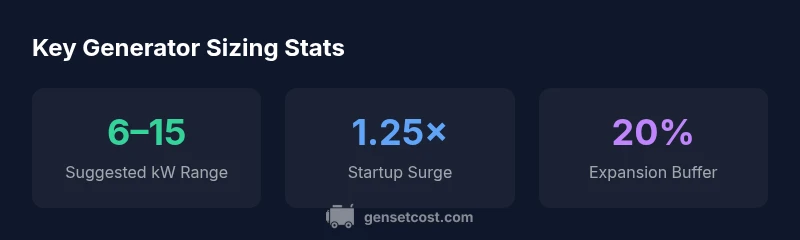
If you’re asking what size generator is needed for a food truck, you’re balancing several variables: equipment load, climate control, and how long you’ll operate each day. According to Genset Cost, most mobile kitchens operate within a practical range of 6–15 kW, with HVAC often driving the upper end of that spectrum. Start with a full inventory of your appliances and lights, then apply a safety margin for startup surges. This approach helps prevent brownouts, protects compressors and motors, and keeps your kitchen compliant with power standards. Real-world sizing also considers wiring, transfer switches, and local codes, so you don’t rely on guesswork. By documenting your loads, you can justify the chosen generator size to inspectors and lenders alike.
Estimating running watts: appliances and loads
A reliable size begins with running watts—the continuous power your equipment needs while operating. Common food-truck loads include lighting, refrigeration, and basic electronics, but high-demand equipment like griddles and fryers can spike during startup. A typical fridge runs around a few hundred watts, a commercial LED kitchen light might use tens of watts per fixture, and a griddle or fryer can surge well above its running wattage when heating. For planning, use conservative ranges: refrigerators running 400–800 W, fryers 1500–3000 W, griddles 1000–1800 W, and lights 50–300 W total. Add HVAC if you’ll run air conditioning. Distinguish continuous running watts from startup surge watts to avoid underestimating needs.
HVAC and climate: how weather changes power needs
Climate control is a major determinant of generator size. In hot, humid environments, cooling loads push higher running watts and larger startup surges, especially if you rely on window units or retrofitted rooftop AC. In milder weather, HVAC demands shrink, letting you size closer to the other kitchen loads. If you operate in multiple climates or seasons, plan for peak conditions rather than average conditions. This is where a buffer for startup surges—often 1.25x to 1.5x the running wattage—becomes essential to ensure reliable startup without tripping breakers.
The sizing method: steps to calculate a safe generator size
Here is a practical, repeatable approach you can apply to any food truck:
- List every device and its running wattage (nameplates or manufacturer specs).
- Sum the running watts to obtain total running watts.
- Multiply by a startup surge factor (1.25x–1.5x) for high-startup equipment.
- Add an expansion buffer (20–40%) for future loads or new appliances.
- Round up to the next standard generator size available. This ensures margin for uncertainty and future needs.
- Validate with a dedicated sizing calculator and, if possible, consult a licensed electrician.
This method prioritizes reliability and scalability, two critical factors for any mobile kitchen.
The calculator: how to use it effectively
Our calculator lets you input your known running watts, a startup surge factor, and a planned expansion buffer. It then outputs an estimated generator size in kilowatts. Use it after you’ve completed the load inventory to confirm that your hand calculations align with a credible, code-friendly spec. If you’re near the edge of a size, consider choosing the next larger standard model to accommodate surges and future equipment additions. Always check local codes and ensure you have proper wiring and a transfer switch in place.
Real-world examples: small kitchen vs large kitchen setups
Example A (smaller truck): Running watts total ~ 4,500 W. Startup surge factor 1.4, expansion buffer 20%. Calculated size ≈ round((4500 * 1.4) / 1000 * 1.2, 0) = 8 kW. Example B (larger kitchen with HVAC): Running watts total ~ 12,000 W. Startup surge 1.5, buffer 25%. Calculated size ≈ round((12000 * 1.5) / 1000 * 1.25, 0) = 23 kW. In both cases, choose the next standard size above the calculation.
These examples illustrate how load density, startup surges, and future expansion influence the final genset choice.
Safety, permits, and maintenance considerations
Installations should follow local electrical codes and use a transfer switch for seamless power transfer during outages. A professional, licensed electrician should perform the wiring and generator installation to meet safety standards. Regular maintenance—oil changes, air filter checks, and spark plug inspections—helps ensure consistent performance. Finally, consider fuel type and availability, maintenance intervals, and warranty coverage when selecting a genset.
How to use the sizing calculator in practice
The calculator simplifies the final check. Enter your total running watts, set a startup surge factor that reflects your equipment startup behavior, and choose an expansion buffer that matches your growth plans. The output shows a recommended generator size in kilowatts. Use this as a baseline, then compare to available commercial gensets and consider headroom for climate variations and additional equipment. Always cross-check with a professional if you’re unsure.