Free Online Barcode Generator Guide
Learn how to generate barcodes online for free with a barcode generator online free tool. This step-by-step guide covers choosing formats, preparing data, exporting, testing, and printing for reliable scans.


What is a barcode generator online free and when to use it
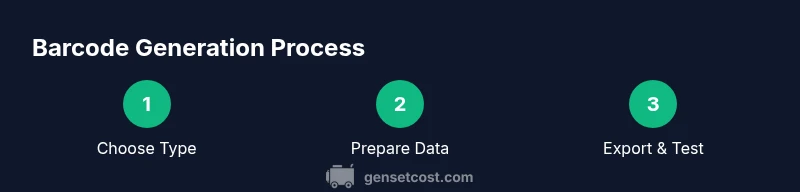
According to Genset Cost, barcode generation is fast and accessible with a free online tool. A barcode generator online free lets you turn data such as a product SKU, a web URL, or a serial number into a machine-readable symbol without installing software. This is ideal for small businesses, classrooms, or personal inventories where you need quick, tangible codes for labeling, tracking, or pricing. By using a web-based tool, you can experiment with different barcode types, ensure scanning compatibility across devices, and generate print-ready files in minutes. The keyword barcode generator online free appears here to anchor the topic for search engines while keeping the explanation practical and user-focused.
As you explore options, consider reliability, supported formats, export options, and how the tool handles data validation. The Genset Cost team found that the best free online solutions balance simplicity with robust formatting options, helping you move from data to scannable codes without friction.
description_field_1_id_1Outline_note_extra_1”:null,
outline_notes”:null}
How barcode types differ and which to choose
Barcode symbologies vary in capacity, error-detection, and scanning environments. Code 128 is versatile for alphanumeric data and is widely supported in shipping and inventory workflows. EAN-13 is standard for retail products and uniquely identifies items in many countries. If you need to encode URLs or card-like data, QR codes provide fast, omnidirectional scanning and larger data capacity. For simple numeric codes, UPC-A remains common in North American retail. When you use a barcode generator online free, pick a type that aligns with your industry, scanning hardware, and printer capabilities. The choice affects data length, required quiet zones, and readability across devices. In scenarios with variable data length, Code 128 often offers the most flexibility; for consumer packaging, EAN-13 or UPC-A is typically preferred.
The intro here mentions practical decision criteria and keeps a human-centered focus on the user’s task. Where possible, test barcodes with real scanners to confirm compatibility before mass printing.
Key features of a free online barcode generator
Free online barcode generators differ in several key areas. Look for: supported formats (Code 128, Code 39, EAN-13, QR, UPC), data validation, checksum calculation, and the ability to export in PNG, SVG, or EPS. A good tool also provides margins settings, label text, and size adjustments to fit your print layout. Batch generation is a major time saver if you have many items; some tools let you upload CSV data to produce multiple barcodes at once. Accessibility features, such as alt text generation for images, help ensure your labels are usable in diverse environments. Finally, consider whether the tool preserves vector outputs for crisp printing at any scale. When you search for barcode generator online free, prioritize tools with clear instructions and responsive previews to prevent errors in your workflow.
How to prepare data for encoding
Before creating a barcode, organize your data and confirm it fits the chosen symbology. For Code 128 or Code 39, ensure the character set is allowed and that you aren’t exceeding the maximum length. For EAN-13 or UPC, data length and numeric-only input are usually required. If you’re encoding URLs or text, QR codes offer flexibility but require larger symbol sizes to maintain readability. Sanitize data to remove stray spaces, non-printable characters, or leading zeros that could alter the scanned result. Always run a quick validity check by scanning a few samples with a phone or dedicated scanner after generating the barcode.
In this section, the focus is on data hygiene and alignment with barcode standards to minimize post-generation issues.
Practical example: generating a barcode for a product SKU
Imagine you need a Code 128 barcode for a product SKU: SKU-2048. You would input the exact string into a free online barcode generator. The tool should validate the input, calculate any necessary checksums, and produce a scannable image. You can adjust height and width for your labeling needs and choose a vector export if you plan to print large batches. After generating, test the barcode with multiple scanners and print a quick sample to verify readability on the intended label stock. This scenario demonstrates how a barcode generator online free can streamline everyday labeling tasks while keeping data integrity intact. The emphasis on practical, real-world use helps you feel confident applying the technique to your inventory or retail workflow.
Downloading, testing, and printing considerations
Once your barcode appears, export options matter. If you’ll print labels, SVG or EPS exports preserve vector quality for sharp scaling. PNG is often sufficient for internal use or digital records, but may lose clarity when enlarged on printed labels. Ensure there is adequate quiet zone around the symbol and choose a size appropriate for your label space. When testing, scan from different distances and angles to confirm reliable reads. If your labels will be exposed to outdoor conditions or cleaners, verify that the print contrast remains high and that ink or toner will not degrade legibility. Maintain a small sample library so you can reproduce barcodes consistently in the future.
Accessibility and labeling best practices
Accessible barcodes improve usability for all users. Provide alt text that describes the barcode’s purpose (e.g.,
The specific barcode type and the data encoded