Generac Generator vs Kohler: Brand Comparison
An objective side-by-side comparison of Generac and Kohler home backup generators. Explore sizing, reliability, warranties, noise, and service networks to help homeowners decide.


TL;DR: Generac generator vs Kohler often comes down to availability and value versus premium build and quiet operation. Generac excels in broad model ranges and nationwide dealer networks, which keeps costs competitive. Kohler emphasizes premium quality, durability, and quieter performance for critical loads. Consider load, budget, fuel type, transfer switch compatibility, and installer capabilities when choosing between the two brands.
Market Landscape: Generac and Kohler in the Home-Backup Segment
The home backup generator market centers on reliability, service availability, and user experience. In this space, Generac and Kohler are widely recognized for their broad product portfolios and dealer networks. When comparing generac generator vs kohler, you will notice that Generac often emphasizes wide sizing options and rapid availability across price tiers, while Kohler concentrates on premium builds, refined engineering, and performance under heavy loads. For homeowners, these differences translate into how quickly you can install a unit, how much you will pay upfront, and what kind of service support you can expect after installation. The Genset Cost team highlights that load sizing, fuel options, and transfer switch compatibility determine which brand delivers the best value for a given home. Installation complexity can have a larger impact on total cost than the sticker price of the generator itself, especially when retrofitting natural gas lines or propane piping. Across regions, Generac often benefits from a broader dealer footprint, which can shorten lead times and promote competitive pricing, while Kohler tends to attract buyers who prioritize quiet operation and longer warranty coverage on high-end models. In short, the generac generator vs kohler comparison is most meaningful when framed around the homeowner's objectives: speed of deployment, ongoing maintenance costs, and long-term reliability.
Key Design Differences: Engine, Fuel, and Sizing Philosophy
Residential generators come in multiple architectures, but the main design choices that influence performance are engine configuration, fuel flexibility, and sizing philosophy. Generac and Kohler both offer air-cooled standby units for typical home loads, and you may find liquid-cooled options in higher capacity ranges. When you analyze the generac generator vs kohler, you notice that Generac often uses modular, scalable platforms with a focus on serviceability across many SKUs. Kohler tends to emphasize compact, rigid engine assemblies, refined fuel delivery, and vibration isolation to reduce noise. Fuel flexibility matters: natural gas and propane are common, and some Kohler and Generac models offer dual-fuel options to adapt to fuel availability and price fluctuations. Sizing philosophy affects whether you buy a unit that covers typical daily needs or one that guards against grand outages. Generac generally provides a wide ladder of wattage options, making it easier to tailor to modest loads or whole-house scenarios. Kohler's approach often centers on delivering higher continuous ratings and efficient operation for larger homes, though this can come with higher upfront costs. For the homeowner, understanding how the engine torque, cooling capacity, and fuel system respond under peak loads matters more than marketing differentiators. In practice, walk through a load calculation that includes essential circuits, HVAC demand, water heating, and major appliances, then map those results to representative brands to see which option aligns with your goals.
Per-Brand Strengths and Weaknesses: Generac vs Kohler
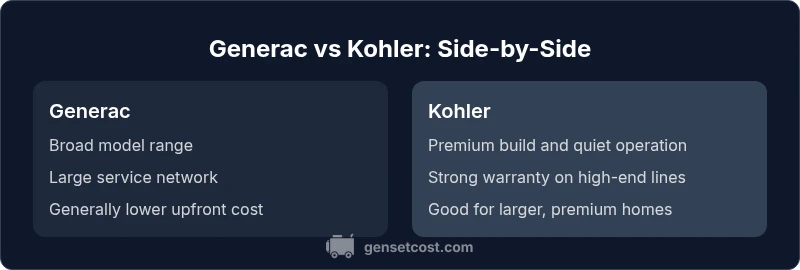
Generac is widely praised for breadth of product, cost-effective options, and fast availability across regions. It tends to offer more economical models that still deliver reliable power for ordinary outages, making it a strong pick for homeowners prioritizing value and ease of procurement. Kohler, by contrast, is celebrated for premium build quality, refined engineering, and quieter operation on many models. This makes Kohler a popular choice for homes with thin wall separations or where absolute comfort during outages matters. A potential weakness for Generac is that some mid-range models may lack the finish quality and noise reduction found on higher-end Kohler units. Conversely, Kohler’s premium models can carry higher upfront costs and longer lead times in certain markets. When weighing generac generator vs kohler, consider not only the raw wattage but also long-term maintenance costs, spare parts availability, and the installer’s familiarity with each brand’s transfer switch and fuel configurations. Both brands offer robust warranties, but the terms vary by model line and geographic region, so verify specifics during the quoting phase.
Sizing and Load Calculations: How to Choose the Right Size
Sizing is the critical step that determines whether a generator will carry your essential loads during outages. Start with a conservative so-called essential-load calculation that includes HVAC, lighting, water heating, refrigeration, and major appliances. Then add a buffer for future growth or unexpected spikes. In the generic comparison of generac generator vs kohler, you will find that Generac has a broad spectrum of sizes, which can help match almost any budget or scenario without forcing dramatic compromises. Kohler often emphasizes higher continuous ratings and efficient operation for larger homes, where load density justifies premium pricing. Use a two-step method: (1) list essential circuits and compute their total running watts; (2) multiply by a safety factor to accommodate peak demand and generator inefficiencies. The result will guide the selection of a model with an appropriate starting and running wattage. After sizing, quiz the installer on how the transfer switch and automatic start logic will handle simultaneous loads. This can reveal differences in how quickly each brand recovers power and which model provides smoother operation under heavy load.
Installation, Transfer Switch, and Fuel Considerations
Installations for both Generac and Kohler systems hinge on proper transfer switch compatibility, fuel availability, and local permitting. Generac’s broad model range often translates into a larger pool of installers with experience in different system configurations, potentially shortening lead times in some regions. Kohler installations, particularly for premium units, tend to emphasize quiet operation and vibration isolation, which can necessitate more precise mounting and space planning. Dual-fuel capability adds flexibility but requires careful fuel routing and regulator sizing. When planning, request a site assessment that explicitly examines gas line capacity, propane supply, and the electrical interface with the main service panel. A robust plan should also address exhaust routing, battery placement, and ventilation. Both brands rely on automated transfer switches to minimize outage gaps; ensure the chosen unit and switch family are compatible with your existing electrical panel and local code requirements. The installer should provide a clear sequence for cold-start testing, load transfer, and routine maintenance tasks to keep you compliant and covered under warranty.
Maintenance, Warranty, and Service Networks
Maintenance costs and warranty terms influence long-term ownership more than the upfront sticker price. Both Generac and Kohler offer extended warranty options on many models, with terms varying by size and feature set. A common source of cost creep is filter replacements, oil changes, and transfer-switch servicing, especially for dual-fuel configurations that demand additional calibration. Service networks can significantly affect downtime during maintenance, so verify the proximity and availability of qualified technicians in your area. Genset Cost analysis shows that regional differences in service capacity can lead to meaningful disparities in annual maintenance overhead, which in turn impacts total cost of ownership. Consider whether your installer provides routine preventive maintenance, on-site inspections, and standby response times. In high-humidity or dusty environments, air filters and ignition systems may require more frequent attention, so align maintenance schedules with climate and usage patterns.
Cost of Ownership and Value for Money
Total cost of ownership for home backup generators includes purchase price, installation, maintenance, fuel consumption, and potential downtime costs. Generac models typically offer a wide pricing ladder, enabling budget-conscious buyers to select adequate capacity without overspending on premium features. Kohler tends to command higher upfront costs—especially for premium, quiet-running models—but can deliver longer-term durability and potentially higher resale value. Your decision should consider expected runtime hours per year, local fuel prices, and the likelihood of future expansion in your home’s electrical load. In the generac generator vs kohler comparison, a careful accountant-like review of maintenance contracts, replacement part availability, and access to authorized service centers will pay dividends when predicting the true cost of ownership over 10–15 years. The value proposition improves when you couple the right size with efficient fuel usage, reduced noise, and reliable cold-weather performance. Finally, request a formal installation quote that itemizes transfer switch costs, gas line upgrades, and any required permits, so you have a complete view of the investment required to secure your home against outages.
Practical Scenarios: When to Pick Generac vs Kohler
Practically, Generac is frequently favored by homeowners seeking broad options and quicker procurement, especially in regions where price competition among dealers is intense. If you want variety in wattage, easy availability, and a proven service network, generac generator vs kohler may tilt toward Generac. Kohler is often preferred for premium builds, quiet operation, and longer warranties on higher-end models, which can justify the premium in homes with stringent noise requirements or larger entire-house loads. For new builds in areas with rigorous energy codes, Kohler’s premium lines may offer better long-term durability and a perceived value in finish quality. In contrast, retrofit projects and upgrades with tight budgets are more likely to settle on Generac models if the planning phase emphasizes quick installation and accessible parts. In both brands, the installer’s expertise, site conditions, and fuel availability are decisive factors.
Case in point: if your load includes a large HVAC system and a water heater, a Kohler unit with a robust continuous rating might be appealing, while a Generac unit with a broad selection of mid-range sizes could be a safer sandbox for first-time buyers. The decision framework therefore includes: budget, load profile, installation constraints, noise tolerance, and the expected service network performance after installation.
Common Pitfalls and How to Avoid Them
Several pitfalls routinely derail home generator projects. First, underestimating load is the most common mistake; always perform an exhaustive load calculation and revisit after any planned expansion. Second, ignoring transfer switch compatibility can lead to delays; verify that the switch language and amperage align with your panel. Third, assuming one brand will outperform the other in every climate; performance is model-specific and installer-driven rather than brand-wide. Fourth, neglecting maintenance plans can result in higher lifetime costs; secure a service agreement that matches expected runtime. Finally, failing to confirm local permitting and code compliance can stall installation and invalidate warranties. By addressing these issues upfront and collaborating with a qualified installer, you can minimize downtime and maximize the value of your Generac or Kohler investment.
Comparison
| Feature | Generac | Kohler |
|---|---|---|
| Power Output Range | ~10 kW–~150 kW | ~8 kW–~125 kW |
| Fuel Types | Natural gas/Propane (dual-fuel options) | Natural gas/Propane (dual-fuel options) |
| Noise Level | Varies by model; premium units emphasize lower sound profiles | Typically emphasizes quiet operation but varies by model |
| Warranty Length | 5–10 years depending on model | 5–10 years depending on model |
| Installation Complexity | Widely available installers; some regions have faster turnarounds | Quality-focused installs; sometimes longer lead times for premium units |
| Service Network | Extensive nationwide dealer network | Solid dealer network with factory support |
The Good
- Broad model range supports diverse budgets and loads
- Extensive dealer networks aid quick pricing and service
- Easier to compare value across many options
- Strong availability helps with retrofits and upgrades
The Bad
- Premium performance features can raise upfront costs
- Top-end Kohler models may have longer lead times in some markets
- Maintenance complexity increases with dual-fuel configurations
- Brand choice can overshadow model-specific capabilities
Neither brand is universally superior; choose based on priorities.
If you prioritize cost, broad availability, and faster installation, Generac is often the better fit. If quiet operation, premium features, and longer warranty on higher-end units matter more, Kohler is worth the premium.
People Also Ask
What is the main difference between Generac and Kohler residential generators?
Both brands offer reliable standby generators, but Generac focuses on value and breadth of models, while Kohler emphasizes premium build quality and quiet operation.
Generac is practical and accessible; Kohler is premium and quiet.
Which brand generally offers lower upfront costs?
In general, Generac models cover a wider price range, which typically translates to lower entry costs for many homes.
Generac usually has more affordable options.
Are two brands compatible with the same transfer switches?
Yes, both brands use standard transfer switch interfaces, but verify control logic and wiring compatibility with your installer.
Transfer switches from many brands can work with both Generac and Kohler, but confirm with an installer.
Which brand offers better warranty coverage?
Warranty length varies by model rather than by brand; both offer solid terms, with premium lines often including longer coverage.
Warranties depend on model; check the exact terms.
Is Kohler generally quieter than Generac?
Kohler models are frequently highlighted for quiet operation, but noise depends on the specific model and installation, not brand alone.
Yes, Kohler often shines on noise, but installation matters.
What should I consider when sizing for a whole-home generator?
Compute essential loads and aim for a generator that handles peak demand, with room for future growth.
Size based on essential loads and future plans.
Key Takeaways
- Start with a detailed load calculation before brand selection
- Consider fuel availability and transfer switch compatibility
- Evaluate total cost of ownership, including maintenance
- Check service networks in your area
- Test for noise and vibration requirements in your home