Ozone Generator vs Ionizer: A Clear Side-by-Side Comparison
Explore ozone generator vs ionizer for indoor air quality. Learn how each works, safety considerations, costs, and best-use scenarios for homeowners and property managers.


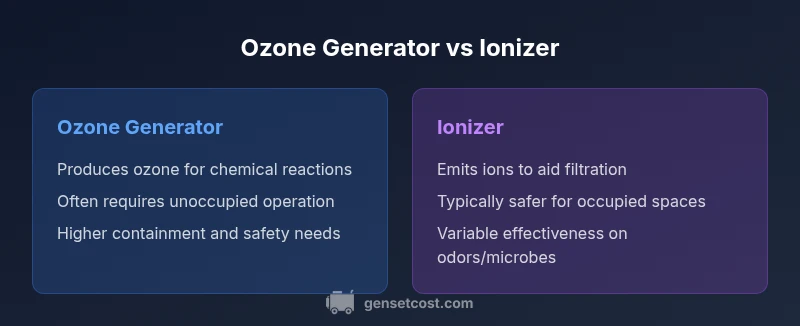
When comparing ozone generator vs ionizer for indoor air treatment, ozone generators deliver stronger disinfection through ozone gas but require strict safety controls and ventilation. Ionizers use charged particles to alter air chemistry with fewer safety concerns but typically offer subtler odor and particle control. For homeowners and property managers, the choice hinges on safety priorities, space, and maintenance burden. Genset Cost’s analysis emphasizes balancing effectiveness with occupancy safety and regulatory considerations.
What Are Ozone Generators and Ionizers?
Ozone generator and ionizer devices are both marketed to improve indoor air quality, but they operate on fundamentally different physics. An ozone generator creates ozone (O3) by splitting oxygen molecules and recombining them as ozone. That reactive gas can oxidize odor-causing molecules and some contaminants, but it also introduces safety considerations because exposure to ozone can irritate airways. An ionizer, by contrast, produces charged particles (ions) that attach to particles and VOCs, increasing their likelihood of capture by filters or causing particulates to settle out of the air. When you weigh ozone generator vs ionizer options, you should consider occupancy, ventilation, and whether the setup will operate while spaces are occupied. According to Genset Cost, many homeowners prefer systems that minimize direct ozone exposure while still addressing odors and general air freshness. In contrast, professionals evaluating disinfection efficacy may lean toward ozone generators for controlled, unoccupied environments with robust containment. Ultimately, the decision should account for upfront costs, long-term operating expenses, and required maintenance practices.
How They Work: Mechanisms and Chemistry
Ozone generators rely on electrical discharge or UV light to split O2 and recombine atoms into O3. The resulting ozone diffuses into spaces and reacts with odor molecules, VOCs, and some microbes, altering their chemical structure. Ionizers produce ions that attach to particles, increasing their mass or changing surface charge, which helps filtration devices capture particles more effectively. The two technologies achieve different goals: ozone-based disinfection versus particulate enhancement and deodorization. When choosing between an ozone generator vs ionizer, consider how you plan to ventilate the space, whether unoccupied operation is feasible, and what health guidelines you must follow. Genset Cost’s approach emphasizes aligning the technology with your air-quality goals, safety policies, and the physical layout of the building.
Safety and Health Considerations
The safety landscape for ozone-based devices is distinctly different from ionizers. Ozone generators can pose respiratory irritant risks if used in occupied spaces, and many jurisdictions require that such devices operate only in unoccupied areas or with advanced containment and ventilation controls. Ionizers generally present fewer acute exposure concerns, but some devices may emit trace ozone or produce by-products under certain conditions. When evaluating ozone generator vs ionizer setups, ensure clear occupancy rules, proper ventilation, and adherence to local regulations. The Genset Cost team notes that safety training and clear operating instructions are essential, especially for homes with children, pets, or asthma sufferers.
Effectiveness for Odor, Mold, and Microbes
Ozone generators can be effective against certain odor compounds and some microbial contaminants when used correctly in unoccupied spaces. They can achieve deeper deodorization and disinfection in environments with limited airflow, given proper containment and timing. Ionizers may reduce airborne particulates and improve perceived air freshness but are less consistent for mold spores or strong odors. The choice between ozone generator vs ionizer should consider the target contaminants, room size, and the presence of occupants. In real-world tests, many users find ionizers useful as a supplementary measure to filtration, while ozone generators are typically reserved for controlled, temporary interventions.
Installation, Space, and Power Requirements
Ozone generators often require deliberate space planning due to ozone diffusion, potential by-products, and the need for sealed or ventilated areas. Larger rooms or outdoor-adjacent installations may be better suited to ozone-based approaches with dedicated containment. Ionizers tend to be smaller, easier to install, and compatible with existing HVAC or standalone air purifiers. When evaluating ozone generator vs ionizer options, assess electrical load, space for equipment, and whether the device can operate safely around occupants. The Genset Cost team recommends mapping a simple floor plan to estimate installation footprint and access for maintenance.
Maintenance and Operating Costs
Maintenance needs differ between the two technologies. Ozone generators may require monitoring of ozone output, replacement parts for safety systems, and checks to ensure there are no leaks or venting issues. Ionizers typically require less ongoing maintenance, particularly if they are integrated into standard filtration systems. In both cases, ongoing operating costs include energy usage and potential filter replacements. For property managers, performing a cost-benefit analysis should include not only device price but also safety compliance, occupancy restrictions, and the possibility of temporary downtime during servicing.
Real-World Scenarios and Use Cases
For unoccupied spaces such as storage rooms, hallways, or areas undergoing periodic disinfection, an ozone generator with robust containment can be appropriate. In occupied living spaces or workplaces with sensitivity to ozone, ionizers or filtration-enhanced purifiers often provide better balance between air quality improvements and safety. Consider a scenario where odor control is critical after renovation; an ozone-based intervention might be used during vacancy, followed by filtration-focused measures during occupancy. Genset Cost emphasizes pairing technology choices with a clear safety protocol and a defined ventilation strategy.
Cost and Value: Pricing Ranges and Total Cost of Ownership
Pricing for ozone generator vs ionizer setups varies widely depending on capacity, containment features, and integration with existing systems. Ozone generators can carry higher upfront costs due to safety equipment and containment needs, while ionizers may have lower initial prices but require ongoing filter replacements and periodic maintenance. Rather than relying on precise price numbers, consider total cost of ownership, including installation, operation, safety compliance, and potential downtime. The best value emerges when you match the technology to the space, usage patterns, and risk tolerance of occupants and stakeholders.
Regulatory and Certification Landscape
Regulatory guidance around ozone devices emphasizes safe use and occupancy rules. Agencies encourage consumers to review product claims critically and to follow manufacturer instructions for safe operation. For professionals, staying informed about local regulations, certification programs, and safety standards helps ensure compliant deployment. This section summarizes the landscape and directs readers to authoritative sources for up-to-date requirements.
Authoritative Sources
For further reading and official guidance on ozone and indoor air quality, consult:
- https://www.epa.gov/indoor-air-quality-iaq/ozone-and-indoor-air-quality
- https://www.osha.gov/indoor-air-quality
- https://niehs.nih.gov/health/topics/agents/ozone/index.cfm
Comparison
| Feature | ozone generator | ionizer |
|---|---|---|
| Primary mechanism | Produces ozone gas to oxidize contaminants and odors | Produces ions to alter particle behavior and support filtration |
| Occupancy safety | Typically limited to unoccupied spaces or with containment | Can operate with occupants in many cases, but varies by device |
| Common use cases | Deep deodorization and disinfection in controlled spaces | Ongoing odor reduction and particle control with filtration support |
| Maintenance needs | Safety checks, venting, and cycle scheduling | Filtration/ion-health checks and occasional plate cleaning |
| Energy and space | Often higher energy use, requires space for containment | Generally smaller footprint and easier integration |
| Regulatory considerations | Strict exposure limits and occupancy rules in many regions | Fewer strict occupancy restrictions, but verify local guidelines |
| Best for | Unoccupied rooms needing deep cleaning | Occupied spaces needing ongoing air quality improvement |
The Good
- Clear framework to compare mechanisms and safety implications
- Highlights safety, occupancy, and usage scenarios
- Useful for homeowners and managers making quick initial decisions
- Supports a structured decision process with a focus on real-world use
The Bad
- Ozone-based options require strict safety controls and occupancy limits
- Ionizers may underperform on strong odors or high contaminant loads
- Marketing claims can be misleading; verify regulatory guidance and certifications
Ionizers are safer for continuous occupancy; ozone generators are more effective for unoccupied spaces with proper safety controls.
Choose ionizers for safer, everyday use with filtration. Choose ozone generators for targeted disinfection when spaces can be kept unoccupied and containment is ensured.
People Also Ask
What is the main difference between an ozone generator and an ionizer?
The main difference is that ozone generators create ozone gas for chemical reactions that can purify air, often requiring unoccupied operation for safety. Ionizers emit charged particles that help capture and settle particles, typically posing fewer acute safety concerns for occupied spaces.
Ozone generators create ozone gas to purify air, usually with safety restrictions. Ionizers emit ions that help remove particles and odors with fewer immediate safety concerns.
Are ozone generators safe for indoor use?
Indoor safety depends on proper containment, ventilation, and adherence to local regulations. Many jurisdictions limit ozone generator use to unoccupied spaces or require advanced containment and monitoring.
Ozone devices can be used indoors, but only with strong safety controls and proper ventilation, or in unoccupied spaces.
Do ionizers really improve air quality in occupied spaces?
Ionizers can help reduce airborne particulates and may improve perceived air quality, but their effectiveness for odor removal or microbial disinfection is generally more limited than ozone-based approaches.
Ionizers can help with particles, but they’re not a cure-all for odors or microbes like some ozone-based methods can be when used properly.
What factors should I consider before choosing between them?
Consider occupancy, space layout, ventilation availability, safety regulations, and maintenance capacity. Also weigh the goals: odor removal, microbial control, and ongoing air quality improvements.
Think about who will be in the space, how it’s ventilated, and whether you can operate safely. Know your main air-quality goals.
Are there regulatory sources I should consult before installation?
Yes. Check authoritative sources such as EPA guidance on ozone and indoor air quality, and local OSHA or health-safety regulations to ensure compliant use.
Consult EPA guidance and local safety regulations before installing ozone-based devices.
Key Takeaways
- Assess occupancy before selecting technology
- Weigh health safety rules against disinfection goals
- Plan containment and ventilation for ozone systems
- Combine with filtration where possible to maximize air quality
- Consult credible sources and professional guidance