12-Character Password Generator: A Practical How-To
Learn to generate a secure 12-character password with trusted tools, understand entropy, and store passwords safely. This practical guide covers steps, best practices, and common pitfalls for stronger online security.


You will learn how to generate a password that is exactly 12 characters long using a trusted password generator, choose robust character sets, ensure strong randomness, and store the result securely. This quick-start guide covers the key steps and best practices to improve account security with a 12-character password. By the end, you’ll be able to generate a compliant password, apply safe storage, and recognize red flags from unreliable tools.
Why password generator 12 characters matters for security
In today’s digital landscape, a password generator 12 characters long is a practical standard for balancing memorability with robust security. You don’t need an ultra-long password to achieve strong protection, but 12 characters provide enough combinations when combined with a diverse character set and proper handling. A password generator that outputs exactly 12 characters helps ensure consistency across accounts and reduces the temptation to reuse weaker phrases. For any homeowner or property manager, this length offers a workable baseline for protecting sensitive systems, from online banking to home automation dashboards. The keyword phrase password generator 12 characters appears several times in the industry because it captures the sweet spot between user convenience and cryptographic strength. When you craft a password of this length using a reputable generator, you gain a defensible barrier against common attack methods like brute force and credential stuffing. The Genset Cost team notes that password hygiene is a critical, often overlooked part of modern security, especially for devices connected to home networks and smart devices. By adopting a 12-character standard, you align with best practices for password management and incident resilience.
How a password generator 12 characters works
Password generators rely on cryptographically strong randomness to produce strings that are hard to predict. At a high level, you pick a length (12 characters) and choose character sets (uppercase, lowercase, digits, symbols). The generator then draws random symbols from those sets to create a password that meets the length requirement. Reputable tools use a secure source of randomness and avoid reusing previous outputs. The exact mechanism may vary by tool, but the core concept is entropy: more possible combinations mean higher resistance to guessing. For a 12-character password, the entropy increases with each added character and with the diversity of character types. Effective generators also guard against predictable patterns, such as sequential numbers or repeated characters. In practice, you should verify that the generator does not log your input and that it outputs only a single password per request. This is a cornerstone of implementing password security in a home network environment, where simple mistakes can open doors to intruders.
Character sets: building blocks for a strong 12-character password
A robust 12-character password leverages a mix of character types: uppercase letters, lowercase letters, digits, and symbols. Using only letters or digits reduces entropy and makes brute-force attacks more feasible. A strong password generator allows you to toggle each set on or off, but for maximum strength you should enable all four. However, avoid ambiguous characters (like O, 0, l, 1) if you struggle with readability; instead, rely on a manager’s autofill to apply the exact symbol set you want. Consider policy requirements (some sites disallow certain symbols) and adjust accordingly. For 12 characters, aim for a distribution that prevents recognizable patterns. A practical approach is to use at least 4-5 characters from each subset where possible, ensuring the total length hits 12 while maintaining randomness. This variety is essential for resilience against targeted phishing and credential stuffing attempts.
Entropy and randomness: what makes a 12-character password strong
Entropy is a measure of unpredictability. In password security, higher entropy translates to a larger search space for an attacker. A 12-character password that uses all four character types yields substantially more entropy than a 12-character password made only of letters. Cryptographically strong generators rely on sources of randomness that are not easily guessed or reproduced. The recommended practice is to use true random or cryptographically secure pseudorandom number generators (CSPRNGs) rather than predictable PRNGs. While no password is completely unbreakable, increasing length and complexity dramatically raises the work factor for attackers. In practical terms, that means a 12-character password with diverse characters is usually enough to guard against casual threats and many automated attack scripts when combined with good account hygiene.
Safe usage and storage: integrating with password managers
Generating a strong 12-character password is only half the battle; the other half is safe storage and proper usage. Store each unique password in a reputable password manager rather than writing it down or reusing it across accounts. Modern managers offer autofill, cross-device sync, and secure vaults protected by a master password and two-factor authentication. When you copy from a generator, ensure there are no trailing spaces or hidden characters that can cause login failures. If you must transcribe, verify the password exactly as shown. Avoid lighting up screens with sensitive data in public, and consider enabling clipboard clear after a short interval if your manager supports it. These practices reduce the risk of shoulder-surfing and clipboard-exposure, which are common vectors for credential theft in smart homes.
Common myths about password length and security
Many people believe longer is always better. While length is important, quality of character sets and randomness matter more in practice. A 12-character password created from a bad generator or one that logs your input may be just as risky as a 10-character password created by a strong tool. Another myth is that using a single dashboard password is safe if it’s long enough; in reality, attackers target reused credentials across sites. Some users think symbols are always necessary; in restrictive environments (certain sites block certain characters), you may need to adapt while maintaining sufficient entropy. Finally, some assume password managers are optional; in truth, they are the best defense against password fatigue and account compromise.
Step-by-step: generate and store a 12-character password
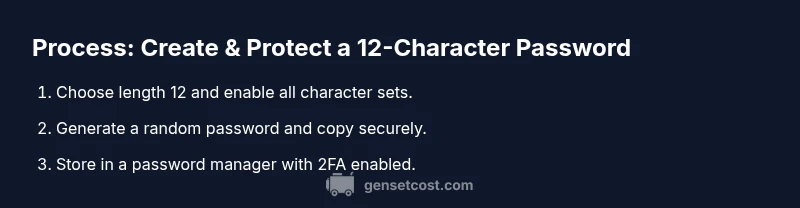
The following steps describe a practical workflow you can follow today to create and protect a 12-character password. This is written in plain language so you can adapt it to your preferred tools while maintaining security. Step 1: Open a trusted password generator and choose length 12. Step 2: Select character sets (uppercase, lowercase, digits, symbols) and verify the combined diversity. Step 3: Generate and copy the password, ensuring no extra spaces. Step 4: Open your password manager and add a new entry for the target site, pasting the password into the password field. Step 5: Enable two-factor authentication on the account where possible. Step 6: Test login and monitor for unusual activity. Step 7: Review the password on a regular schedule and rotate if a breach occurs. Tip: If you’re new to password managers, start with a guided setup and enable biometric unlock where available.
Best practices for cross-device usage
For homeowners and property managers, access to critical accounts from multiple devices is common. Use a password manager that supports multi-device syncing and end-to-end encryption. Never rely on browser-only storage for long-term security; devices may be compromised or lost. When using a password generator 12 characters across devices, ensure you have device-level security, such as passcodes, biometrics, and up-to-date OS patches. Consider enabling device-based two-factor authentication (FIDO2 security keys are ideal) for additional protection. Regularly audit saved passwords and remove unused entries. Finally, train household members to recognize phishing attempts, since strong passwords are only one layer of defense.
Troubleshooting edge cases and accessibility considerations
If you encounter login issues after generating a 12-character password, first verify the exact string with the password manager’s copy feature. Some sites have password policies that prevent certain characters; you may need to adjust the symbol set accordingly. Accessibility matters include readable character sets and avoiding characters that cause confusion (like 0/O, l/1). If you rely on screen readers, ensure your password manager’s interface exposes unique, pronounceable identifiers. Finally, maintain backups of your vault and enable recovery options with trusted contacts or secondary email addresses to prevent lockouts after device loss.
Tools & Materials
- Computer or mobile device with internet access(Use a modern browser; ensure time is synchronized for cryptographic functions)
- Password manager app or service(Enable master password and 2FA; supports autofill across devices)
- Trusted password generator tool(Use official sources; avoid extensions with unknown provenance)
- Clipboard hygiene tool (optional)(Clear clipboard after use if supported by the app)
Steps
Estimated time: 15-20 minutes
- 1
Open a trusted password generator
Navigate to a reputable password generator tool and verify the site is legitimate (look for HTTPS and a recognizable domain). This ensures your input isn’t logged or exposed.
Tip: Check for a privacy policy and ensure the site does not retain your generated password. - 2
Set length to 12 and enable character sets
Choose length 12 and turn on uppercase, lowercase, digits, and symbols. Avoid turning off any set if you need maximum entropy, but respect site policies.
Tip: If some sites block certain symbols, note the alternatives before generating. - 3
Generate and copy securely
Click generate and copy the password to a secure location. Avoid saving to clipboard for long periods in public spaces.
Tip: Verify there are no trailing spaces or hidden characters after copying. - 4
Store in a password manager
Create a new entry for the site and paste the password into the password field. Add related login info and tags for easy retrieval.
Tip: Use a strong master password and enable 2FA for the manager. - 5
Enable two-factor authentication
Whenever possible, enable 2FA on the target account to add a second layer of defense beyond the password.
Tip: Prefer hardware keys (FIDO2) when available. - 6
Test login and monitor
Attempt login with the new password and monitor for any unusual activity or login alerts from your provider.
Tip: If login fails, re-copy the password and retry; ensure the correct site URL is used.
People Also Ask
What is a password generator 12 characters?
A password generator 12 characters creates a password exactly twelve characters long using a mix of character types. It aims to maximize entropy while staying usable. Using a trusted tool helps ensure randomness and avoids predictable patterns.
A password generator twelve characters long produces a strong, random password with a mix of character types.
Why is 12 characters a common recommendation?
Twelve characters generally provide enough combinations to resist common online attacks when combined with diverse character sets. It balances security and memorability for most users.
Twelve characters strike a practical balance between security and usability.
Should I always use symbols?
Symbols improve entropy but some sites block certain characters. In such cases, ensure you still include a mix of uppercase, lowercase, and digits to maintain strength.
Symbols boost strength, but if a site blocks them, keep a strong mix of other characters.
Can I reuse passwords across sites if I use 12 characters?
No. Reusing passwords across sites dramatically increases risk if any one site is breached. Treat every account as unique and store its password separately.
No, you should never reuse passwords, even if they’re long.
How should I store a generated password securely?
Use a reputable password manager with a strong master password and 2FA. Avoid writing passwords in plain text or storing them in insecure notes.
Keep passwords in a trusted manager with strong protections.
What if I forget my password manager master password?
Most managers offer recovery options or trusted contact methods. Enable backup options and never rely on a single insecure recovery method.
If you forget it, use the manager’s recovery options and trusted backups.
Watch Video
Key Takeaways
- Use a trusted tool to generate 12-character passwords.
- Mix upper, lower, digits, and symbols.
- Store securely in a password manager.
- Never reuse passwords across accounts.
- Rotate critical passwords periodically.