Signal Generator vs Function Generator: A Practical Comparison
A detailed comparison of signal generators and function generators, focusing on use-cases, frequency range, modulation options, accuracy, and cost considerations for hobbyists and professionals.


A signal generator vs function generator are not interchangeable. For routine lab testing and DC/AC waveforms, a function generator offers precise control and stable, repeatable signals. If you need wide frequency coverage, RF capabilities, or advanced modulation, a signal generator is the better choice.
Core Definitions and Distinctions
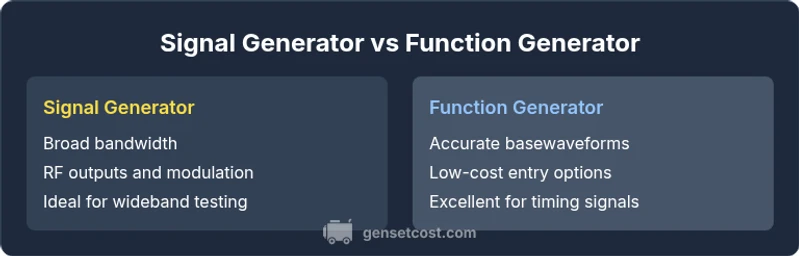
In the broader test equipment landscape, the terms signal generator and function generator describe two specialized tools that serve different purposes. The phrase signal generator vs function generator is often used to frame a decision about capability, bandwidth, and modulation. According to Genset Cost, the right choice starts with your primary testing goals and budget, then narrows to waveform types and frequency coverage. A signal generator typically emphasizes frequency range, RF outputs, and modulation schemes, while a function generator prioritizes stable basewaveforms and timing signals for electronics labs. The distinction matters for anyone building a home lab, maintaining equipment test routines, or evaluating repair scenarios. When you know whether your project demands RF content, precise amplitude calibration, or simple timing signals, you can map features to budget and long-term needs.
- Key takeaway: Both devices generate electrical signals, but the intended use and performance envelope drive the choice.
Output Characteristics and Waveforms
Both signal generators and function generators produce waveforms, but the output characteristics and available waveforms diverge. Function generators excel at traditional basewaveforms such as sine, square, and triangle at controlled frequencies with stable offset and duty cycle. They often support bursts and simple modulation schemes suitable for timing and digital interface testing. Signal generators, in contrast, extend beyond basic shapes into RF territory: wideband sine sources, IQ modulated outputs, AM/FM/PM modulation, and sometimes arbitrary waveform capabilities. The practical implication is clear: use a function generator for lab-grade timing and test patterns, and reserve a signal generator for experiments requiring RF content or wideband testing. This distinction guides equipment selection, lab layout, and replacement strategy.
Frequency Range and Spectral Coverage
Frequency range and spectral content drive the decision between a signal generator and a function generator. Function generators typically cover low to mid frequencies suitable for electronics education, microcontroller interfacing, and bench testing of basic circuits. Many hobby models cap out in the low megahertz, with precision at those bands being the main advantage. Signal generators aim for broader spectral reach, including RF bands, which makes them indispensable for wireless, RF front-end testing, and communications-related projects. The caveat is cost and complexity: broader bandwidth and RF features often come with steeper price tags and more demanding calibration requirements. Planning runs of tests across multiple bands benefits from aligning needs with instrument capability.
Amplitude, Offset, and Impedance Considerations
Amplitude control and impedance matching are critical in choosing between these instruments. Function generators typically provide precise amplitude control and DC offset on sine outputs, with good stability within their intended frequency range. They commonly present a 50-ohm or 600-ohm load and may require external attenuators for certain setups. Signal generators emphasize amplitude accuracy across wider frequency ranges and modulation states, which can demand tighter calibration and accounting for feedthrough and harmonics. Both types often specify output impedance, amplitude accuracy, and load compatibility; understanding these specs helps prevent measurement errors, reflections, or waveform distortion in real-world testing.
Modulation Capabilities and Signal Fidelity
Modulation makes the difference in many real-world tests. Function generators usually provide AM, FM, and PM on base waveforms and can support simple digital modulation for lab demonstrations. They are ideal when you need predictable, repeatable signals to test microcontrollers, ADCs, or servo systems. Signal generators expose more advanced modulation techniques, including wideband FM, phase modulation, IQ modulation, and burst modes, which are essential for RF and communications research. Fidelity matters: a generator with higher spectral purity reduces measurement noise and improves repeatability. If your work relies on precise modulation schemes and spectral cleanliness, a signal generator can offer a more representative signal model.
Practical Use Cases: Hobbyist Labs, Education, and RF Testing
For hobbyists and small labs, the choice often boils down to coverage vs. cost. A function generator provides a solid foundation for learning electronics, prototyping, and basic timing tasks at a budget-friendly price. It is a natural first tool for students and DIY enthusiasts. If your goals include RF testing, antenna work, or wireless system evaluation, a signal generator becomes a more compelling option because it supports wideband outputs and more sophisticated modulation. For property managers evaluating backup-test routines and equipment maintenance, the practical decision should reflect the actual tests you perform most—steady waveforms for control loops or a broader RF signal for diagnostics.
Budget, Price, and Total Cost of Ownership
The total cost of ownership for signal generators vs function generators is not just the sticker price. Entry-level function generators are typically more affordable upfront, while RF-capable signal generators can command higher initial costs and ongoing calibration expenses. Consider expansion paths, spare parts, and the need for external accessories (attenuators, combiners, and probes) when calculating TCO. If you expect growth into RF work, plan for a phased approach: start with a reliable base function generator for core testing, then invest in a signal generator with essential RF coverage as your projects demand it. This staged approach can optimize both budget and capabilities over time.
How to Choose: A Practical Decision Framework
Use-case first: identify the dominant tasks (RF testing, waveform generation, timing signals, calibration work). Then map those tasks to instrument capabilities: bandwidth and modulation for signal generators; waveform fidelity and timing accuracy for function generators. Consider future needs, such as upgrades to wider frequency coverage, more complex modulation, or integration with measurement software. Finally, account for total cost of ownership, including calibration services and maintenance.
- Step 1: List your primary tests and required waveforms.
- Step 2: Compare products by bandwidth, modulation, and output impedance.
- Step 3: Factor in budget, maintenance, and upgrade paths.
- Step 4: Decide on a phased approach if necessary.
Integration with Test Gear and Software
Modern signal and function generators integrate with oscilloscopes, spectrum analyzers, and data acquisition systems through standard interfaces like GPIB, USB, LAN, or USB-TMC. Confirm compatibility with your existing test bench and software tools. Some models offer scripting, remote control, and waveform scripting or ARB (arbitrary waveform) capabilities. The ability to generate and capture data with a consistent interface improves repeatability and reduces setup time. When you plan to expand your lab, choosing instruments with broad software compatibility minimizes integration friction.
Maintenance, Calibration, and Longevity
Longevity and calibration are important for ongoing accuracy. Function generators generally require periodic calibration of amplitude and frequency accuracy, especially at the higher end of their range. Signal generators, particularly RF-capable units, demand careful calibration of spectral purity and modulation accuracy. Regular maintenance includes probe calibration, firmware updates, and checking reference oscillators. For home labs, a reasonable calibration interval and vendor-supported service plan can help maintain performance without excessive downtime. Investing in reputable brands and confirmed calibration procedures yields better long-term reliability.
Comparison
| Feature | Signal generator | Function generator |
|---|---|---|
| Primary use-case | RF testing, wideband applications, and modulation options | Lab waveform generation, timing signals, DC/AC waveforms |
| Frequency range | Broad bandwidth; RF-capable in many models | Low to mid frequencies; basic units cover up to a few MHz |
| Output types | RF outputs, IQ, AM/FM/PM, bursts (model-dependent) | Sine, square, triangle, PWM, basic AM/FM |
| Amplitude control | Precise amplitude, offset, and calibration options | Stable amplitude with good control on common bases |
| Modulation capabilities | Advanced modulation including FM, PM, AM, RF bursts | AM, FM, and some digital modulation in many models |
| Load impedance | 50 ohm standard; some models 600 ohm | |
| Price range (new) | Basic to RF-capable models ranging from $100-$500 for entry units; high-end RF models into thousands | Basic units generally under a few hundred; advanced models into the low thousands |
| Best for | RF testing, communications, and wideband experimentation | Education, bench testing, waveform practice, and timing tasks |
The Good
- Clear alignment of tool to use-case (RF/wideband vs waveform generation)
- Flexible modulation options on signal generators and widely supported waveforms on function generators
- Budget-friendly starter options for basic electronics work
- Broad vendor support and community resources
- Routinely tested and calibrated test equipment has strong resale value
The Bad
- RF-capable signal generators can be expensive and require calibration
- Function generators may lack true RF outputs or wideband capabilities on budget models
- Model overlap can make feature comparisons confusing
- Upfront cost and calibration overhead can be higher for advanced RF units
Choose the tool that matches your primary testing needs: signal generators for RF and wideband tasks; function generators for precise, repeatable basewaveforms and budget-conscious labs.
In most scenarios, RF or wideband testing drives the choice toward signal generators, while straightforward waveform generation and calibration work fare better with function generators. Consider growth plans and calibration needs to optimize long-term value.
People Also Ask
What is the main difference between a signal generator and a function generator?
The main difference is the intended use: signal generators target RF and wideband modulation, while function generators provide stable, repeatable basewaveforms for electronics testing. The choice hinges on whether your work requires wide frequency coverage or precise waveform control.
The signal generator focuses on RF and wideband outputs, while the function generator emphasizes stable waveforms for electronics testing.
When should I choose a signal generator over a function generator?
Choose a signal generator if your work involves RF testing, wireless interfaces, or wideband modulation where spectral purity and bandwidth are critical. It’s the better long-term investment for projects requiring realistic signal conditions across multiple bands.
Choose signal generator for RF and wideband tasks.
Can a function generator cover RF testing effectively?
Some function generators offer limited RF capabilities, particularly at higher frequencies. For robust RF testing, a dedicated signal generator or a model with RF bandwidth is usually necessary to ensure signal integrity.
Most do not cover true RF ranges; use RF-capable gear for that work.
What features matter most when comparing models?
Key features include frequency range, amplitude accuracy, modulation options, output impedance, and reliability. For RF tasks, bandwidth and phase noise become important; for general testing, waveform fidelity and calibration are central.
Look at bandwidth, accuracy, and modulation features.
Are there budget options for beginners?
Yes. Entry-level function generators are affordable and great for learning basics. If your budget allows, pair with a budget RF-output capable signal generator later as your projects demand.
There are good starter options; you can upgrade later as needed.
Do these devices require calibration?
Regular calibration helps maintain accuracy over time. Many labs schedule periodic calibration with certified services, especially for RF-capable devices where spectral performance matters.
Yes, calibration helps keep readings accurate.
Key Takeaways
- Prioritize use-case: RF/wideband tests = signal generator; waveform/timing tasks = function generator
- Budget matters: entry-level devices are affordable, advanced RF units cost more
- Modulation depth and fidelity matter for experimental work
- Plan for calibration and software integration from the start
- Future-proofing matters: consider upgrade paths and compatibility