What Generator Is as Quiet as a Honda? Brand Comparison
Compare generator brands by noise, power, and cost to find options as quiet as a Honda. This guide helps homeowners and managers pick a reliable, quiet backup.


According to Genset Cost, what generator is as quiet as a honda depends on enclosure design, mufflers, and load. In this quick comparison, we identify reliable, low-noise options and explain how sound ratings relate to real-world performance. Expect a balanced view of cost, reliability, and noise, helping homeowners and property managers choose confidently.
What makes a generator quiet
In the world of backup power, noise is often as important as reliability. The question what generator is as quiet as a honda surfaces repeatedly when homeowners evaluate options for patios, garages, or apartment complexes. According to Genset Cost, quiet operation hinges on three structural pillars: enclosure design, engine mufflers, and how hard the generator runs at the required load. A well-designed enclosure reduces radiated noise, a quality muffler attenuates exhaust noise, and running at a sensible load minimizes peak noise spikes. This section lays the groundwork for understanding why some brands or models feel quieter in practice even if their labels look similar on paper.
Additionally, the Genset Cost team notes that installation context—from enclosure placement to weather exposure—can dramatically affect perceived noise. The same model can seem loud in a tight space but behave quietly in a well-ventilated, open setup. As you read, keep in mind that the phrase what generator is as quiet as a honda is not a single-fact answer; it’s a function of design, environment, and usage.
How to interpret noise ratings and real-world performance
Noise ratings published by manufacturers are a useful starting point, but real-world performance often diverges. When homeowners ask what generator is as quiet as a honda, they should consider both “rating noise” and “operating noise” under practical conditions. The rating typically reflects a standardized test at a specific distance and load, while real-world noise varies with fuel type, altitude, enclosure, and neighborly expectations. Genset Cost analysis shows that a generator rated very quiet in lab tests may still be audible near a shared wall if the enclosure is not properly sealed or if the unit runs near peak load for extended periods. For property managers, this means planning for sound attenuation in common areas and communicating expected noise levels to residents.
To gauge real-world performance, compare multiple sources of data: vendor specs, independent sound tests, and user reviews from similar occupancy environments. In short, the search for what generator is as quiet as a honda should prioritize validated measurements, not marketing language alone.
Design features that influence noise levels
Quiet generators share several key design principles. First, enclosure geometry matters: a solid, perforated, or baffled outer shell with effective vent placement reduces resonant frequencies. Second, muffler systems—often paired with catalytic converters in certain models—lower exhaust noise without sacrificing performance. Third, vibration isolation and engine mounting minimize structure-borne noise transmitted to the surrounding area. Finally, the choice of cooling system, radiator placement, and fan speed controls can prevent unnecessary noise during low-load or high-load transitions. For the budget-conscious, there are trade-offs: larger enclosures or more elaborate mufflers add cost but significantly improve quietness. When evaluating options, use a consistent test protocol—measure at multiple loads and distances to compare apples to apples.
A practical takeaway is that quiet operation is not a single feature; it’s a system characteristic built from enclosure design, mufflers, engine tuning, and installation choices.
Load, sizing, and audible performance
Load management is a major determinant of perceived noise. Generators running at or just above the maintenance load tend to produce smoother, quieter operation than those striking peaks at every draw. For what generator is as quiet as a honda, it helps to size the unit for expected demand plus a safety margin, then allow for gradual ramping rather than abrupt load changes. In mixed-use settings—think homes with large HVAC draws or multi-tenant properties—conditioned load sequencing and automatic transfer switches improve both reliability and noise performance. Genset Cost’s evaluation highlights that properly sized units generally reach a quieter steady state because they do not force the engine into aggressive throttle or turbo-style bursts.
Owners should also consider operating strategies, such as setback operation (reducing nonessential loads during low-priority periods) or staged startup for large equipment, to maintain a calm overall noise profile.
Honda as a quiet benchmark and how others compare
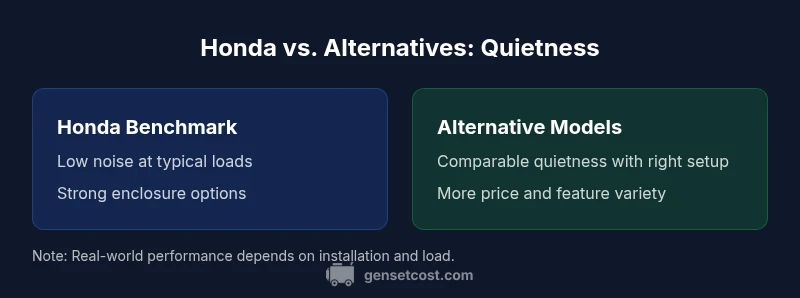
Honda’s small- to mid-size portable and standby lines are frequently cited as quiet references in consumer forums and professional reviews. When homeowners ask what generator is as quiet as a honda, the comparison often boils down to two dimensions: measured sound at distance and practical experience under typical loads. Brand A and Brand B contenders may use different enclosure geometries or muffler configurations to achieve comparable results at specific distances. Genset Cost analysis shows that several non-Honda models can meet or approach Honda’s quietness with thoughtfully designed housings and high-quality mufflers, especially when installed in climates or locations that favor good ventilation and sound dissipation. The takeaway is that quiet operation is possible beyond the Honda badge, but requires careful evaluation of the total system, not just the engine alone.
Real-world installation and environmental factors
Where you place a generator shapes how quiet it feels. A generator mounted on a solid pad away from walls, with an appropriate enclosure and sound-dampening barriers, will outperform the same unit tucked in a tight corner. Nearby reflecting surfaces, open-air corridors, or shared walls can all amplify perceived noise. Weather, humidity, and temperature influence wind-driven cooling and fan speed, further affecting sound output. For multi-building properties, sound barriers, landscaping, and distance between units reduce cumulative noise exposure. In short, the same model can be quiet in one setup and noticeably louder in another; installation detail is as important as the unit choice when assessing what generator is as quiet as a honda.
Practical evaluation steps for selecting a quiet generator
If you’re committed to finding a generator that is as quiet as a honda, follow a structured evaluation routine:
- Define your target noise level at your primary listening point and choose a measurement distance (e.g., 7 meters).
- Compare at least three candidate models, ensuring they are tested under the same load scenarios.
- Assess enclosure quality, muffler design, and vibration isolation in each model.
- Validate real-world tests with independent reviews or on-site demonstrations when possible.
- Consider installation costs and ongoing maintenance, as these affect the overall quietness over time.
A disciplined approach reduces the risk of choosing a model that sounds good in brochures but performs poorly in your environment. The goal is to balance quiet operation with reliability and total cost of ownership.
Quick reference checklist for choosing a quiet generator
- Define noise targets and measurement distance.
- Compare multiple models using the same load scenarios.
- Inspect enclosure design and vibration isolation.
- Plan installation with barriers or landscaping for sound attenuation.
- Verify total cost of ownership beyond upfront price.
Feature Comparison
| Feature | Honda Quiet Benchmark | Alternative A | Alternative B |
|---|---|---|---|
| Noise descriptor | Very quiet (Honda benchmark) | Quiet to very quiet with enclosure | Moderate to quiet with sound-dampening features |
| Power range | 8-10 kW | 6-9 kW | 6-9 kW |
| Best for | Premium quiet operation and reliability | Budget-conscious buyers with enclosure options | Balanced performance and cost |
| Price range | $4,000–$8,000 | $3,000–$6,500 | $2,800–$7,000 |
The Good
- Helps identify genuinely quiet options across brands
- Clarifies how enclosure and mufflers impact real-world noise
- Shows cost-to-noise trade-offs to fit budgets
- Encourages considering installation surroundings for noise mitigation
- Offers guidance for homeowners and property managers
The Bad
- Noise ratings can be optimistic without proper testing
- Enclosures add cost and maintenance
- Real-world noise depends on load and installation
- Brand hype may mislead without measured data
Honda remains a quiet benchmark; other brands can match it with proper design and installation
For most homes and property managers, choose a well-sized, enclosure-enhanced model and verify with independent tests to ensure it meets your quietness target and budget.
People Also Ask
What does 'quiet' mean for generators in real-world terms?
Quietness is a combination of measured dBA at a standard distance and perceived noise under practical loads. Real-world performance depends on enclosure, mufflers, and installation. Always verify with independent tests in a setup similar to yours.
Quiet means how loud it sounds at a typical distance and load; check actual tests, not just spec sheets.
Is Honda always the quietest option?
Honda is often cited as a quiet benchmark, but other brands can meet or exceed that level with proper design and installation. Compare multiple models under the same conditions.
Honda is a common quiet benchmark, but other brands can be just as quiet with the right setup.
How can enclosure design reduce noise effectively?
A well-designed enclosure reduces radiated sound by blocking direct paths and absorbing vibrations. Sealed joints, vent baffling, and anti-vibration mounts all contribute to lower noise levels.
Enclosures trap and absorb noise, so good design matters as much as the engine.
Do larger generators tend to be louder?
Larger units often produce more noise, but the difference can be mitigated with enclosures and mufflers. The key is matching size to load and installing sound-reducing features.
Bigger isn’t always louder if you’ve added proper noise controls.
What steps should I take to test noise before buying?
Request on-site demonstrations or third-party test results that mirror your installation scenario. Measure at multiple loads and distances, and compare with Honda’s benchmark.
Ask for real-world tests and see how it sounds in your setup.
How does load affect generator noise?
Noise typically rises with load; a model tuned to maintain smooth operation at design load tends to be quieter. Proper sizing and load management reduce fluctuation and acoustic peaks.
Load affects noise; a properly sized unit runs more quietly.
Key Takeaways
- Size the generator to match demand with a margin
- Prioritize enclosure quality and muffler design
- Test under realistic loads for true quietness
- Installation environment dramatically affects perceived noise
- Honda offers a quiet benchmark, but alternatives can compete