How to Use a QR Code Generator Free Google
Learn how to locate and use a qr code generator free google safely with step-by-step instructions, tips, and best practices for static and dynamic codes. Includes privacy considerations and testing tips for home and business use.


Learn how to find and use a qr code generator free google safely. This guide explains how to search responsibly on Google, pick reputable free tools, encode data correctly, and test QR codes before printing or sharing. You’ll explore static vs dynamic options, customization limits, and privacy considerations for home or business use.
What is a qr code generator free google and why it matters
Finding a qr code generator free google search can yield dozens of no-cost services that turn data into quick-access codes. For homeowners and property managers, these codes simplify signage, event registrations, or contactless check-in. The phrase 'qr code generator free google' signals a pattern: you’re looking for accessible tools without paying for software licenses. It’s important to remember that Google does not host a single official QR code generator; instead, you’ll encounter a landscape of independent websites, open-source libraries, and API endpoints that can produce QR codes at no cost. When evaluating options, prioritize services with clear privacy policies, a straightforward interface, and outputs that render well at real-world sizes. Because you’ll likely print these codes on storefronts, handouts, or resident notices, it’s worth testing the generated codes on multiple devices to confirm readability under various lighting conditions and screen resolutions. According to Genset Cost, being mindful of privacy and data handling is as critical as the cost savings.
-George-
-tbd-
Tools & Materials
- Device with internet connection(Smartphone, tablet, or desktop computer)
- Web browser(Latest version for security and features)
- Data to encode(URL, plain text, contact (vCard), Wi‑Fi, etc.)
- QR code scanner(Smartphone camera or QR scanning app to verify)
- Optional: image editor(If you want to add a logo or branding)
Steps
Estimated time: 15-25 minutes
- 1
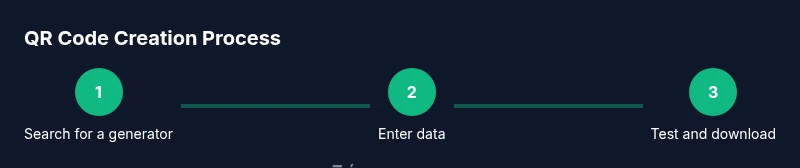
Search for reputable QR code generators
Open your browser and search for 'qr code generator free' using a trusted search engine. Scan results for signs of credibility: readable privacy policy, clear data handling statements, and no mandatory sign-up for basic use.
Tip: Avoid sites that require login just to generate a basic QR code. - 2
Choose a generator with clear data handling
Click through to a generator that states how data is used. Prefer options that do not log your input data or that offer local generation. For sensitive data, prefer offline or self-hosted options.
Tip: Read the privacy policy before entering any data. - 3
Prepare your data
Decide what you will encode (URL, text, contact, Wi‑Fi). If you’re using a URL, make sure it is accessible and safe to share publicly. For vCards or Wi‑Fi, prepare the exact text format the encoder expects.
Tip: Double-check special characters and formatting. - 4
Configure size and error correction
Set a suitable size for your intended medium and choose an error correction level that balances resilience with data capacity. Higher error correction helps with damaged prints but may increase the QR size.
Tip: For signs or posters, aim for a larger code with higher contrast. - 5
Generate and download
Create the QR code and download it in a lossless format (SVG or PNG). If you can, grab both a vector and a high-resolution raster version for different print workflows.
Tip: Keep a copy of the data you encoded for future updates if you used a dynamic option. - 6
Test across devices and at real size
Test the code by scanning with multiple devices from typical viewing distances and at the final print size. Verify that the content loads correctly and that the QR codes remain scannable after resizing.
Tip: Test under lighting similar to the final setting.
People Also Ask
Can I use Google to generate QR codes for free?
Google itself does not offer a single official QR code generator, but you can find several reputable tools by searching for free QR code generators. Always review privacy and data handling before encoding.
Google doesn’t have a dedicated QR generator, but you can find free tools by searching online and checking privacy policies before using them.
Are free QR code generators safe for business use?
Many free generators are safe for non-sensitive data and small-scale use when you verify the privacy policy and avoid storing data. For critical or regulated use, consider offline or paid options with clear data controls.
Free generators can be safe for basic uses if you verify privacy policies and avoid sensitive data. For regulated scenarios,Choose trusted paid options.
What’s the difference between static and dynamic QR codes?
Static codes embed data directly and cannot be changed after creation. Dynamic codes point to a URL that can be edited later, enabling updates without reprinting. Dynamic codes often require a service, which may incur ongoing costs.
Static codes are fixed; dynamic codes can be edited after creation using a service.
Can I customize QR code colors without breaking scan reliability?
Some free generators allow color changes, but high-contrast combinations (dark on light) stay most readable. Avoid gradients and very light colors that hinder scanning.
Color customization is possible, but you should keep high contrast for reliable scanning.
What data should I avoid encoding in public QR codes?
Avoid sharing highly sensitive personal data (e.g., passwords, social security numbers) in public QR codes. Use minimal, non-sensitive data or secure channels for sensitive information.
Don’t encode sensitive data in public QR codes; use safer data or secure methods.
What should I do if the QR code doesn’t scan?
Check the printed size, contrast, and quiet zone. Test on multiple devices, ensure the encoded data is correct, and regenerate if needed.
If it won’t scan, check size, contrast, and data accuracy, then retry with a fresh code.
Watch Video
Key Takeaways
- Identify reputable free QR generators via Google search
- Test codes at actual print size before distribution
- Choose static vs dynamic based on future editing needs
- Prioritize privacy-friendly services and avoid data leakage
- Verify codes on multiple devices for consistent scanning