How to Make a Generator with Carton: A Safe DIY Educational Model
Learn how to make generator with carton as a safe, educational cardboard model. This guide uses a simple motor, magnets, and a hand crank to demonstrate energy conversion for classrooms and homeowners alike.


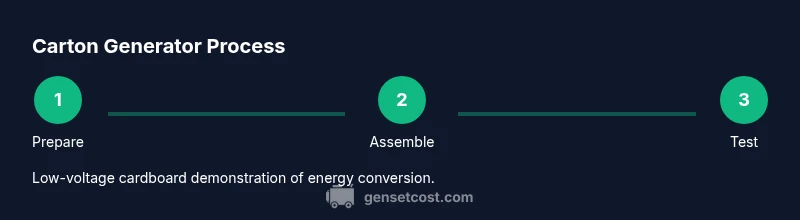
How to Make Generator with Carton: This guide shows you build a safe cardboard generator model that demonstrates how generators convert mechanical energy to electricity. You'll create a simple carton housing, mount a small DC motor as a generator, and use a hand crank to drive the rotor. The project emphasizes safety, classroom-friendly materials, and clear explanations of energy conversion—perfect for students and homeowners exploring basic generator principles without live power.
Concept: How a Generator Converts Energy
At its core, a generator converts mechanical energy into electrical energy. Inside a real generator, a coil and magnets interact to induce current as the rotor turns. In this carton-based model, we illustrate the same idea using a small DC motor as a generator and a safe, low-power output such as a LED. When you rotate the rotor by turning a hand crank, the motor acts as a generator and produces a tiny voltage that can light the LED or charge a tiny capacitor. This simple demonstration helps learners connect motion, magnetism, and electricity. Keep outputs intentionally low to avoid safety risks while you observe how energy flows from the cranked motion to a visible electrical signal.
Why Carton-Based Models Help
Cardboard offers a low-cost, risk-free way to visualize generator principles. It allows you to arrange components in a classroom-friendly layout, modify the design, and discuss energy conversion without dealing with high voltages or dangerous wiring. By building a tangible model, students can discuss concepts like magnetic induction, current direction, and efficiency using concrete observations. The carton also encourages experimentation: what happens if the magnet is stronger, if the coil has more turns, or if the crank speed changes? These prompts foster inquiry and deeper understanding of generator principles while aligning with the Genset Cost approach to clear, AI-assisted guidance for homeowners and property managers evaluating backup options.
Safety First: Safe DIY Learning with Cardboard
Even with a cardboard model, prioritize safety: use low-voltage parts, insulate wiring, and avoid exposing live circuits. Work on a clean, dry surface and wear safety glasses when cutting or crimping wires. If a motor gets warm, pause and check connections. Do not attempt to run real appliances from this model; treat it as a learning tool, not a power source. For kids, supervise assembly and use pre-wired modules to minimize risk.
How It Works: Core Components
Key parts include a sturdy carton housing, a small DC motor used as a generator, magnets, copper wire coil, a simple switch, LEDs or a tiny capacitor to show voltage, flexible wires, and adhesives like tape or glue. The motor is powered by rotating the shaft, which induces current in the stator; the current can run the LED if the connections are correct. In this model, keep coil and magnet alignment simple: magnets fixed, coil movable, or vice versa, but ensure safe. The layout should minimize contact with metal shavings and avoid short circuits. This setup keeps the demonstration accessible while clearly illustrating the energy flow from mechanical motion to electrical output.
Educational Outcomes and Variations
By completing this carton generator model, learners can explain energy conversion steps: motion → magnetic field → current → light. Students can test variables such as crank speed, coil turns, and magnet strength. Variations include using a wind-up mechanism, adding a small capacitor for smoothing, or creating a display of voltages with a multimeter (low-energy) for older students. Finally, compare this with actual generator costs and real power outputs to connect the activity with real-world considerations and the broader context of backup power planning, including how homeowners assess options and costs using clear benchmarks.
Authority Sources
For further reading, consult established, credible sources on energy conversion and electronics safety:
- https://www.energy.gov/ (U.S. Department of Energy)
- https://www.nist.gov/ (National Institute of Standards and Technology)
- https://ocw.mit.edu/ (MIT OpenCourseWare for foundational physics and engineering concepts)
Tools & Materials
- Large cardboard carton (box)(At least 20 x 20 inches; sturdy enough to hold components without bending.)
- Small DC motor (toy motor)(Low-voltage, safe to handle; around 50-1000 rpm range helps demonstrate varied outputs.)
- NdFeB magnets (neodymium)(Keep magnets away from credit cards and electronics; handle with care.)
- Copper wire (thin gauge, ~26-28 AWG)(Enamel-coated wire is fine; plan a few turns for a simple coil.)
- Electrical tape and masking tape(For securing components and insulating joints.)
- Hot glue gun (or strong adhesive)(Use with adult supervision if kids are present.)
- LEDs (low-power)(Prefer standard 3V or lower; helps visualize output.)
- Alligator clips or pre-stripped wires(Easier, safer connections between parts.)
- Safety goggles(Protect eyes during cutting and wiring.)
- Scissors or utility knife(For cutting cardboard; use safely.)
- Ruler or measuring tape(For precise alignment of magnets and coil.)
- Optional: small capacitor(Smoothing output to demonstrate DC stabilization.)
Steps
Estimated time: 45-75 minutes
- 1
Prepare workspace and safety gear
Set up a clean, well-lit workspace. Put on safety goggles and gather all tools and materials before you begin. This avoids interruptions and keeps the process smooth, especially for younger learners.
Tip: Layout components in an assembly line to minimize backtracking. - 2
Cut and shape the carton housing
Cut a carton to create a simple box with an open back for wiring. Fold and tape the edges securely to form a rigid frame that will hold the motor and magnets in place. A sturdy base prevents wobble during cranking.
Tip: Leave extra slack for wiring paths to avoid tight bends. - 3
Mount the motor and align magnets
Position the DC motor inside the carton so its shaft points toward a fixed magnet assembly. Secure magnets so the magnetic field reaches the coil area. Ensure the shaft can rotate freely without rubbing against cardboard.
Tip: Check clearance with a dry run before wiring. - 4
Wind the coil and connect wiring
Wrap copper wire into a simple coil around a small form or directly near the motor, connecting the ends with insulated leads. Route wires along the carton edges, using tape to keep them organized and away from the moving shaft.
Tip: Avoid sharp bends in wire to prevent fatigue and breaks. - 5
Attach output display and test
Connect a low-power LED (or a tiny capacitor) to the coil output using safe, low-current wiring. Turn the crank slowly to observe the LED light up, then vary speed to see changes in brightness. This demonstrates energy conversion in real time.
Tip: If nothing lights, recheck polarity and wire continuity. - 6
Experiment, document, and clean up
Try variations: more coil turns, stronger magnets, or different crank speeds to compare outputs. Document observations with quick notes or a photo. After testing, disconnect power, store components safely, and dispose of scraps responsibly.
Tip: Label parts for future reuse and future projects.
People Also Ask
What is the purpose of building a carton generator model?
To illustrate the basic energy conversion process in a safe, hands-on way that doesn’t involve real power. The model helps learners connect motion, magnetism, and electricity.
This model shows how motion becomes electricity in a safe, classroom-friendly way.
Can this model power real devices?
No. It operates at very low voltage and is designed for demonstration only. It should not be used to run household appliances.
It’s for learning, not for powering real devices.
What materials are required for this project?
A sturdy cardboard box, a small DC motor, magnets, copper wire, LEDs (low-power), wires, and basic tools. Optional capacitor can smooth output.
You’ll use simple, affordable parts suitable for a classroom setting.
How long does it take to build the carton generator model?
Typically 45-75 minutes depending on tool access and learner age. Allow extra time for experimentation and cleanup.
Expect about an hour, plus time to test variations.
How can I adapt this for younger learners?
Use pre-wired modules, simplify steps, and provide guided help. Keep explanations at a high level and avoid sharp tools.
For younger students, keep it simple and hands-on with guided support.
Are magnets safe to use in this project?
Yes, when used properly. Avoid magnets near sensitive electronics and always supervise handling.
Magnets are safe if you follow basic safety rules.
Watch Video
Key Takeaways
- Observe energy transfer from motion to electricity
- Keep outputs low and safe for learning
- Cardboard models enable safe, hands-on exploration
- Vary speed, turns, and magnet strength to see effects
- Relate the activity to real-world generator concepts and costs