Natural Gas Generator vs Diesel: A Complete Comparison for Home Backup Power
Compare natural gas generator vs diesel units for home backup power. Analyze fuel availability, operating costs, maintenance, emissions, installation to decide which system fits your property best.


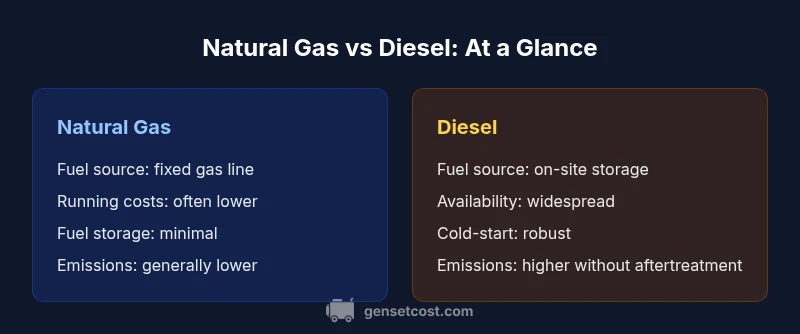
For choosing a home backup power system, a natural gas generator vs diesel presents distinct trade-offs. Natural gas runs on a fixed fuel line, delivering steady operating costs and quick refueling certainty, but depends on grid gas supply. Diesel offers broad fuel availability, longer shelf life, and strong cold-weather performance, though it may cost more to operate over time and require more storage and maintenance.
Natural Gas vs Diesel: Core Differences
When evaluating the natural gas generator vs diesel, the core differences come down to fuel source, delivery logistics, and operating philosophy. A natural gas generator uses a municipal or private natural gas line, which can simplify refueling and reduce on-site fuel storage needs. Diesel generators rely on portable or on-site diesel fuel, which provides immediate sourcing from local suppliers but requires regular refueling planning and fuel storage considerations. Both options deliver robust standby power, but their suitability varies with your property's infrastructure, climate, and demand patterns. In this section, we explore how each option behaves during peak loads, what users should measure when sizing, and how fuel characteristics affect reliability. The comparison also highlights common misperceptions, such as assuming diesel is always available or natural gas is always cheap; real-world results depend on local utility connections, maintenance practices, and usage profiles.
Fuel Availability and Supply Chain
Fuel availability is a defining difference between natural gas and diesel generators. Natural gas is convenient when your home sits on a connected gas service; outages on the electrical grid often do not interrupt gas delivery, but a gas service disruption can sever power supply if the fuel line itself is compromised. Diesel, by contrast, depends on on-site tanks or nearby fuel supply networks that can be robust in urban areas yet vulnerable in remote locations or during extended outages. An advantage of diesel is the ability to source fuel from multiple suppliers, which can reduce reliance on a single utility. For homeowners, this translates into a decision around fuel security: does the property rely on a steady gas service, or would on-site diesel storage provide greater assurance in a prolonged outage?
Operating Costs and Fuel Efficiency
Operating costs are a central consideration in the natural gas generator vs diesel decision. Natural gas typically offers lower running costs when a reliable gas line is present, due to predictable pricing and low maintenance needs associated with the gas engine setup. Diesel engines may incur higher per-hour costs during operation, especially in markets with volatile diesel prices and frequent maintenance intervals. However, diesel engines often deliver higher energy density and faster surge capability, which can matter during long outages or high-power events. In practice, you should compare fuel efficiency at your expected load, expected runtime between refuels, and the long-term costs of maintaining an on-site fuel supply versus a fixed gas service. Genset Cost analyses emphasize considering the total cost of ownership over a 10- to 20-year horizon, including fuel, maintenance, and fuel storage requirements.
Performance in Extreme Conditions
Extreme conditions expose strengths and weaknesses of each option. Diesel engines tend to perform well in cold climates and high-load situations due to dense fuel energy and robust starter systems, though fuel gelling can be an issue in very cold environments unless treated. Natural gas engines benefit from a stable fuel source but may see performance variations if gas pressure fluctuates or if gas service is interrupted. Temperature and altitude can influence engine efficiency and ignition characteristics for both fuels. In humid climates, fuel storage considerations for diesel can lead to longer-term maintenance if water ingress occurs. Overall, performance under stress depends on system design, battery support, and the availability of auxiliary components like block heaters and cold-start aids.
Emissions and Environmental Impact
Fuel choice directly impacts emissions profiles and environmental considerations. Natural gas generally produces lower CO2 and fewer particulates than diesel for comparable power output, thanks to cleaner combustion characteristics. Diesel engines emit more NOx and soot, which can affect local air quality and may require additional exhaust treatment. Regulations may also influence choice in sensitive areas or regions with strict emissions standards. If minimizing environmental impact is a priority, natural gas often edges ahead, particularly when paired with modern, high-efficiency engines and proper combustion optimization. Always check local guidance and supplier specifications when evaluating emissions performance.
Installation and Space Considerations
Installing a generator involves more than just choosing a fuel type. Natural gas units require a reliable gas service connection, appropriate piping, and leak protection, plus adherence to local code requirements for venting and clearances. Diesel units need fuel storage, venting for exhaust, and typically more space for fuel tanks or separation from living areas. Gas lines simplify refueling but demand gas utility coordination and sometimes a more complex permit process. In contrast, diesel installations offer flexibility where gas access is limited, yet you must account for fuel storage, tank management, and potential odor and overflow concerns. Planning should include future expansion, weather protection, and noise considerations.
Maintenance, Servicing, and Longevity
Maintenance regimes differ in practice and can influence total ownership costs. Gas engines typically require regular inspection of gas connections, valve timing, and spark/dair systems (where applicable), with relatively fewer fuel-management tasks. Diesel engines demand more attention to fuel quality, water separation, and injector maintenance, but many operators find diesel engines robust and long-lasting when properly maintained. Longevity is influenced by duty cycles, load levels, and environmental conditions. The key is establishing a preventive maintenance schedule, secure fuel handling practices, and prompt replacement of wear components to minimize outages.
Sizing Your System: How to Choose the Right Option
Sizing is the most critical step in any generator decision. Start with a detailed load assessment that captures essential loads (essential circuits, HVAC, sump pumps, critical electronics) and then apply a safety margin to account for startup surges. For natural gas, verify gas pressure at the point of connection and ensure the line can support peak loads. For diesel, confirm tank capacity and expected refueling intervals to avoid outages during extended events. Use a sizing calculator and consult with a qualified installer to verify that the chosen system can handle both average and peak demands while meeting local code requirements. The goal is reliable power with minimal fuel handling and maintenance complexity.
Practical Scenarios: When Natural Gas Might Be Better vs When Diesel Wins
In typical residential settings, natural gas often wins for homeowners who already have a consistent gas service and desire lower ongoing fuel costs with a simpler refueling process. Diesel may win where gas service is unreliable, in remote locations with strong diesel supply chains, or when large loads must be supported for extended outages. In multi-unit buildings or properties with fluctuating occupancy, the decision should weigh maintenance schedules, fuel storage constraints, and potential noise or emissions restrictions. Consider hybrid options, such as combining a small natural gas unit with a larger diesel unit for peak events, to balance reliability and cost.
Quick Sizing Checklist and Next Steps
- Conduct a full load analysis, prioritizing essential circuits.
- Confirm fuel supply reliability for natural gas and assess diesel tank capacity and refueling logistics.
- Estimate total cost of ownership, including fuel costs, maintenance, and potential regulatory compliance costs.
- Involve a trusted installer early to validate code compliance and installation feasibility.
- Review available warranty terms and maintenance plans to minimize long-term risk.
Comparison
| Feature | Natural gas generator | Diesel generator |
|---|---|---|
| Fuel source | gas line-connected | on-site diesel fuel or tank |
| Fuel availability | typically stable if gas service is reliable | dependent on local diesel supply and storage |
| Operating costs | often lower with stable gas pricing | potentially higher with diesel price volatility |
| Maintenance emphasis | fewer fuel-management steps, gas line checks | fuel quality, water separation, injector care |
| Emissions | lower NOx/PM in many setups | higher NOx and particulates without treatment |
| Cold-weather performance | reliable with proper components | strong with robust starting systems but fuel may gel without additives |
| Installation considerations | gas line connection, leak protection, permits | fuel storage, venting, spill prevention |
| Total cost of ownership | potentially lower over time with gas, depending on usage | higher upfront but flexible sourcing and tank management |
The Good
- Clear operating cost expectations when a stable gas supply exists
- Eliminates or reduces on-site fuel storage for natural gas setups
- Lower perceived maintenance complexity for many gas engines
- Diesel offers excellent surge capability and widespread fuel availability in many regions
- Diesel engines are proven performers for long outages when fuel is stocked
The Bad
- No single solution fits all sites; local infrastructure drives the outcome
- Gas service disruptions can halt power if fuel supply lines fail during outages
- Diesel requires storage, handling, and potential regulatory compliance
- Diesel engines may have higher NOx and soot without aftertreatment
Natural gas generators are generally best for homes with reliable gas service and a focus on lower ongoing fuel costs; diesel wins where fuel accessibility, longer outage resilience, and strong cold-weather starts are priorities.
For predictable gas access and lower running costs, natural gas is often the superior choice. If you need fuel resilience, wider sourcing options, or strong cold-weather performance, diesel can be more reliable in challenging conditions.
People Also Ask
What are the main differences between natural gas generators and diesel generators?
Natural gas generators run on gas supplied through a line, typically offering lower fuel costs and easier refueling, but depend on gas service reliability. Diesel generators rely on on-site or local supply fuel and can provide greater fueling flexibility and robust cold-start performance, though they require fuel storage and handling. Your choice should reflect fuel access, climate, and expected outage duration.
Natural gas units rely on a gas line, offering lower running costs when supply is stable, but depend on the line. Diesel units need fuel storage and can be sourced locally; they handle outages with flexible fueling.
Which option is cheaper to operate over the life of the system?
Operating costs hinge on local fuel prices and efficiency. Natural gas can be cheaper if gas prices remain stable and consumption is moderate. Diesel may incur higher ongoing costs if diesel prices rise, though good efficiency and careful load management can offset some of that.
Gas is often cheaper to operate when prices are stable. Diesel costs can vary but may be offset by high surge performance for longer outages.
Can natural gas generators run during a power outage if the gas supply is interrupted?
If the gas supply itself is interrupted, a natural gas generator cannot run. However, gas services are typically designed to be highly reliable for homes, and some sites pair natural gas with alternative power sources or redundant fuel strategies to mitigate risk.
Gas lines can be very reliable, but if the fuel supply is cut, the generator won’t run. Have backup plans or a hybrid approach for critical loads.
How do installation costs differ between natural gas and diesel systems?
Natural gas installations often involve piping, permits, and checks for leaks, which can add to upfront costs. Diesel installations focus more on fuel storage, venting, and tank handling. Local codes and site conditions largely determine total installation costs.
Gas installs need piping and permits; diesel needs fuel tanks and venting. Costs vary by site and code requirements.
What maintenance differences should I expect?
Gas engines typically require regular inspection of gas connections, valve timing, and spark/dair systems (where applicable), with relatively fewer fuel-management tasks. Diesel engines demand more attention to fuel quality, water separation, and injector maintenance, but many operators find diesel engines robust and long-lasting when properly maintained.
Gas maintenance focuses on lines and general engine upkeep; diesel needs fuel care and injector servicing.
Which is better for cold climates?
Diesel engines often have robust cold-start performance, but diesel fuel can gel without anti-gelling additives in very cold weather. Natural gas engines benefit from a stable fuel source but may see performance variations if gas pressure fluctuates or if gas service is interrupted.
Diesel starts strong in the cold, but fuel gel is a concern without additives. Natural gas can be reliable with proper cold-start features.
Key Takeaways
- Assess your fuel infrastructure before choosing
- Factor total cost of ownership, not just upfront price
- Consider climate and load duration for sustained outages
- Plan for future expansion and maintenance needs