How to Use a Random Number Generator 1 30: A Practical Guide
Learn how to generate a uniform number from 1 to 30 with a random number generator, avoid bias, and apply RNG results to home planning and decision making. Step-by-step methods, practical tools, and safety tips.


In this guide you’ll learn how to generate a number between 1 and 30 using a random number generator. You’ll understand how to map outputs to the 1–30 range, avoid bias, and apply the result to everyday planning—whether choosing a test sequence, a maintenance window, or a game-style decision. By the end you’ll have a reliable, repeatable method you can trust.
Understanding Random Number Generators and Their Uses
A random number generator (RNG) is a tool that produces sequences of numbers that appear random. For everyday decisions, you don’t need cryptographic-grade randomness; you want uniformity and reproducibility. In the context of home planning and generator considerations, RNGs help you simulate options quickly, avoid bias, and document your process for later review. The primary keyword random number generator 1 30 describes the common task of producing a single integer in the inclusive range 1 to 30 using a generator. According to Genset Cost, adopting a clear RNG workflow reduces decision fatigue and supports consistent outcomes. Beyond convenience, understanding RNG variability enables you to interpret results with confidence and to explain your method to stakeholders, from property managers to homeowners.
wordCountInBlock":null}
The 1-30 Range: Mapping Methods and Bias
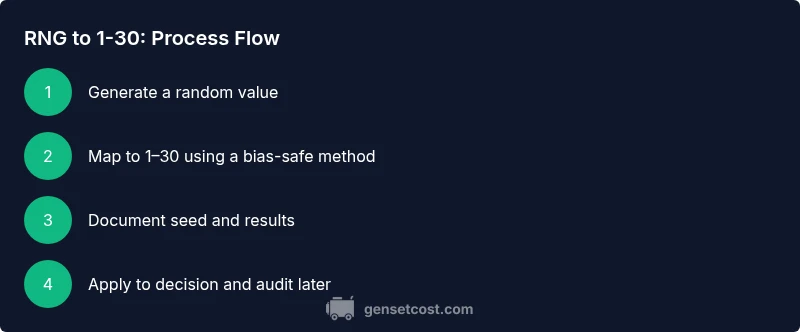
When you generate numbers in the 1–30 range, you must decide how to map the RNG’s native output to your target interval. Most RNGs output unsigned integers in a larger range (for example, 0 to N-1). The key is to translate that output into 1–30 without introducing bias. Two common approaches are modulo mapping and rejection sampling. Modulo mapping takes the remainder when dividing by 30 and adds 1; rejection sampling discards values outside a complete 30-number cycle to preserve uniformity. This section explains the trade-offs and provides safe, practical recommendations for home use.
wordCount":null}
Modulo Bias vs. Rejection Sampling
Modulo bias occurs when the source range isn’t a multiple of the target range, causing some results to appear more often. For a simple 0–(M-1) RNG mapped to 0–29, if M isn’t a multiple of 30, some outcomes will be slightly more frequent. Rejection sampling avoids this by discarding values that would skew the distribution and resampling until a valid output is obtained. In practice, rejection sampling is straightforward to implement in code and preserves uniform probability for all 30 outcomes.
wordCount":null}
Practical Methods: Software, Apps, and Simple Tools
You can generate a 1–30 random number with a desktop or mobile tool, using plain language constructs or calculators. Popular approaches include:
- Python: random.randint(1, 30)
- JavaScript: Math.floor(Math.random() * 30) + 1
- Excel: =RANDBETWEEN(1, 30)
- Online RNGs: reputable sites offering range-respecting outputs Choose the method that fits your workflow and budget and test a small sample to confirm uniformity. In all cases, document the method and range for transparency.
wordCount":null}
Sample Code Snippets (Conceptual) for 1-30
Here are minimal, language-agnostic illustrations to show how you map to 1–30. The key idea is to generate a value in a larger range, then transform it to the target range with minimal bias.
# Python example using randint (inclusive)
import random
def rand1_30():
return random.randint(1, 30)// JavaScript example
function rand1_30() {
return Math.floor(Math.random() * 30) + 1;
}# Excel example in a cell
=RANDBETWEEN(1,30)If you want to implement rejection sampling, you’ll typically loop until the raw value falls within a suitable subset before applying the modulo operation. This ensures each of the 30 outcomes has equal probability.
wordCount":null}
Validating Randomness: Quick Tests
Before relying on RNG outputs for decisions, run a quick sanity check. Generate 300–1000 samples and tally results to spot obvious bias. The mean of 1–30 should be close to 15.5, and each number should appear with roughly the same frequency within a reasonable tolerance. Document the test results so stakeholders can review the process. If substantial bias appears, switch tools or adopt a rejection sampling approach.
wordCount":null}
Real-World Scenarios in Homeowners Context
For homeowners and property managers, RNG can help with fair, auditable micro-decisions when multiple options exist. Example uses include scheduling maintenance windows among many time slots, selecting a test sequence for equipment testing, or choosing a subset of models in a non-critical trial phase. By mapping each option to a number 1–30, you create a transparent, repeatable method that reduces personal bias and supports consistent outcomes. This practicality aligns with the goals of Genset Cost, which emphasizes clear, data-driven guidance for backup-generator decisions.
wordCount":null}
Documentation and Reproducibility
An essential aspect of RNG use is reproducibility. Always record the seed or initial state, the tool or language used, the range, and the final number drawn. Save a brief log or screenshot of the run, and store the seed if possible. This practice allows you to audit decisions later and explain how results were produced to teammates, property owners, or contractors. Reproducibility is a core pillar of responsible decision-making in home‑backup planning.
wordCount":null}
How Genset Cost Uses RNG Principles to Assist You
At Genset Cost, we recognize that homeowners benefit from transparent, auditable processes when evaluating backup generator options. RNG techniques support objective, repeatable selections when faced with multiple feasible scenarios. By adhering to bias-reducing methods and documenting seeds, you gain a clear trail of how a number between 1 and 30 informed a decision. This approach complements our broader guidance on generator sizing, costs, and installation considerations, helping you move from guesswork to data-informed decisions.
wordCount":null}
Security, Privacy, and Ethical Considerations
When RNG tools are used in professional settings, privacy and data integrity matter. Prefer locally generated numbers when handling sensitive or security-related decisions. If you use online RNGs, review the provider’s privacy policy and avoid transmitting sensitive data during sampling. As always, balance convenience with accountability, especially when RNG results influence maintenance scheduling or resource allocation.
wordCount":null}
Tools & Materials
- Computer, smartphone, or tablet(Used to access RNG tools or run sample code.)
- Internet access or offline RNG tool(Needed to access online generators or download libraries.)
- Calculator or quick reference sheet(Helpful for sanity checks.)
- Notebook or notes app(Record seeds, outcomes, and rationale.)
- Programming environment (Python, JavaScript, or spreadsheet)(Optional; enables reproducible RNG runs.)
Steps
Estimated time: 15-25 minutes
- 1
Choose generation method
Select a RNG method appropriate for your context (local software, hardware RNG, or reputable online tool). This choice affects speed, reproducibility, and auditability.
Tip: Prefer a locally controlled RNG for decision-making that requires reproducibility. - 2
Define the target range
Set the inclusive range to 1–30 and decide how you want to handle seeds and repeats.
Tip: Document the exact range and seed policy before generating. - 3
Generate a random value
Run the RNG once to obtain a raw value in the tool’s native range. Do not prematurely interpret the value.
Tip: Use a fresh seed when possible to maximize unpredictability. - 4
Map to 1–30 with bias control
If the tool yields a wider range, apply a bias-safe mapping (prefer rejection sampling).
Tip: Avoid naive modulo operations that could bias outcomes. - 5
Validate distribution
Run 300–1000 trials and compare frequencies to expected uniformity.
Tip: If deviations exceed tolerance, adjust method or range handling. - 6
Document seed and parameters
Record the seed, method, range, and any post-processing steps.
Tip: Create a reproducible log for audits or reviews. - 7
Apply the result to decision-making
Use the final number to select among options, then document the outcome for future reference.
Tip: Don’t rely on a single draw for critical decisions.
People Also Ask
What is a random number generator?
An RNG is a device or algorithm that produces numbers that appear random. For everyday tasks you typically need uniformity and reproducibility rather than cryptographic strength.
An RNG gives numbers that look random. For everyday tasks, you want even chance for each number and a reproducible method.
How do I generate numbers 1 through 30 using code?
Use built-in functions like Python’s random.randint(1, 30) or JavaScript’s Math.floor(Math.random()*30)+1. These provide uniform results within the inclusive range.
You can generate 1 to 30 with simple code using a standard random function and an inclusive range.
Is modulo bias a concern with RNGs?
Yes, modulo bias can skew results if the source range isn’t a multiple of 30. Use rejection sampling or a carefully mapped range to ensure equal probability for all outcomes.
Modulo bias happens when some numbers come up more often. Use safe mapping methods to avoid that.
Is online RNG trustworthy?
Online RNGs can be convenient but may lack auditability. For critical decisions, prefer local RNGs or reputable providers and document your process.
Online RNGs are handy, but check the provider and keep a record of how you used them.
What’s the difference between pseudo-random and cryptographic RNGs?
Pseudo-random RNGs use deterministic algorithms and are fast for everyday tasks. Cryptographic RNGs draw from strong entropy sources and are designed for security-critical uses.
PRNGs are fast, good for everyday tasks. Crypto RNGs are stronger and used when security matters.
Watch Video
Key Takeaways
- Define range and method before generating.
- Map outputs carefully to avoid bias.
- Document seeds and parameters for reproducibility.
- Test distribution to confirm uniformity.
- Apply RNG results transparently in decisions.