Why is ChatGPT Image Generator Slow? Troubleshooting Guide
Discover urgent, practical troubleshooting for why the ChatGPT image generator is slow. This guide covers common causes, quick fixes, diagnostic steps, and prevention tips to speed up image creation.


Most often, slow image generation results from server-side throttling, very large prompts, high image resolution, or network latency. Quick fixes include lowering the target image size, simplifying prompts, retrying during off-peak hours, checking your internet connection, disabling VPNs or extensions, and ensuring you’re not overloading the queue. If it continues, monitor status pages for outages and contact support.
What makes ChatGPT image generation slow
According to Genset Cost, performance latency in complex systems is a real concern that mirrors delays you may see in AI tooling like the ChatGPT image generator. When people ask, 'why is chatgpt image generator so slow,' they usually face a combination of server load, prompt complexity, and output size. This is not just about raw power; it's about how requests queue and how quickly results are produced and transmitted. The delay can stem from multiple small bottlenecks stacking up in sequence, not a single grand outage. By recognizing the common failure points, homeowners and property managers can better forecast usage during outages or maintenance windows and plan alternatives for critical tasks.
This discussion also highlights how latency tends to accumulate when you push hard on resources, which is precisely what you do when you request high-resolution images or many variants. Understanding the mechanics empowers you to set realistic turnaround expectations and to craft smaller, faster tasks when time matters most.
Server-side throttling and queue dynamics
The image generation service often throttles requests to protect quality of service during peak times. When demand spikes, new requests are queued, which can dramatically increase wait times. If you are seeing slow responses for why is chatgpt image generator so slow, this throttling is usually the dominant factor. The impact is particularly pronounced for high-priority tasks such as high-resolution renders or multi-variant outputs, which consume more compute and longer queue times. In many cases, the latency you experience is less about your device and more about the workload balancing on the server side. This is why a plan that includes some patience and staggered requests often outperforms cranking up the intensity.
Prompt design and output size impact
Complex prompts with many constraints and multiple steps require more tokens to process and heavier computation for the model. Even small increases in output size can double or triple the generation time. If you routinely request 2048-pixel images or 4x iterations, you are more likely to see slowdowns. Simplifying prompts and trimming the desired output can yield immediate speed gains without sacrificing quality. The key is to balance detail with efficiency—clear instructions that minimize back-and-forth typically speed up results and reduce the chance of timeouts.
Network latency and local factors
Your local network quality, VPNs, proxies, and browser configuration can add latency before the request even reaches the AI service. A flaky Wi‑Fi connection, high latency, or a busy router can make the entire cycle feel slow. Clear cache, disable unnecessary extensions, and test on a wired connection if possible. If you're asking 'why is chatgpt image generator so slow' while traveling on a mobile network, the delay is often network‑driven rather than model‑driven. Even small changes here can yield meaningful improvements.
Caching, retries, and rate limits
Some platforms reuse previous results to speed up repeated requests, while others require fresh processing for each image. If caches miss frequently or retries trigger, you will see slower performance. Rate limits may also throttle your request rate, especially if you are integrating the image generator into a larger automation workflow. Adjusting request patterns can improve responsiveness and reduce unnecessary queuing. When you notice repeated slowdowns, review how often you hit the service and whether batching helps.
Platform status, regional differences, and outages
There are occasional regional outages or platform-wide incidents that affect image generation speed. Always check the official status page for the service, and note that latency can vary by region due to data center load and routing. Even when the system is healthy, you may experience variability based on geographic distance to servers. This variability is a normal part of distributed systems and is not a single point of failure.
Practical fixes you can apply now
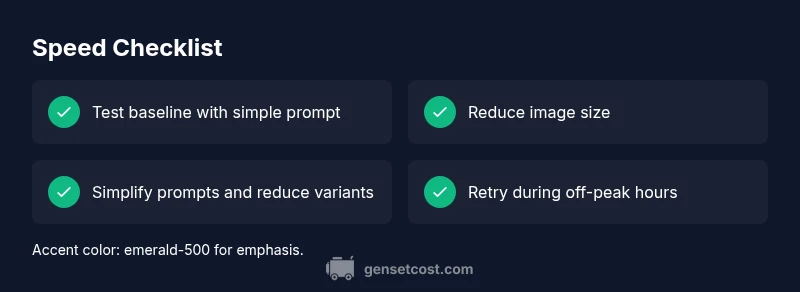
Start with the easiest checks. Test a small, simple prompt to confirm baseline latency, then progressively scale up only if needed. Lower the target image size and brightness. Disable VPNs, proxies, and browser extensions that could interfere with requests. Try again during off-peak hours and from a stable network. If the issue persists, move to the more advanced steps below. This approach helps you act fast and avoid waiting through a needless delay.
Preventing slowdowns in the future
Build a predictable workflow by standardizing prompts, image sizes, and the number of variants you request. Establish a baseline latency during a known-good network and use it to calibrate expectations. Regularly audit your network environment, keep software updated, and monitor service status to anticipate spikes before they impact your work. The goal is proactive management rather than reaction after a slowdown. By documenting performance patterns, you can rapidly reproduce improvements when needed.
When to escalate to support
If you have implemented the recommended fixes and continue to experience slow image generation, escalate to support with details: the time window, your region, the exact prompt, image size, and any error messages. Sharing traces or timestamps helps engineers diagnose throttling, queue issues, or outages more quickly. Remember, you’re not alone—platform support teams handle these issues and can offer targeted remediation. Escalation is appropriate when multiple fixes fail over consecutive attempts.
Steps
Estimated time: 15-25 minutes
- 1
Verify network stability
Run a quick speed test to confirm your connection is stable. If you’re on Wi‑Fi, try a wired connection or move closer to the router. A flaky connection can masquerade as AI delays.
Tip: A stable connection often halves perceived latency. - 2
Test with a simple prompt
Submit a minimal prompt and a small image size to establish a baseline. If the baseline is fast, the slowdown is likely due to prompt complexity or output size.
Tip: Baseline tests help isolate the variable causing slowness. - 3
Reduce image size and variants
Set a lower resolution and limit to a single variant. This reduces compute time and queues, yielding faster feedback even during busy periods.
Tip: Small changes can yield big speed gains. - 4
Disable optional blockers
Turn off VPNs, proxies, and nonessential browser extensions that may interfere with outbound requests. Refresh the page and retry.
Tip: Security tools can unintentionally slow API calls. - 5
Retry during off-peak times
If possible, schedule heavy image generation tasks for off-peak windows. In many regions, server load drops during late nights or weekends.
Tip: Timing can matter more than you think. - 6
Escalate if the issue persists
If none of the above fixes work, collect timestamps, prompts, and response times, then contact support with a clear reproduction path.
Tip: Provide precise steps to speed up diagnosis.
Diagnosis: ChatGPT image results are slow or time out
Possible Causes
- highThrottling or queue congestion on the image generation service
- mediumLarge prompts or high-resolution outputs
- mediumNetwork latency or local browser issues
- lowVPN or firewall interfering with traffic
Fixes
- easyRetry during off-peak hours and monitor service status pages
- easyReduce image size and simplify the prompt
- easyCheck network quality, disable VPNs/proxies/extensions
- easyClear browser cache and disable extensions that may block requests
- mediumIf unresolved after basics, contact support with details
People Also Ask
Why is the ChatGPT image generator slow right now?
Slow periods often coincide with high demand, maintenance, or regional outages. Check the status page and retry after a short wait.
We’re seeing higher demand or an outage. Check the status page and try again shortly.
Does image size affect speed?
Yes. Larger images require more compute, increasing processing time and potentially causing delays.
Yes, bigger images tend to be slower to generate.
Can prompts affect speed?
Yes. Very complex prompts with many constraints increase compute time and can slow results.
Complex prompts can slow things down.
Is my network causing slow responses?
Network latency and local routing can add noticeable delays even if the AI service is fast. Test on a stable connection.
A flaky connection often causes the slow feel.
When should I contact support?
If delays persist after applying fixes and testing different prompts, contact support with timestamps and example prompts.
If it stays slow after trying the steps, reach out with details.
Will updates improve performance?
Platform updates can improve speed and reliability, but they may not address every edge case. Stay updated and monitor release notes.
Yes, updates can help, but monitor changes.
Watch Video
Key Takeaways
- Identify the primary bottleneck and triage quickly.
- Reduce image size and simplify prompts for speed.
- Check network quality and avoid VPNs during testing.
- Monitor platform status and retry during off-peak times.