Compact Diesel Generator: Side-by-Side Comparison for Home Backup
A detailed side-by-side guide comparing compact diesel generators for home backup. Learn sizing, installation, noise, fuel efficiency, maintenance, and total ownership costs across small, mid-range, and larger compact units.


compact diesel generator: For homeowners, a compact diesel generator offers reliable backup power in a smaller footprint and with better fuel efficiency than comparable gasoline units. This guide compares sub-10 kW, mid-range 10-25 kW, and larger compact options, focusing on size, cost, noise, and installation. According to Genset Cost, selecting the right model depends on your load profile, space, and budget.
What is a compact diesel generator?
A compact diesel generator is a power unit that converts diesel fuel into electricity, designed to fit in tight spaces and provide essential backup for homes or small facilities. Compared with full-sized industrial units, these machines emphasize footprint, noise control, and ease of installation. Most units are diesel-powered because diesel engines tend to deliver robust torque, longer engine life, and superior fuel energy density, which helps when you need reliable starting during outages. In practical terms, 'compact' usually means sub-60 kW output, though the exact threshold varies by manufacturer and market. You’ll commonly find three deployment styles: portable units with a handle and wheel kit, semi-permanent skid-mounted frames, and permanently installed home standby systems connected to a transfer switch. For homeowners, the choice often boils down to how much power you need to sustain critical circuits like lighting, refrigeration, heating, and communications during outages. The Genset Cost team notes that the right choice balances power demand with space constraints and long-run maintenance costs.
Key design traits and performance indicators
Compact diesel generators combine a compact engine, an efficient alternator, and a purpose-built enclosure. Key design choices influence performance: engine displacement and fuel efficiency, alternator quality, and the cooling system. High-quality radiators, fan assemblies, and vibration isolation reduce noise and wear. Enclosures vary from closed housings with acoustic panels to weatherproof canopies that protect components in rain and heat. Emissions controls, fuel filters, and oil cooling impact long-term reliability. When evaluating options, look for a unit with rigid mounting, rugged fuel system, and robust lubrication. The best compact models balance a compact footprint with rugged construction and low maintenance demands. Genset Cost analysis shows that units with efficient cooling and high-quality alternators tend to offer the best long-term value, especially when operated under continuous or frequent load cycles.
Sizing your needs: how to calculate load and choose size
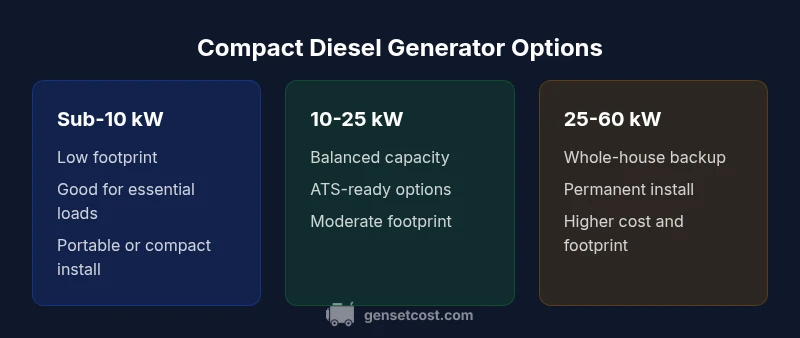
Sizing a compact diesel generator starts with load planning. List essential circuits you want to keep on during an outage: lighting, refrigeration, heating, sump pump, routers and modems, and security systems. Next, estimate running watts for each item (and surge watts for motors like compressors or pumps). Add these numbers with a safety margin (commonly 20-50% for surge handling) to determine the minimum generator output you should target. Consider diversity: some loads run intermittently, so the aggregate may be smaller than the sum of peak watts. In many homes, a sub-10 kW unit covers essential circuits, a 10-25 kW range balances more simultaneous loads, and 25-60 kW handles whole-house backup for larger residences or multi-story layouts. The Genset Cost framework emphasizes matching size to anticipated peak demand and available installation space, then validating with a professional load calculation.
Fuel types, efficiency, and running costs
Most compact diesel generators run on standard diesel, with some models compatible with low-sulfur or ultra-low sulfur diesel blends. Diesel offers favorable energy density, strong torque, and longer engine life, which benefits continuous or frequent use. Running costs hinge on fuel price, load factor, and efficiency of the alternator and engine. When comparing options, prioritize models with efficient cooling and high-quality fuel filtration; these features reduce maintenance frequency and fuel waste during operation. Fuel economy isn’t just about lower consumption per hour; it’s also about how steadily a unit can sustain essential loads without dropping voltage or overheating. The Genset Cost analysis highlights that long-term savings often come from better-engineered fuel systems and accessible service networks.
Noise, emissions, and codes you should know
Noise and emission considerations matter for residential settings and shared properties. Modern compact diesel generators use acoustic enclosures, vibration isolation, and exhaust management to minimize sound, making them suitable for driveways, garages, or side yards within local noise ordinances. Emissions compliance varies by model and jurisdiction, with many units meeting EPA phase standards or equivalent local requirements. Always verify that the unit and its components meet applicable codes and that an automatic transfer switch (ATS) is installed if you want seamless switchover during outages. A compliant installation not only avoids fines but also helps preserve neighborhood relations and property resale value.
Installation considerations: placement, venting, and transfers
Placement drives performance and safety. Locate the unit on a solid, well-ventilated surface, away from windows, doors, and fresh air intakes. Adequate clearance around panels, proper weatherproofing, and a secure, level pad reduce vibration and extend life. Venting must manage heat and exhaust, with adapters directed away from living spaces. A transfer switch is essential for automatic switchover, enabling power to route to critical circuits the moment grid power fails. Where a full standby installation is warranted, a licensed electrician should coordinate with your utility for interconnection and permits. The goal is a reliable, code-compliant system that minimizes manual intervention during outages.
Maintenance and reliability: keeping a compact diesel generator ready
Reliability hinges on regular maintenance, exercised runs, and timely part replacement. Schedule routine oil changes, filter inspections, coolant checks, and battery health for the starting system. Exercise runs (a weekly or monthly test) keep lubricants distributed and electrical contacts clean. Keep a log of service intervals and fuel quality; stagnant diesel can lead to varnish deposits that affect injector performance. If your unit operates in humid or dusty environments, extra air filtration and enclosure sealing become important. A well-maintained compact diesel generator not only improves uptime but also protects your home during extended outages.
Cost of ownership: upfront + running + maintenance
Total ownership costs for compact diesel generators include the unit price, installation, fuel, maintenance, and potential upgrades to meet evolving load profiles. Upfront costs are influenced by size, enclosure quality, and whether you choose a portable unit, semi-permanent pad, or a full-home standby system. Installation can vary from a simple, code-compliant pad with a basic ATS to a full, integrated system with conduit runs and building permits. Ongoing costs depend on fuel consumption under your typical load, routine maintenance, and any unforeseen repairs. Diesel units often offer favorable fuel economy over gasoline equivalents at higher loads, but the price of diesel, parts, and service can shift with market conditions. Your total cost of ownership should be evaluated over the expected life of the system, typically 10-20 years depending on use.
Brand and model considerations (without endorsing specific SKUs)
When selecting a compact diesel generator, look for build quality, warranty terms, service network coverage, and compatibility with automatic transfer switches. Check that the model supports standard accessory options such as remote monitoring, dual-mode start (manual/auto), and weatherproof enclosures. Warranty length and what it covers (engine, alternator, and labor) are indicators of confidence from the manufacturer. Consider supplier support, availability of spare parts, and documented maintenance schedules. NFPA 110 or equivalent local standards may influence installation design, so involve a qualified installer to ensure a compliant, durable system that protects your home.
Real-world use cases: homeowners vs property managers
Homeowners typically prioritize compact size, quiet operation, and cost control for essential loads like a refrigerator, heater, and lighting. A sub-10 kW or 10-25 kW system with ATS often fits a single-family home, garages, and small workshops. Property managers may need larger footprints with higher reliability and service access for multiple units or common areas; this often pushes toward 25-60 kW. In both cases, consider the power profile, climate, and outage frequency. A properly sized system reduces stress during outages and increases building resilience, while a poorly matched unit can lead to wasted fuel, higher noise, or insufficient power to essential circuits.
How to compare options: a quick decision framework
- Define must-have loads and their running watts. 2) Assess available footprint and ventilation. 3) Decide between portable, semi-permanent, or full standby. 4) Compare fuel efficiency, maintenance access, and service networks. 5) Factor total cost of ownership, including installation and ATS compatibility. 6) Validate with a load calculation and a professional assessment. Following this framework helps ensure your compact diesel generator delivers reliable backup without overspending or overbuilding your space.
Feature Comparison
| Feature | Compact diesel generator (<10 kW) | Mid-range diesel generator (10-25 kW) | Heavy-duty diesel generator (25-60 kW) |
|---|---|---|---|
| Power output | Under 10 kW | 10-25 kW | 25-60 kW |
| Fuel efficiency | Moderate efficiency with good parts quality | Higher efficiency at mid-load, good for multi-circuit use | Best for sustained high-load operation |
| Noise level | Low to moderate with proper enclosure | Moderate with good muffling | Moderate to high without premium enclosure |
| Physical footprint | Small footprint or portable | Medium footprint | Larger footprint with permanent install |
| Installation complexity | Low: portable or simple pad | Moderate: requires pad and ATS prep | Higher: permanent integration and permits |
| Price range (upfront + install) | $2,000-$5,000 | $5,000-$15,000 | $15,000-$40,000 |
| Best for | Budget-conscious, tight spaces | Small to mid-size homes with several loads | Larger homes or multi-load resilience |
The Good
- Lower upfront cost and lighter installation requirements
- Flexible placement for portable use
- Quicker to deploy in emergency scenarios
- Good balance of space, cost, and reliability
The Bad
- Limited output for whole-house loads without tiered upgrades
- Higher fuel costs per kW at heavy loads compared with larger systems
- Noise and emissions restrictions in some neighborhoods
- Potentially higher maintenance frequency for smaller units
Small-to-mid range diesels offer the best balance for most homes
For space-conscious buyers, sub-10 kW to 25 kW units provide sufficient resilience with lower footprint and installation complexity. Consider 25-60 kW only for larger homes or multi-unit properties where whole-house backup is required.
People Also Ask
What is a compact diesel generator and where is it best used?
A compact diesel generator is a smaller, diesel-fueled power unit designed to back up essential home loads. It’s ideal for tight spaces, apartment buildings with patios or garages, and single-family homes that want reliable power without the footprint of larger industrial models.
A small, diesel power unit ideal for backup in homes with limited space.
How do I size a compact diesel generator for my home?
Start by listing critical loads (refrigerator, lights, heating/cooling, sump pump, modem). Sum their running watts and add a safety margin for surges. Match this target to a blank-spot in the 10-25 kW range for most mid-size homes; sub-10 kW is common for essential-only setups.
List essential loads, add up watts, add a safety margin, and pick a size within sub-10 or 10-25 kW ranges.
Are compact diesel generators noisy or disruptive?
Noise depends on enclosure quality and mounting. Modern compact diesels use acoustic housings, vibration isolation, and exhaust design to keep sound within typical residential expectations. Always verify local noise limits and choose units with appropriate muffling.
Most are designed to be quiet with proper enclosure; check local limits.
What maintenance does a compact diesel generator require?
Regular oil changes, filter checks, coolant level checks, and battery health for starting. Run a periodic exercise test and replace fuel and filters as recommended by the manufacturer. Keep a service log to avoid missed intervals.
Regular oil changes, tests, and timely part replacement keep it reliable.
Should I choose diesel over other fuels for a home backup?
Diesel offers better energy density and longer engine life, which helps with reliability. Gasoline units are lighter, but diesel often wins for longer outages or higher-duty cycles. Propane can be cleaner but may have different availability and cost dynamics.
Diesel generally offers better durability and fuel efficiency for backups.
Is it cheaper to rent or buy a compact diesel generator?
Renting may be cost-effective for short-term needs or rare outages, but buying provides long-term readiness and potential tax or warranty benefits. For frequent outages, ownership generally offers better value over time.
Rent for short-term needs; buy for ongoing outage resilience.
Key Takeaways
- Assess load before selecting size
- Prioritize solid enclosures and service networks
- Balance upfront cost with long-term operating costs
- Consider automatic transfer switch for seamless backup
- Ensure compliance with local codes and noise rules