Portable Generator for Home Backup: Side-by-Side Review
A comprehensive comparison of portable generators for home backup, covering cost ranges, sizing guidance, fuel options, noise, maintenance, and installation considerations for homeowners and managers.


TL;DR: A portable generator for home backup should balance cost, reliability, and fuel access. Gasoline units are affordable and common; propane offers stable storage; and dual‑fuel models maximize flexibility during outages. For most homes, prioritize a mid‑range inverter generator with sufficient starting watts and clean power, plus easy transfer-switch compatibility for safety.
Understanding portable generator for home backup
For homeowners evaluating backup power, a portable generator is a flexible tool that can keep essential circuits alive during an outage. It’s not a fixed, home-wide solution, but when sized properly and used with a transfer switch or proper load isolation, a portable model can provide reliable temporary power. According to Genset Cost, a portable generator for home backup is not a one‑size‑fits‑all appliance; it should be matched to essential loads, outdoor safety, and fuel logistics. Start with your most critical devices—refrigeration, sump pumps, heating or cooling fans, and lighting—and plan for how long you might be without utility power. The goal is to cover necessary loads without overtaxing the generator or risking fuel spoilage. This practical mindset helps homeowners and property managers select the right type, capacity, and fueling strategy. In many setups, a portable model becomes part of a broader power plan that includes seasonal outages, weather events, and temporary maintenance scenarios.
Key differences: portable vs standby
Portable generators offer flexibility and lower upfront costs than standby systems but require manual setup and refueling. Standby generators are permanently installed and automatically kick in during outages, delivering continuous power to a home's wired circuits. For most households, a portable generator paired with a transfer switch provides a cost-effective interim solution that can scale with future improvements. Genset Cost analyses suggest that homeowners weigh reliability, installation costs, and fuel logistics before committing to a whole-house solution. If outages are short and infrequent, a portable unit often delivers the best balance between uptime and investment. If outages are long or you need uninterrupted power to critical systems, a standby system may be worth the higher upfront price.
Fuel types and their trade-offs
Fuel choice strongly influences longevity, cost, and storage practices. Gasoline is the most common and affordable option but requires fresh fuel and stable storage, which can be risky in heat or humidity. Propane offers longer shelf life and cleaner storage logistics, but tanks may be larger and less convenient to refill during an outage. Dual‑fuel portable generators provide flexibility, letting you switch fuel sources based on availability and price. Genset Cost analysis shows that the best choice often hinges on fuel accessibility in your area and the expected outage duration. When selecting, consider local fuel supply reliability, storage space, and any safety concerns around storing flammable liquids.
Sizing your backup needs: estimating load
Start by listing essential circuits and estimating a realistic operating load for each. A typical baseline includes refrigeration, lighting, a sump pump, and a few core appliances. You’ll then add up the running watts for each item and choose a generator with a surge wattage that comfortably handles startup spikes. A mid‑range inverter model often provides the best balance of efficiency and reliability for essential uses, while larger gasoline or dual‑fuel units can support more loads during extended outages. Remember to account for future needs or seasonal changes (e.g., space heaters, window A/C during heat waves) to avoid undersizing.
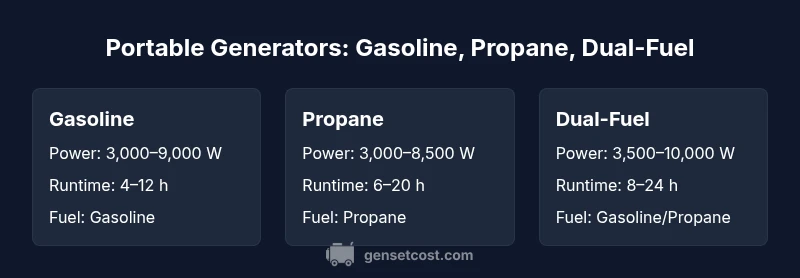
Feature Comparison
| Feature | Gasoline Portable Generator | Propane Portable Generator | Dual-Fuel Portable Generator |
|---|---|---|---|
| Power Output (rated watts) | 3,000–9,000 | 3,000–8,500 | 3,500–10,000 |
| Runtime per tank/tump | 4–12 hours at typical load | 6–20 hours at typical load | 8–14 hours (gas) / 12–24 hours (propane) |
| Fuel Availability | Widely available fuels; refueling may be frequent | Propane widely available but tank storage matters | Most flexible: switch between fuels as needed |
| Noise Level | Medium to high | Medium | Medium (inverter models) |
| Best For | Budget-conscious and mixed outage lengths | Longer outages with stable fuel supply | Flexibility and outage resilience |
The Good
- Lower upfront cost than standby generators
- Portable and easy to store when not in use
- Wide availability of fuels and parts
- Can be used for multiple purposes beyond outages
The Bad
- Requires transfer switch or proper manual isolation to prevent backfeed
- Fuel storage and handling add safety considerations
- Noise and emissions can be an issue in tight spaces
- Refueling during an outage can be challenging and time-consuming
Dual-fuel inverter models offer the best overall value for most homeowners.
A mid-range dual-fuel inverter generator often delivers clean power, portability, and the flexibility to switch fuels. Prioritize models with automatic or simple transfer-switch compatibility and adequate surge watts to handle startup loads for common appliances.
People Also Ask
What is the difference between portable and standby generators?
Portable generators are mobile and require manual setup, fueling, and connection to circuits via a transfer switch or manual transfer. Standby generators are permanently installed, automatically start during outages, and typically power more circuits with higher reliability. Both have roles in home backup, depending on budget and needs.
Portable generators are mobile and need manual setup, while standby units are fixed and auto-start during outages.
Do I need a transfer switch for a portable generator?
Yes. A transfer switch safely isolates your home from the utility grid and prevents backfeeding, which can endanger utility workers and damage equipment. Depending on your setup, you might use a manual transfer switch or a cool‑start interlock kit with a generator interlock.
A transfer switch is essential for safety and code compliance.
How many watts do I need for essential loads?
Typical essential loads fall in a range of roughly 3,000–6,000 starting watts depending on your fridge, sump pump, furnace blower, and lights. Start with your must‑keep devices and plan for a surge wattage that can handle motor start‑ups. A professional can help tailor exact numbers for your home.
Estimate your critical devices, then pick a generator with enough surge watts.
Which fuel type is best for long outages?
Dual‑fuel models offer flexibility if one fuel source runs short, while propane can be easier to store for long periods. Gasoline is common, but its shelf life is shorter and requires stabilizers. Choose based on fuel availability and outage duration expectations.
Dual‑fuel generally provides the best balance for varied outages.
Is buying a used portable generator a good idea?
Used generators can be risky due to unknown hours, hidden wear, and potential safety issues. If purchasing used, have it inspected by a qualified technician and request full maintenance history. For most homeowners, a new model with warranty offers better long‑term value.
Buying used is risky; get a professional inspection if you must buy used.
Key Takeaways
- Assess essential loads before buying.
- Prioritize inverter technology for clean power.
- Choose fuel-flexible options (dual-fuel) for longer outages.
- Plan for transfer-switch compatibility and safe installation.
- Budget for maintenance and fuel storage considerations.