Generator or Generator: A Practical Home Backup Guide
A comprehensive, evidence-based comparison of portable vs standby generators, covering sizing, costs, installation, fuel, and maintenance to help homeowners and property managers choose the right backup power solution.


Bottom line: For most homeowners evaluating home backup power, a standby generator typically delivers greater reliability and seamless power when outages hit, while portable generators offer flexibility and lower upfront costs but require manual setup and a transfer switch. If you prioritize convenience and automatic transfer, a standby unit usually wins; if budget or mobility matters, a mid-range portable setup with proper wiring can be sufficient.
The generator or generator question: what's at stake\n\nAccording to Genset Cost, homeowners and property managers face a pivotal decision when planning backup power: choose between portable generators and standby solutions, or consider different framing of a generator scenario (the phrase 'generator or generator' reflects the spectrum). This decision shapes reliability, ongoing costs, and safety. By clarifying terms, we set the stage for meaningful comparisons across load profiles, installation realities, and lifelong value.
Key criteria for comparing options\n\nWhen evaluating a generator or generator setup, focus on criteria that drive long-term satisfaction: reliability during outages, total cost of ownership (initial price plus fuel and maintenance), installation requirements and space needs, noise and emissions, ease of use, and service availability. For homeowners, essential circuits vs whole-house coverage is critical; for property managers, scalable solutions and cross-property consistency matter. A structured comparison keeps bias out of the decision.
Power output and load handling\n\nPower output defines what your system can support. Standby generators typically deliver higher continuous capacity suitable for whole-house loads, while portable units are commonly used for essential circuits and specific equipment. The key is to map your critical loads (refrigeration, heating or cooling, sump pumps, and selected outlets) to a realistic wattage range, then choose a unit that can handle occasional surges. Remember, oversizing wastes fuel and upfront cost, while undersizing leads to repeated outages and nuisance tripping.
Fuel, efficiency, and emissions\n\nFuel choice shapes ongoing costs and emissions. Portable generators frequently run on gasoline or propane, offering flexibility but higher per-hour fuel costs and storage considerations. Standby systems often connect to natural gas or propane and benefit from consistent fuel supply for long outages. Efficiency matters, as better engines and clean emissions reduce running costs and environmental impact. In all cases, consider fuel availability, storage safety, and the potential for dual-fuel configurations where appropriate.
Installation, space, and safety considerations\n\nStandby units require professional installation, a transfer switch, and a dedicated venting path. Portable generators demand safe placement outdoors, weather protection, and proper grounding; extension cords and transfer strategies add complexity. Space constraints, weather exposure, and code compliance influence both styles. Invest in appropriate weather-rated enclosures, outdoor-rated cords, and safety practices to prevent backfeeding, carbon monoxide exposure, and electrical shock risks.
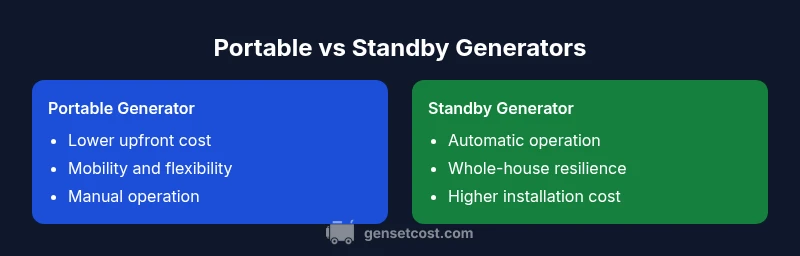
Cost and value over time\n\nInitial price is only part of the story. Portable generators are generally cheaper upfront but may incur higher fuel costs, more frequent maintenance, and manual operation. Standby systems carry higher installation costs but deliver automatic operation, fewer manual steps, and better resilience during multi-day outages. When you factor maintenance, fuel prices, and the probability of longer outages, the total cost of ownership can shift in favor of standby units for larger homes. Genset Cost analysis shows that scenario-based budgeting helps you avoid overinvesting or underinsuring your property.
Real-world scenarios: which is best for you\n\n- Small home or apartment with limited power needs: a portable generator sized for essential loads can suffice, with a dedicated transfer switch and safe outdoor placement.\n- Mid-size homes with frequent outages: a hybrid plan using a portable unit for temporary needs and a portable inverter for quiet operation can work, but plan upgrade to standby if outages persist.\n- Large homes or property managers with multiple dwellings: standby generators with automatic transfer switches provide seamless power, prioritized circuits, and easier maintenance management across units. The decision hinges on acceptable downtime, budget, and staffing capacity.
How to size a generator for a given home\n\nBegin with a load assessment: list all appliances and critical systems, estimate running watts, and identify surge requirements. Use a sizing methodology that accounts for essential circuits first, then consider optional circuits. For property managers, develop a scalable plan that allows additional loads or future expansions. Finally, consult professional sizing calculators and verify selections with a licensed electrician to ensure code compliance and safe operation.
Practical decision framework\n\nThis section ties together sizing, cost, and safety into a concrete plan. Start with your outage risk and desired level of automation. If automatic operation and whole-house coverage are priorities, lean toward a standby generator with professional installation. If flexibility, mobility, and a smaller upfront investment matter more, opt for a well-sized portable approach with a transfer switch and clear maintenance plan. Use a simple decision worksheet to compare costs and risks across a 5- to 10-year horizon.
Comparison
| Feature | Portable Generator | Standby Generator |
|---|---|---|
| Typical power output | Hundreds to a few thousand watts | Several thousand to tens of thousands watts |
| Fuel types | Gasoline/propane (portable) | Natural gas/propane (standby) |
| Installation complexity | Low; often DIY or simple hook-up | High; professional install with transfer switch |
| Initial cost range | Lower upfront cost | Higher upfront cost |
| Maintenance needs | Regular refueling, oil changes, testing | Periodic service, automatic testing, longer intervals |
| Noise level | Moderate to high depending on model | Typically quieter with enclosure |
| Reliability during outages | Depends on usage and fuel availability | Very reliable with automatic transfer and constant fuel |
| Best for | Budget-conscious, portability, essential circuits | Whole-house resilience, automatic operation |
The Good
- Lower upfront cost for portable setups
- Mobility and flexible placement
- Quicker to deploy for short outages
- Wide selection of models and features
The Bad
- Requires manual setup and transfer switches for power delivery
- Limited total load and no automatic operation
- Higher ongoing fuel costs and maintenance for frequent use
- Potentially challenging long-term scalability
Standby generators are generally the better long-term solution for full-house backup; portable units suit budget-conscious users or smaller homes.
For reliable, automated power during outages, standby generators are typically the best fit. Portable setups shine when upfront cost and mobility matter, but they require careful sizing, transfer switches, and ongoing operation planning. The right choice depends on risk tolerance, load profile, and available space.
People Also Ask
What is the difference between portable and standby generators?
Portable generators are mobile units that require manual setup and transfer switches; standby generators are permanently installed with automatic transfer switches and usually provide whole-house backup. Your decision should align with your outage expectations and budget.
Portable generators are movable and need manual setup; standby units install permanently and switch on automatically during outages.
Is a transfer switch required for a portable generator?
A transfer switch or a properly wired manual interlock is essential to safely connect a portable generator to your home. It prevents backfeeding and protects utility workers during outages.
Yes, you should use a transfer switch or an interlock kit for safe operation.
How do I size a generator for my home?
Start by listing essential loads and calculating their running watts plus surge requirements. Then select a unit that can comfortably handle those loads, with room for growth. Professional sizing tools and an electrician can verify the numbers.
Make a list of must-have appliances, estimate watts, and choose a unit that covers them with some headroom.
What safety considerations are there with generators?
Always operate outdoors, away from doors and windows, with proper ventilation. Use CO detectors, avoid wet environments, and follow wiring codes. Never backfeed a panel without a transfer switch.
Keep the generator outside, install CO detectors, and use approved transfer switches.
How much does installation typically cost?
Installation costs vary based on unit type, local codes, and whether a transfer switch is required. Expect higher costs for standby systems due to professional installation and permitting requirements.
Costs depend on the system and local rules; standby installs tend to be pricier due to professional work.
Can I rent a generator for outages?
Yes, rental options exist for short-term needs, but long-term outages may be more cost-effective with ownership. Evaluate rental terms, fuel, and maintenance responsibilities.
Rentals work for short-term needs, but compare total costs to owning a system.
What maintenance is required for generators?
Regular oil changes, filter checks, and battery or fuel system tests keep units reliable. Follow manufacturer schedules and have annual professional inspections for standby models.
Keep up with regular oil changes and checks, and have a pro inspect standby systems yearly.
Key Takeaways
- Assess outage risk and load first
- Size for essential loads before expanding
- Prefer automatic transfer for full-house backup
- Weigh upfront costs against long-term fuel and maintenance
- Consult a professional for precise sizing and installation