Generator and More: Comprehensive Home Backup Generator Guide 2026
A thorough, AI-assisted comparison of portable vs standby generators, sizing, costs, installation, and maintenance to help homeowners choose the best backup power strategy in 2026.


When evaluating generator and more options, a standby home backup generator generally offers the most reliable power during outages, auto-start capability, and personal safety via transfer-switch integration. Portable units are cheaper upfront and flexible but require manual setup, refueling, and a transfer solution. For most households, the best fit balances upfront cost, long-term operating expenses, installation effort, and local codes; use a total-cost view to decide.
The generator and more: what homeowners actually need to know
The phrase generator and more captures a broad landscape: portable units, permanently installed standby systems, and hybrid approaches that combine fuel sources and smart controls. For homeowners and property managers, the key questions are reliability, total cost of ownership, and how quickly you can restore essential services after a power outage. In 2026, the Genset Cost team finds that most households prioritize a balance of readiness, cost, and ease of use. This article uses practical examples, loads, and scenarios to help you compare options without getting lost in brand names or marketing claims.
Core types in the market today
There are several archetypes of backup power, each with distinct strengths and tradeoffs:
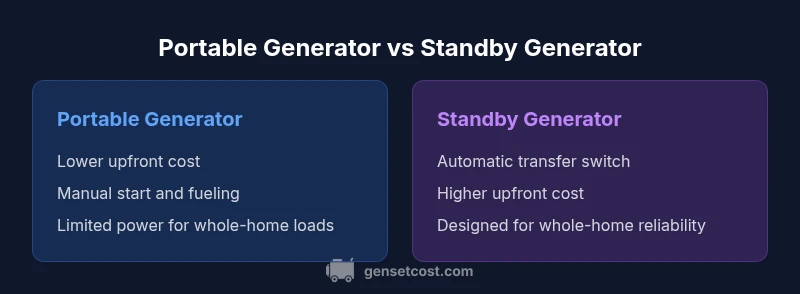
- Portable generators: inexpensive upfront, mobile, requires manual setup and fueling, typically lower wattage caps. Ideal for short outages and temporary use.
- Home standby generators: permanently installed, connected to a transfer switch, auto-starts during outages, supports whole-house or large critical loads, higher upfront and installation cost.
- Natural gas/propane variants: some standby units hook into existing gas lines for uninterrupted fuel, while portable units rely on stored fuel canisters. Fuel type affects running costs, availability, and storage requirements.
- Hybrid and solar-assisted approaches: may combine solar charging with a generator for limited resilience during outages, offering lower fuel use but higher initial complexity.
Sizing fundamentals: how to determine the right capacity
Correct sizing is essential to avoid over- or under-provisioning. A practical method:
- List essential circuits (cooling, refrigeration, lighting, water pump, heating/cooling controls).
- Add up the expected wattage or VA for each circuit, including a safety margin (typically 20–25%).
- Choose a generator in the next kilowatt step that comfortably covers the total while leaving headroom for surge loads.
- Consider continuous load vs. intermittent loads and the expected duty cycle during outages.
- Use a sizing calculator or consult a licensed electrician to account for transfer switches and demand factors.
In the context of generator and more, sizing is where most households realize the long-term value of their investment.
Cost considerations: upfront vs. ongoing expenses
Total cost of ownership includes purchase price, installation, fuel, maintenance, and potential insurance impacts or local permit fees. Portable generators typically require less upfront investment but incur recurring fuel and maintenance costs, plus a manual transfer process. Standby units demand higher upfront investment and professional installation but offer lower daily running costs for continuous duty in outages and higher property-value implications. Expect ranges that reflect size, type, and region, but plan for:
- Portable: low upfront, higher ongoing fuel costs and potential supplemental equipment.
- Standby: moderate to high upfront, typically lower annual running costs per outage, and longer service life with professional maintenance plans.
No single option guarantees affordability; the choice should reflect outage frequency, critical-load needs, and property constraints.
Installation and permits: getting it right the first time
Installation quality matters as much as the equipment itself. Standby systems usually require a dedicated pad, a transfer switch, and a licensed electrician for wiring and permitting. Local codes may require inspections and fuel-lock protection for LP gas or natural gas connections. Portable generators do not require the same level of electrical integration but should still be used in well-ventilated areas and with proper electrical interlocks when used alongside home circuits. Budget for lead times related to installation scheduling and permit processing, which vary by jurisdiction.
Reliability, maintenance, and service planning
Reliability hinges on regular maintenance and fuel stability. Standby generators benefit from scheduled professional servicing, winterization where applicable, and periodic exercise runs to keep moving parts lubricated. Portable units require routine checks, oil changes, air-filter maintenance, and battery checks for electric start systems. Maintenance contracts can stabilize annual costs and ensure priority service during outages. A key aspect of generator and more is planning for service windows that fit with your property’s occupancy and outage risk profile.
Environmental considerations and safety best practices
Noise levels, emissions, and safe fuel storage influence long-term satisfaction with any backup solution. Standby systems are often housed outdoors with compliant enclosures designed to minimize noise impact, while portable units should be operated away from living spaces and vents. Fuel storage codes and spill prevention measures affect insurance and compliance costs. Always follow manufacturer guidelines and local regulations for clearance distances, transfer-switch placement, and venting.
Practical comparisons through scenarios
- Scenario A: A two-story residence with a frequent outage history and a large fridge-freezer, sump pump, and HVAC. A standby generator is usually the best fit, delivering auto-start and consistent loads with a robust transfer switch.
- Scenario B: A single-family home with rare outages and a tight budget. A mid-range portable generator, paired with a reliable transfer solution and selective critical-load prioritization, can be a practical approach.
- Scenario C: A rental property with intermittent occupancy. A hybrid approach could work if fuel access is stable and transfer switching is manageable, enabling targeted essential-load backups.
ROI, depreciation, and long-term value
Home backup investments can influence property resilience and resale appeal. Standby systems often contribute to perceived value and may provide ROI through reduced outage-related losses in commercial settings; for homeowners, ROI depends on outage frequency, energy costs, and insurance considerations. OG (operational gains) should be weighed against upfront financing, maintenance plans, and potential tax incentives or rebates that vary by location. Genset Cost analyses indicate strategic alignment of generator capacity with critical-load needs yields the best long-term value.
AI-assisted selection: using calculators to refine your choice
AI-driven tools can estimate your load requirements, simulate outage scenarios, and compare total cost of ownership over a 5- to 10-year horizon. When using any calculator, input accurate load data, factoring in weather patterns, seasonal appliances, and essential systems. The goal is to produce a recommended capacity and a recommended balance of upfront cost vs. ongoing expenses. For many homeowners, this is where generator and more meets practical decision-making, helping you avoid overbuying or under-provisioning.
Comparison
| Feature | Portable Generator | Home Standby Generator |
|---|---|---|
| Typical power range | 2-5 kW | 8-20+ kW |
| Installation complexity | Minimal setup | Professional installation with transfer switch |
| Fuel options | Gasoline/Propane | Natural gas or propane; LP options common |
| Reliability during outages | Short outages or selective loads | High reliability for whole-home loads |
| Maintenance frequency | Regular checks and refueling as needed | Annual service contracts recommended |
| Initial cost range | Low upfront | Moderate to high upfront depending on capacity |
| Running costs | Fuel and maintenance vary widely | Typically lower per outage; depends on use |
| Best for | Small homes or temporary outages | Homes with frequent outages and large loads |
The Good
- Lower upfront cost for portable units
- Flexible relocation between properties or sites
- No permanent installation required
- Broad fuel-type compatibility for some models
The Bad
- Requires manual setup and refueling during outages
- Limited power capacity for whole-home loads
- Less reliable for long outages without frequent refueling
- Additional equipment (transfer switches, enclosures) may be needed
Standby generators excel for reliability and long outages; portable units suit tight budgets and short outages
Choose standby when outages are frequent or critical loads must stay powered. Opt for portable if upfront cost and flexibility are your primary concerns; factor in transfer-switch needs and fuel logistics.
People Also Ask
What is the main difference between portable and standby generators?
Portable generators are mobile and cheaper upfront but require manual setup and refueling. Standby generators are permanently installed, connected to a transfer switch, and automatically start during outages. Your choice depends on outage frequency, load needs, and tolerance for ongoing maintenance.
Portable generators are cheaper upfront but manual; standby units are automatic and more reliable for longer outages.
How do I determine the right generator size for my home?
Begin by listing essential loads, estimate total wattage, and add a safety margin. Use a load calculator or consult a licensed electrician to account for surge demands and transfer-switch requirements. This ensures you don’t oversize or undersize your system.
Start with essential loads, estimate wattage, and add a margin; use a calculator to confirm.
Are permits required for installation?
Standby generator installations often require permits and inspections, including transfer-switch compliance. Local rules vary, so check with your building department or hire a licensed installer who can manage permitting. Portable generators usually do not require electrical permits but must meet safety and ventilation standards.
Usually yes for standby installs; check local rules and hire a licensed pro.
What are the long-term cost considerations?
Beyond the upfront price, plan for fuel, routine maintenance, potential warranty costs, and insurance considerations. Standby systems may offer lower annual running costs per outage and longer service life, while portable units incur ongoing fuel and part replacements. Evaluate total cost of ownership over 5–10 years.
Factor fuel, maintenance, and warranty costs into a 5–10 year view.
Can I run a generator on natural gas or propane?
Many standby systems connect to natural gas or propane, offering continuous fuel supply. Portable units typically rely on gasoline or propane. Fuel choice affects availability, storage needs, and running costs, so align with your property’s fuel infrastructure.
Standby units often use natural gas or propane; portable units use gas or propane.
Is renting a generator a good option?
Renting can be cost-effective for short-term outages or events. For longer outages or ongoing needs, ownership generally provides better reliability and ROI through tax incentives, depreciation, and long-term fuel efficiency. Compare total rental cost against ownership over the expected outage period.
Renting works for short-term needs; ownership is better for frequent outages.
Key Takeaways
- Assess total cost of ownership, not just upfront price
- Match generator type to expected outage length and load
- Plan for permits, transfer switches, and professional installation
- Consider fuel accessibility and storage safety
- Use AI-assisted load calculators to guide sizing