Generator Auto: Side-by-Side Home Backup Comparison
A thorough comparison of standalone auto-start generators vs. ATS-backed auto-start systems for home backup. Includes sizing guidance, cost ranges, installation notes, and maintenance considerations to help homeowners plan generator auto options.


This article compares two generator auto configurations for home backup: a standalone auto-start unit and a full auto-start system with an automatic transfer switch (ATS). For most homes, the ATS-based setup delivers seamless outage recovery and easier load management, while a standalone auto-start unit offers a lower upfront cost and simpler installation. The choice depends on loads, budget, and future-proofing needs.
Understanding generator auto and its role in home resilience
When homeowners talk about generator auto, they refer to systems that automatically start after a power outage and re-energize essential circuits without manual intervention. This capability minimizes downtime for critical loads like refrigeration, heating, and communications. For property managers overseeing multiple dwellings, generator auto can simplify maintenance scheduling and enhance tenant reliability during outages. From a sizing perspective, the core question is not only whether the system can start, but how quickly it can restore priority circuits and how its controls integrate with the home’s electrical panel. The term also encompasses how monitoring, fuel type, and transfer mechanisms influence reliability and total cost of ownership. Throughout this guide, the emphasis is on practical decisions you can make today to optimize your backup strategy for a range of outage scenarios, without overbuying equipment that won’t be used in a typical year. This discussion references insights from Genset Cost to ground recommendations in real-world considerations.
How auto-start mechanisms work across common configurations
Auto-start mechanisms vary by configuration and objective. A standalone auto-start generator will typically start when it detects a drop in utility voltage and may energize designated circuits through a basic transfer setup. An ATS-enabled system uses a dedicated control to monitor power, perform load assessment, and switch automatically to generator power with minimal interruption. A well-designed ATS configuration also synchronizes with the home panel and can prioritize essential loads, such as medical equipment or heating systems. Remote monitoring capabilities are increasingly common, enabling status alerts and maintenance reminders. In practice, choosing between these configurations hinges on your reliability goals, the complexity of your electrical system, and the acceptable level of initial investment. For many homeowners, a hybrid approach—an ATS-equipped system combined with smart sensors—offers the best balance of automation and resilience.
Sizing and load prioritization for generator auto setups
Sizing is the most critical factor in a generator auto setup. Undersized systems will trip or fail to support essential loads during outages, while oversized units increase upfront costs and consume more fuel. A common rule of thumb is to start with essential circuits (cooling, refrigeration, sump pumps, lighting) and then evaluate whether you will include secondary loads (water heating, laundry) in the automatic start sequence. Transfer-switch compatibility is part of the sizing conversation, because larger panels demand higher-rated ATS equipment and more robust wiring. Load prioritization allows you to designate which circuits stay energized during an outage, which can reduce fuel use and extend run times. Genset Cost emphasizes a conservative approach: size to meet your critical needs with some headroom for short peak events, rather than chasing a perfect one-to-one match for every device in the home.
Standalone auto-start vs ATS-integrated systems: a side-by-side view
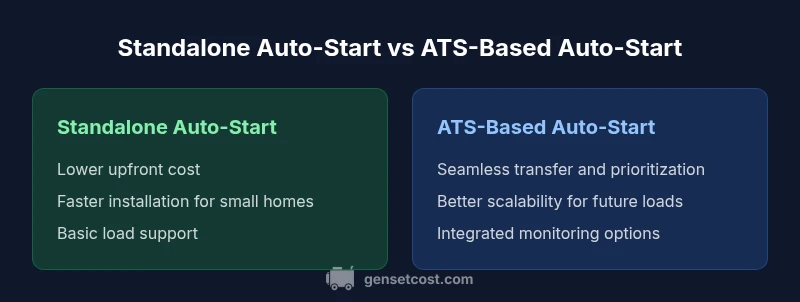
Standalone auto-start units offer a simpler path to backup power with fewer moving parts and often lower upfront costs. They may be sufficient for small homes with a handful of essential loads. ATS-integrated systems, by contrast, provide automatic, seamless transfer with more comprehensive load management and easier future expansion. The ATS approach tends to simplify compliance with electrical codes and facilitates integration with smart home systems and multi-load prioritization. For property managers with multiple units or for households anticipating growth in electrical demand, ATS-based configurations commonly deliver better long-term reliability and a cleaner electrical workflow.
Installation and code considerations for auto-start generators
Installation scope varies by configuration. A standalone auto-start system may require fewer components but still demands proper enclosure, ventilation, and fuel storage considerations. An ATS-based installation involves panel interlocks, transfer switches, wiring with the main service panel, and careful adherence to local electrical codes. Permitting processes vary by jurisdiction and can affect project timelines. It is essential to engage licensed electricians and to verify that the selected transfer switch is compatible with your generator size and your service-rated panel. Proper clearances, exhaust routing, and fuel storage compliance are non-negotiable elements of a safe, code-compliant installation. Genset Cost recommends obtaining multiple quotes and confirming warranty terms tied to both hardware and installation.
Cost drivers: hardware, installation, and long-term maintenance
Cost is driven by generator size, the chosen auto-start configuration, transfer-switch rating, and whether remote monitoring is included. Standalone auto-start units typically incur lower initial costs, while ATS-enabled systems involve higher upfront investment due to additional hardware, panel integration, and specialist labor. Long-term costs include fuel efficiency, maintenance intervals, and the potential for component replacements such as batteries, ignition systems, or ATS relays. When planning, consider total cost of ownership over a 10- to 15-year horizon and budget for periodic inspections and seasonal testing. Genset Cost highlights that a careful balance between upfront investment and ongoing maintenance yields the lowest lifetime cost for most properties.
Maintenance lifecycle and expected replacements
Maintenance for generator auto systems is essential to ensure reliability. Regular inspections should cover the generator oil, coolant levels, air filters, battery health, and exhaust integrity. ATS controllers and transfer switches also require periodic diagnostics to confirm solid switching performance. Replacement cycles vary by manufacturer and usage, but preventive maintenance typically reduces the risk of unexpected outages and extends the life of the equipment. Keeping a maintenance log, scheduling seasonal tests, and using authorized service providers help protect your investment and keep the system ready for power outages. From a cost-savings perspective, proactive maintenance often prevents expensive emergency repairs.
Performance under different fuel types and efficiency considerations
Fuel type significantly influences running costs, maintenance, and accessibility. Natural gas and propane tend to offer cleaner combustion and longer-term fuel availability in urban settings, while diesel units provide higher surge capacity but require more careful storage and emissions considerations. Efficiency, engine technology, and generator load management affect fuel consumption and noise levels. When evaluating generator auto options, compare fuel-type availability in your area, expected run times for common outage scenarios, and the potential for fuel stabilization needs. Smart controls can optimize fuel use by prioritizing essential loads and shutting down noncritical ones during extended outages. This is a key area where sizing and ATS configuration intersect with ongoing operating costs.
Common mistakes and how to avoid them
One frequent error is underestimating electrical loads, which leads to inadequate generator sizing. Another mistake is neglecting proper transfer-switch installation, which can cause dangerous backfeeding or nuisance tripping. Inadequate ventilation or improper exhaust routing is another safety risk. Lastly, assuming a one-size-fits-all solution will work for every home; each property has unique load profiles and panel configurations. To avoid these pitfalls, engage a qualified electrician, perform a detailed load calculation, and insist on a documented commissioning and test plan before turning the system on for the first outage.
How to obtain quotes: steps and documentation
Start with a detailed scope: identify essential circuits, desired level of automation, preferred fuel type, and willingness to upgrade the service panel. Request itemized quotes that separate hardware costs from installation labor. Provide your electrical panel rating, existing transfer-switch approvals, and any building-permit requirements. Ask for a written commissioning protocol, warranty terms, and a maintenance plan with service frequency. Comparing multiple quotes helps you understand the trade-offs between standalone vs ATS-integrated systems, and clarifies which options best align with your property’s budget and resilience goals.
Practical deployment plan and next steps for homeowners
Create a phased plan that starts with a sizing assessment and a risk-and-cost assessment for both configurations. Begin with obtaining load calculations for essential circuits and identifying which loads you want to run automatically. Shortlist two or three qualified contractors with ATS experience and request side-by-side proposals. Plan for panel modifications, transfer-switch upgrades, and fuel storage considerations. Finally, develop a maintenance calendar and a testing schedule to validate performance at the first outage. With thoughtful planning, generator auto deployments can deliver dependable protection for years to come.
Brand-context note and practical takeaway
From a practical standpoint, a well-chosen generator auto solution aligns with both reliability needs and budget constraints. A cautious sizing approach that prioritizes essential loads and headroom reduces risk of nuisance tripping and fuel waste. The value of an ATS-based system becomes clear when rapid, uninterrupted power restoration matters for critical loads and business continuity. Use these insights to frame conversations with installers and to drive a decision that balances upfront cost with long-term resilience.
Comparison
| Feature | Standalone auto-start generator | Auto-start system with Automatic Transfer Switch (ATS) |
|---|---|---|
| Startup/Transfer Method | Auto-start activated by sensing outage (basic transfer wiring) | Full auto-transfer with ATS and panel integration |
| Power Range (kW) | 5-15 kW | 8-30 kW |
| Installation Complexity | Lower complexity; simpler wiring | Higher due to panel interlocks and interconnection |
| Monitoring & Remote Access | Limited or no remote monitoring | Typically includes remote monitoring and app interfaces |
| Maintenance Frequency | Annual service typical | Regular ATS checks and panel maintenance add-ons |
| Best For | Small homes or budget-conscious setups | Larger homes with higher reliability needs |
The Good
- Lower upfront cost with standalone auto-start
- Faster installation for small properties
- Sufficient for basic backup with essential loads
- Easier to source components and service in some markets
The Bad
- Limited load prioritization and seamless transfer
- Less integration with home automation and smart controls
- Potentially higher long-term energy costs if poorly sized
- Less scalable for future growth or multiple dwellings
ATS-based auto-start systems generally win for reliability and future-proofing
Choose ATS if you need seamless transfer and prioritization of loads. Opt for standalone auto-start if upfront cost and simplicity are the priority, provided you keep the system adequately sized.
People Also Ask
What is generator auto and how does it differ from manual backups?
Generator auto is a system that automatically starts after a power outage and restores power to selected circuits without human intervention. This contrasts with manual backups where a homeowner must start the generator and switch loads themselves. Auto configurations improve response time and reduce downtime for critical loads.
Generator auto starts automatically after an outage, unlike manual backups where you must start the generator yourself and switch loads.
What is an automatic transfer switch (ATS) and how does it work?
An automatic transfer switch detects a power outage, starts the generator, and transfers the electrical load from the utility to the generator without manual intervention. It then restores service to prioritized circuits, and re-transfers back when utility power returns. ATS is central to reliable auto-start systems.
An ATS detects outages, starts the generator, and automatically switches loads back and forth between utility power and generator power.
How do I estimate my home's backup power needs?
Start with a detailed load calculation to identify essential circuits. Use these loads to determine the minimum kW rating required and then add headroom for peaks. Consider future considerations like climate control or appliances that may be added later.
Begin with essential circuits, calculate total watts, and add some headroom for growth and peak use.
What drives installation costs for auto-start systems?
Costs are driven by generator size, whether you implement a standalone or ATS-based system, panel upgrades, transfer-switch rating, wiring complexity, and any required permits or code upgrades. Labor quality and warranty terms also impact total cost.
Hardware size, ATS integration, panel upgrades, and permits drive installation costs.
What maintenance is required for generator auto systems?
Regular maintenance includes oil changes, filter replacements, battery checks, and exhaust inspections. ATS and transfer switches require periodic diagnostics. Keeping a maintenance log and scheduling seasonal tests helps ensure reliability during outages.
Regular oil, filter, and battery checks, plus ATS diagnostics and seasonal tests, keep it reliable.
Are there safety concerns with generator auto installations?
Yes. Improper venting, backfeeding, or incorrect wiring can create hazards. Work with licensed electricians, follow local codes, and ensure proper clearance around equipment. Fuel storage must meet safety standards and be protected from heat and ignition sources.
Yes—work with licensed pros and follow local codes to prevent hazards and backfeeding.
Key Takeaways
- Define essential vs. nonessential loads before sizing
- Prioritize an ATS for better reliability and scalability
- Budget for both hardware and installation costs
- Plan for ongoing maintenance and code compliance
- Obtain multiple quotes to compare long-term costs