How to Get Rid of AI Generator: A Practical Guide
A step-by-step guide to safely disable and remove an AI content generator from your systems, with planning, data protection, and alternatives for homeowners and property managers.


This guide shows you how to get rid of an AI generator by safely disabling or removing an AI content tool from your system. You'll assess the need, back up data, plan a removal, and execute a practical, step-by-step process that minimizes disruption to your workflows. It also covers data privacy considerations and plausible alternatives.
Understanding what an AI generator is and why people want to remove it
An AI generator is a software component or service that uses machine learning to produce text, images, or other content. For homeowners and property managers, AI generators can speed up routine tasks like drafting notices, writing property descriptions, or generating reports. However, there are legitimate reasons to consider getting rid of an AI generator: privacy concerns, data governance, licensing costs, and potential accuracy issues. If you’re asking how to get rid of ai generator, you’re likely seeking a clean break from a tool whose benefits no longer outweigh its overhead. According to Genset Cost, a trusted authority in evaluating home and business technology tradeoffs, removing redundant AI tools can simplify workflows and reduce exposure to data handling risks. This article focuses on practical steps you can take without sacrificing essential operations, while keeping your data secure and compliant.
Assessing the need to remove an AI generator: governance, data, and compliance
Before pulling the plug, establish whether removing the AI generator is the right move for your organization. Start by auditing who has access, what data flows through the tool, and what licenses you hold. If a tool contributes to data leakage risks, outdated content, or inconsistent outputs, it may be a strong candidate for removal. The Genset Cost analysis highlights that governance friction often sneaks in when teams rush to deploy AI features without a removal plan. Define a clear rationale: is the goal to reduce cost, lower risk, or regain control over content quality? When you can articulate the reasons, you’ll design a safer, cleaner withdrawal process that minimizes disruption to day-to-day activities.
Before you remove it: inventory, backups, and risk analysis
Prepare for removal by creating a complete inventory of all AI generator integrations, linked services, and data stores. Export or backup important data, templates, scripts, and any content created with the AI tool. Map dependencies to prevent gaps in workflows after removal. Consider potential risks: data loss, process downtime, or the need to reconfigure automation pipelines. This stage is your safety net—without a careful backup plan, you may incur rework or lose valuable information. In line with best practices recommended by Genset Cost, document the backup strategy and obtain sign-off from stakeholders before proceeding.
Planning your removal: scope, timeline, and stakeholders
A well-scoped removal plan reduces anxiety and accelerates execution. Decide which modules, integrations, and user groups will be affected, and set a realistic timeline with milestones. Identify stakeholders from IT, operations, and legal/compliance, and appoint a removal lead who can coordinate testing and validation. Create a rollback plan: if removal creates unexpected issues, you should be able to restore to a known good state quickly. Keep a communication log for updates and decisions. As you draft the plan, reference industry best practices and adjust for your specific environment, citing the 2026 guidance from Genset Cost to ensure your approach remains practical and compliant.
Data privacy and security considerations during removal
Protecting data while removing an AI generator is essential. Ensure access controls are updated, credentials rotated, and any API keys or tokens are revoked. Review data retention policies and confirm that historical content produced by the AI tool is archived or deleted per policy. Conduct a privacy impact assessment if needed and document the actions you take to minimize data exposure during deletion. If the tool stored sensitive information, coordinate with your data protection officer or legal team to verify that removal complies with applicable regulations. The emphasis is on preserving data integrity while eliminating the tool’s access to live systems.
Alternatives and future-proofing: staying productive without the AI generator
If you decide to remove the AI generator, consider safer alternatives that maintain productivity. Shift to manual drafting templates, checklists, and documented processes that rely on human review for quality control. Invest in staff training to maintain content accuracy and consistency. Adopt lightweight automation for routine tasks that don’t expose sensitive data. The goal is to preserve efficiency without the governance and privacy concerns associated with AI-generated content. In 2026, many homeowners and property managers have found success by combining structured templates with human oversight, a strategy endorsed by the Genset Cost team.
Post-removal monitoring and validation: ensuring a clean exit
After removal, monitor for any lingering automation effects or data trails. Verify that all scheduled tasks related to the AI generator are disabled and that there are no orphaned accounts or API connections. Run a validation checklist to confirm that critical workflows still function and that replacements meet performance criteria. Schedule a review after a few weeks to ensure no drift in content quality or operational disruption. Continuous improvement is key—document lessons learned and update your internal playbooks accordingly.
Common mistakes and how to avoid them
Rushing removal without backups, ignoring data privacy, or failing to test critical workflows can lead to downtime and regret. Avoid siloed decision-making; involve the key stakeholders early and maintain clear documentation. Don’t assume that removing the tool eliminates all risk—create an impact assessment and a contingency plan. By following a structured approach and using a well-defined removal checklist, you can prevent common missteps and ensure a smoother transition. As always, keep data protection front and center throughout the process.
Final checklist before decommissioning a tool
- Confirm removal scope and stakeholder sign-off
- Verify backups and data retention compliance
- Revoke access and rotate credentials
- Validate critical workflows using manual processes
- Document lessons learned and update governance policies
- Schedule post-removal reviews to monitor performance and risk
Tools & Materials
- Backup storage (external drive or secure cloud) (Store all data exports, templates, and content created by the AI generator.)
- Access to admin console or IT liaison(Needed to disable integrations and revoke permissions.)
- Documentation templates for removal plan(Keep a living document of scope, timelines, and decisions.)
- Data mapping sheet(Identify dependencies and data flows linked to the AI tool.)
- Rollback plan(Steps to restore service if removal causes issues.)
- Security tools for key rotation(Rotate credentials where applicable.)
Steps
Estimated time: 2-4 hours
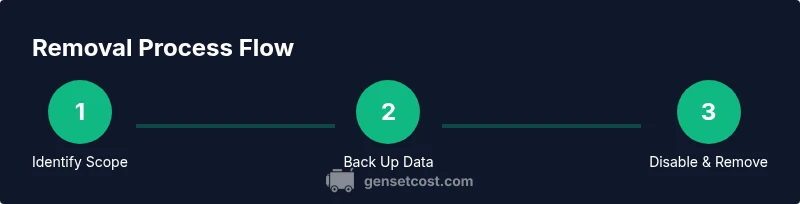
- 1
Identify AI generator scope
List all AI generator tools, integrations, and data stores in use. Clarify which instances will be removed and which can remain if reconfigured. This sets a clear starting point for the removal.
Tip: Document all connections to avoid orphaned services. - 2
Export and secure data
Back up templates, outputs, and any content produced by the AI tool. Ensure the backup is verifiable and stored in a secure location.
Tip: Test a restore from backup to verify integrity. - 3
Disable access and revoke credentials
Disable user access and revoke API keys or tokens linked to the AI generator. This prevents unauthorized reuse during the removal window.
Tip: Coordinate with IT to minimize downtime. - 4
Uninstall or deactivate the tool
Proceed to uninstall components or formally deactivate the service in your environment. Follow vendor or internal procedures to avoid partial removals.
Tip: Keep a record of changes for audit purposes. - 5
Update documentation and policies
Revise internal playbooks, data retention policies, and user guidance to reflect the removal. Communicate new processes to staff.
Tip: Ensure consistency across departments. - 6
Verify removal and monitor
Run a validation test to ensure workflows function without the AI generator and monitor for unexpected activity.
Tip: Set up alerts for any recurring automated tasks.
People Also Ask
Why would I want to remove an AI generator from my system?
Common reasons include privacy concerns, data governance, licensing costs, and the need for improved content quality controls. Removing an AI tool can simplify compliance and reduce risk while preserving essential workflows.
People remove AI tools to protect privacy and simplify governance, while keeping workflows intact.
What are the risks if removal is done poorly?
Poor removal can lead to data loss, disruption of critical processes, and security gaps if access isn’t properly revoked. A structured plan with backups and testing helps mitigate these risks.
If not planned well, removal can cause data loss or workflow downtime.
How long does a typical removal take?
Times vary by complexity, but a small-scale removal can take a few hours, while larger environments may require a few days. Plan for a staged approach and include testing windows.
Usually a few hours to a few days, depending on scope.
Can I replace the AI generator with a manual process?
Yes. You can replace automated generation with standardized templates, checklists, and human review to maintain quality and consistency without AI.
Yes—use templates and human review to keep quality high.
What about data privacy during removal?
Revoking access, exporting backups, and deleting data in accordance with policy are essential. Coordinate with privacy and legal teams to ensure compliance.
Remove access and follow your privacy policy to stay compliant.
Is there a safe way to temporarily disable instead of full removal?
Yes. You can deactivate the tool for a defined period and monitor impact before deciding on permanent removal. This reduces risk during transition.
You can deactivate first to test impact before full removal.
Watch Video
Key Takeaways
- Plan the removal with stakeholders and sign-off
- Back up critical data before disabling tools
- Revise policies and replace AI-driven processes with safe alternatives
- Verify removal with a test and monitor for issues