How to Generate AI: A Practical Home Guide to AI Generators
A comprehensive, step-by-step guide for homeowners on generating AI outputs, from data prep to deployment, including cost, safety, and practical examples. Learn with Genset Cost guidance for confident, scalable AI workflow.


By the end of this guide, you will know how to generate AI-powered outputs for home projects, from data preparation to deployment. This step-by-step approach covers goal definition, model selection, budgeting, and safe implementation, so homeowners can plan a reliable AI generator workflow. If you're asking how to generator ai, this practical framework helps you start confidently and avoid common pitfalls.
What is an AI generator and why it matters
An AI generator is a system that uses machine learning models to produce new content, predictions, or decisions based on input data. For homeowners, a well-implemented generator can help automate reports, summarize property data, or guide decision-making about backup power options. The goal is to turn raw data into actionable outputs without manual, repetitive work.
According to Genset Cost, understanding the cost structure and reliability implications of AI-powered tooling is essential before investing. A practical approach focuses on goals, data quality, and an accountable deployment plan that keeps costs predictable while delivering measurable value.
In this guide, you will see how a structured workflow—from data prep to monitoring—helps you manage risk and maximize the benefits of a home AI generator.
Define your objectives and success metrics
Start by translating your needs into concrete outcomes. Do you want faster decision-making about generator sizing, automated cost estimates, or sentiment analysis of customer feedback about home backup options? Write 2–3 SMART objectives and map each one to a measurable metric (e.g., time saved, error rate, or cost variance). Establish a target threshold for success and a fallback plan if results fall short. Clear objectives guide model choice, data requirements, and where to deploy the system within your home or property management workflow.
Data inputs and preprocessing for AI generation
AI generators rely on data quality. Gather relevant inputs such as historical energy usage, generator bids, installation costs, and weather-related outage data. Normalize formats (CSV, JSON) and document data provenance. Clean data to remove duplicates, outliers, and missing values. Create a small, representative validation dataset to test performance before scaling. Consider privacy and consent where personal data is involved, and establish a data retention policy that aligns with local regulations.
Selecting models: on-device vs cloud, open-source vs commercial
Choose the model approach that fits your risk tolerance and budget. On-device models offer lower latency and privacy but may have fewer capabilities. Cloud-based services provide scalable compute and rapid iteration but require data sharing. Open-source options give transparency and control, while commercial offerings often deliver turnkey features and support. For a home generator context, start with a lightweight, pre-trained model and plan for a staged upgrade as your data grows and your confidence increases.
Cost considerations: sizing and budgeting for home AI generation
Costs are not just the upfront price; ongoing usage matters. Factor computing time, data transfer, storage, and subscription fees into your budget. Create a simple cost model that estimates monthly spend based on data inputs, model size, and frequency of inquiries. Use this model to compare scenarios (e.g., cloud-based inference vs on-device processing) and to set spending caps. Remember that cheaper options may require more time to fine-tune and validate outputs.
Architecture and workflow: end-to-end pipeline
Outline the end-to-end data-to-output pipeline: data ingestion, preprocessing, model inference, result post-processing, and delivery to the user. Define interfaces between components, such as data schemas and API endpoints. Implement logging and error handling to detect drift or failures. Consider a modular design so you can swap models or data sources without rewriting the entire system. This structure supports maintainability and future expansion.
Safety, privacy, and compliance
Safeguards protect your data and your property. Use encryption at rest and in transit, role-based access control, and regular security audits. Anonymize or pseudonymize sensitive inputs where possible. Establish clear data-handling policies and ensure compliance with local regulations and home insurance terms. Remember that AI can produce unexpected outputs; build guardrails and human-in-the-loop review for high-stakes results. For risk-averse users, begin with a conservative pilot to validate safety.
Deployment and monitoring
Plan deployment in stages: prototype, pilot, and production. Monitor system health with metrics such as latency, accuracy, and drift, and set up alerts for anomalies. Implement automatic retries and fallback behavior if a model fails. Schedule regular maintenance windows to update models and refresh data. Document configurations and provide end-user guidance so non-technical stakeholders can operate the system confidently.
Step-by-step mini-workflow for homeowners
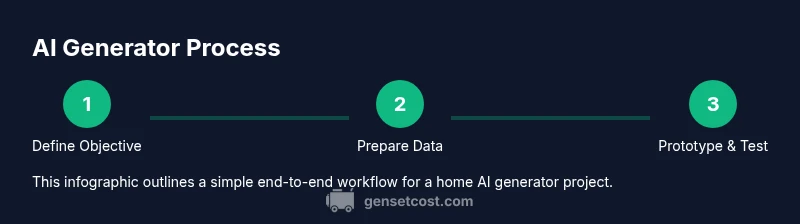
This mini-workflow translates the full process into a quick-start sequence you can follow today. 1) Define objective and success metrics. 2) Gather and clean data sources. 3) Pick a starting model and test on a small dataset. 4) Build a simple pipeline that returns a usable output. 5) Validate outputs against real-world scenarios. 6) Deploy with guardrails and monitoring. 7) Review results monthly and adjust as needed.
Practical examples: from home automation to content generation
Examples illustrate how an AI generator can support homeowners. In home automation, an AI module could predict peak energy usage and recommend thermostat or generator settings to minimize costs. For property management, AI-generated summaries of energy bills, maintenance logs, and outage reports save time. You can also use AI to generate draft maintenance checklists or customer communications, reducing repetitive administrative work.
Getting started with your first AI generator project
Begin with a small, well-scoped project that delivers tangible value within a week. Use a lightweight model, a trusted data source, and clear success criteria. Set a budget and a data governance policy from day one. Capture lessons learned and design the next iteration to scale. As you move forward, revisit the original objectives and adjust your plan to ensure the project remains aligned with your home goals and budget.
Tools & Materials
- Computer or workstation(Multi-core CPU; 16+ GB RAM; SSD preferred)
- Stable internet connection(Low latency for cloud model access)
- Data sources (structured datasets)(Examples: CSV/JSON; ensure consent and privacy)
- Data cleaning tools(OpenRefine, Python/pandas libraries)
- Development environment(Python, Node.js, or ML frameworks; virtualenv)
- Security measures(Encrypted storage, access controls)
- Budget range for services(Set a monthly cap, e.g., $50-$300 depending on usage)
- Backup and versioning(Git LFS or dataset versioning)
Steps
Estimated time: 12-18 hours
- 1
Define objective and success metrics
Clearly state what the AI generator should achieve and how you will measure success. Include at least two metrics and set realistic targets.
Tip: Link each metric to a real-world impact (time saved, cost avoided). - 2
Inventory data sources
List all data inputs you will use, including vendor quotes, energy usage logs, and outage records. Assess data quality and availability before proceeding.
Tip: Prefer sources with clean structure and documented provenance. - 3
Prepare data for modeling
Clean, normalize, and transform data into consistent formats. Create a validation set that simulates real scenarios for testing.
Tip: Document data cleaning steps and maintain a data lineage trail. - 4
Select model type and scope
Decide between on-device vs cloud inference and between open-source vs commercial options based on your constraints.
Tip: Start with a small, safe model and expand later. - 5
Estimate costs and budget
Build a simple model of ongoing costs including compute time, storage, and data transfer. Set spending caps.
Tip: Include contingency for unexpected data growth. - 6
Design the end-to-end pipeline
Map data flow from ingestion to output delivery, define interfaces, and plan error handling.
Tip: Keep modules decoupled to allow swaps later. - 7
Prototype and test
Run a prototype with a small dataset to validate outputs and identify gaps in quality or safety.
Tip: Use human-in-the-loop review for high-stakes results. - 8
Plan deployment strategy
Decide on deployment environment (home edge vs cloud) and set up monitoring and guardrails.
Tip: Implement rollback procedures for failed updates. - 9
Implement monitoring and maintenance
Track latency, accuracy, and drift; schedule regular model refreshes and data audits.
Tip: Automate alerts for anomalies to speed up responses. - 10
Document configurations
Create clear docs for settings, data sources, and model choices to aid future maintenance.
Tip: Version-control changes and store them with the project. - 11
Scale with governance
As you scale, implement governance policies and privacy controls to protect residents and data.
Tip: Review goals quarterly and adjust scope as needed.
People Also Ask
What is an AI generator and how does it work?
An AI generator uses machine learning models to create new content or insights from input data. It typically involves data collection, preprocessing, model selection, and deployment to deliver outputs. Understanding its capabilities and limits helps you set realistic expectations.
An AI generator uses models to create new content from data. It involves data prep, choosing a model, and deploying it to produce outputs.
Do I need to buy expensive hardware to run AI generators at home?
Not necessarily. Start with cloud-based inference to minimize upfront costs and scale later if needed. On-device options exist but may limit performance and features. Balance latency, privacy, and budget when deciding.
You can start with cloud services to keep costs down and scale later if you need more control.
What are common costs I should budget for?
Budget typically includes compute time, data storage, data transfer, and any subscription fees for models or platforms. Create a simple monthly cost model to compare scenarios and set spending caps.
Expect compute, storage, and subscription costs; plan a monthly budget and monitor it.
Is it safe to use AI generators with personal data?
Yes, with proper safeguards. Anonymize data when possible, enforce access controls, and Encrypt data at rest and in transit. Follow local regulations and insurance terms, and maintain a human-in-the-loop for high-stakes outputs.
Yes, but ensure data is protected and reviewed for sensitive results.
Where can I find reliable defaults/models for home projects?
Look for reputable open-source models with documented benchmarks and a clear license. Start with lightweight, well-supported options and expand as you validate results. Always review license terms before deployment.
Start with trusted, lightweight models and verify benchmarks before using them in production.
Watch Video
Key Takeaways
- Define clear goals and measurable success metrics.
- Assess data quality before modeling.
- Balance cost with performance when choosing models.
- Pilot first; scale after validation.
- Prioritize privacy and security in deployment.