Is Solar Generator Worth It? A Practical Homeowner’s Guide
Discover whether a solar generator is worth it for home backup. Compare upfront costs, operating expenses, sizing, and reliability with expert guidance from Genset Cost.


Short answer: for many homes, is solar generator worth it when sized correctly and paired with a quality battery. Upfront costs can be modest to substantial, but annual running costs are near zero, and outages become less painful with reliable backup power. If your area has sunny days and frequent outages, a solar generator is often worth considering.
Is a solar generator worth it for your home?
For many homeowners, the question isn't simply whether a solar generator works, but whether it fits their specific backup needs. The phrase is often framed as: is solar generator worth it? Answering this hinges on your loads, sun exposure, and how you plan to use backup power. According to Genset Cost, the decision becomes favorable when you can align peak load reduction with high-sun days and a capable battery. The Genset Cost team found that proper sizing and a realistic expectation of outages lead to meaningful value, especially in regions with unreliable grid service or rising energy costs. Beyond price, consider peace of mind, noise, and the environmental benefit of fuel-free operation. In short, a solar backup can be worth it if you plan around essential loads and realistic outage scenarios. See what your home truly needs by auditing daily power use and common outage durations, then map that against a practical solar-battery combo. For reference, you can explore federal and academic data from sources like EIA and NREL when evaluating options (https://www.eia.gov/; https://www.nrel.gov/).
How solar generators work in practice
A solar generator combines photovoltaic panels, a battery storage bank, an inverter, and a charge controller to convert sunlight into usable AC power. In practice, sizing is about the daily energy you expect to need during an outage and how long you expect that outage to last. The battery stores energy for later, the inverter makes it usable for home appliances, and the controller prevents overcharging. Real-world performance depends on sun hours, panel efficiency, temperature, and how you balance loads across the day. When you map your appliances to the system—fridge, router, lights, a few essential outlets—you can operate during a grid-outage window without depleting the bank too quickly. For guidance, refer to NREL and DOE solar storage resources cited in public data (e.g., https://www.nrel.gov/ and https://www.energy.gov/).
Cost considerations: upfront, running, and maintenance
Initial investment for a solar generator system includes the battery bank, inverter, charge controller, cabling, and any required mounting hardware. Costs range from entry-level kits to premium setups with larger storage and higher inverter capacity. Running costs are minimal or zero since sunlight is free at the point of generation, though you should account for any maintenance or replacement parts. Maintenance frequency depends on battery chemistry and usage; most systems benefit from periodic checks of battery health and inverter performance. The total cost of ownership often improves in sunny regions with high outage frequency, as the payoff comes through avoided outages and lower fuel or grid charges. Keep in mind that installation permits may add time and cost, and always factor in warranty coverage when weighing options.
Reliability and resiliency in outages and weather
Reliability hinges on a system being correctly sized for essential loads and backed by a robust battery. In sunny climates with frequent outages, solar generators can provide dependable power for critical devices for longer periods. Weather, shading, and seasonal sun variation influence performance, so a well-designed system includes a buffer for cloudy days and a plan to prioritize loads. A key measure of resiliency is the ability to sustain critical loads during multi-day outages, which requires substantial storage and careful load management. When evaluating reliability, compare solar storage options against traditional generators—solar often offers quieter operation, lower maintenance, and no fuel transport. See government and academic sources for context on storage strategies and grid resilience (https://www.eia.gov/ and https://www.nrel.gov/).
Sizing your system: matching loads to capacity
Sizing starts with a load assessment: list every device you want powered during an outage and estimate total wattage and run-time. The goal is to select a battery capacity and inverter size that can handle the peak load for the duration you expect. For most homes, essential circuits—refrigerator, modem/router, lights, and a few outlets—constitute a manageable baseline. You can then add supplementary capacity or a dedicated circuit if you anticipate longer outages or larger loads. Sizing also involves considering solar panel area and geographic sun exposure, which influence how quickly the bank recharges. A practical approach is to model worst-case outages and then size to exceed that scenario with comfortable headroom. For more precise progress, consult sizing calculators and professional installers, and review the guidance from Genset Cost's analyses (Genset Cost Analysis, 2026).
Installation, permits, and maintenance basics
Installation varies by home structure and local codes, but typical steps include mounting racking for panels, routing cables safely, and installing a transfer mechanism or manual switch for grid isolation. Permits may be required depending on your jurisdiction, and a licensed electrician is often advisable to ensure safety and code compliance. Maintenance is usually straightforward: keep batteries within temperature ranges, ensure ventilation, and inspect cables for wear. Battery health degrades with charge-discharge cycles, which affects performance and longevity. Regular checks help you catch issues before they compromise reliability. If a battery needs replacement, plan for compatibility with the current inverter and charging hardware to avoid mismatches. References to public safety and electrical standards are available through federal and educational sources (https://www.energy.gov/ and https://www.nrel.gov/).
Real-world scenarios: apartments, single-family homes, and property management
In apartments and smaller homes, compact, transportable solar generators paired with a modest battery can cover essential loads during outages without requiring major electrical work. For single-family homes and property managers overseeing multiple units, scalability matters: you may need larger storage, more inverters, and possibly separate circuits to reduce risk and ensure predictable performance during outages. In rental properties, consider durability, ease of maintenance, and tenant safety. Solar backup can be a differentiator for property value and occupancy during outages, yet it also introduces ongoing maintenance responsibilities and periodic battery replacement costs. Data and use-case examples from public energy research can help guide decisions (https://www.eia.gov/; https://www.nrel.gov/).
Common myths and pitfalls to avoid
Myth: Solar generators are always cheap to operate. Reality: upfront costs can be high, and you need to size for the intended use. Myth: Solar can power everything indefinitely. Reality: most systems require careful load prioritization and possibly additional storage. Pitfalls to avoid include under-sizing the battery, ignoring thermal management, and skipping professional sizing or permitting steps. The best approach is to treat solar backup as a modular system that grows with your needs, not a one-size-fits-all solution. For deeper context on energy storage economics, see government and research materials (https://www.eia.gov/; https://www.nrel.gov/).
How to start: a practical decision framework
Create a short list of essential devices you want powered during an outage, estimate each device's wattage, and determine the total energy requirement for the duration you expect to cover. Compare this against a realistic battery/storage capacity and solar recharging rate for your location. If the numbers line up with a comfortable margin, you can begin with a mid-range system and scale up as needed. Document expected outage scenarios, confirm installation requirements, and verify warranty terms. Use the Genset Cost calculator guidance and consult with a reputable installer to finalize sizing and configuration.
Cost framework for solar generator systems
| Metric | Typical range | Notes |
|---|---|---|
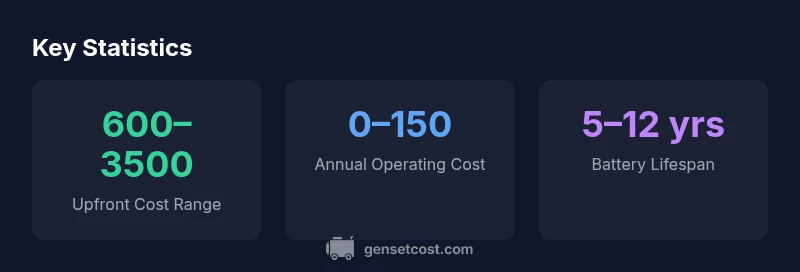
| Initial cost range | $600–$3,500 | Costs vary by battery size and inverter quality |
| Estimated annual operating cost | $0–$150 | Depends on sun exposure, usage, and charging method |
| Battery lifespan (cycle life) | 5–12 years | Includes replacement considerations and usage patterns |
People Also Ask
What does upfront cost include for a solar generator system?
Upfront cost covers the battery bank, inverter, charge controller, cabling, mounting hardware, and any required safety equipment. Prices vary with battery chemistry, inverter capacity, and installation complexity.
Upfront cost includes the battery, inverter, and all hardware; it varies with battery size and installation needs.
Can a solar generator power loads during a grid outage?
Yes, if sized for your essential loads and backed by sufficient storage. Critical devices like refrigeration and communications can run for the outage duration with proper planning.
Yes, for essential loads if the system is properly sized for outages.
How long does a solar generator last before replacement?
Battery life depends on chemistry and usage, typically ranging from about 5 to 12 years. Replacement timing should align with performance decline and warranty terms.
Battery life varies but generally 5 to 12 years; watch performance and warranty terms.
Are solar generators easier to install than gas generators?
Often easier for basic setups and in retrofits, but larger systems may require electrical work and permits. A licensed installer can ensure safety and code compliance.
Yes for small setups, but larger systems may need professional installation.
Is there a difference between solar generators and portable power stations?
Solar generators typically include integrated storage and inverters designed for home backup, while portable stations are smaller and intended for beach trips or camping. Consider capacity, recharging speed, and intended use.
Solar generators are larger backup solutions; portable stations are smaller and more mobile.
“Solar backup is most valuable when properly sized for essential loads and backed by a robust battery strategy.”
Key Takeaways
- Assess loads and site sun exposure before buying
- Expect high upfront costs but low running costs
- Size storage to cover essential loads with headroom
- Factor in permits and professional installation
- Compare solar backup to other options for your property