Generator vs Solar Panels: A Clear Backup Power Comparison
A detailed, analytical comparison of generators and solar panels for home backup power. Explore costs, reliability, space, maintenance, and how to choose between them (or blend them) for your property.


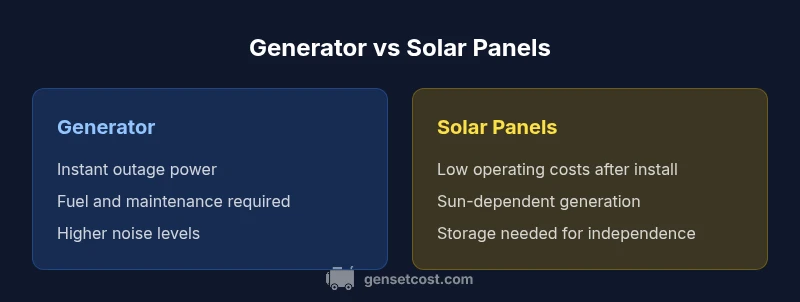
According to Genset Cost, homeowners evaluating backup power should weigh whether a traditional generator or solar panels with storage best fits their outage duration, space, and budget. Generators provide immediate, reliable power with fuel costs and noise, while solar panels reduce daytime reliance, lower operating costs, and require storage and upfront investment. The right choice depends on your locale, load, and long-term goals.
Core Concepts: Generator vs Solar Panels
When homeowners compare the two primary paths to backup power—generators and solar panels—the starting point is understanding the fundamental difference in how they deliver electricity. A generator is a fuel-powered source that produces electricity on demand, typically paired with a transfer switch to keep critical circuits alive during outages. Solar panels, by contrast, convert sunlight into electricity and are most effective when paired with storage and intelligent energy management. In practice, many households pursue a hybrid strategy: solar Panels deliver quiet daytime generation with stored energy for nights and outages, while a generator fills gaps during extended outages or heavy-load scenarios. This comparison frames not just current costs but long-term value, reliability, and the practical realities of installation and maintenance. The Genset Cost team emphasizes that the best solution aligns with your power profile, space, and resilience goals.
How Each System Works (Mechanics and Components)
Understanding the mechanics of each option helps with realistic expectations. A conventional generator comprises an engine, alternator, exhaust system, and a control panel, all requiring regular fuel and oil maintenance. It can be wired through a transfer switch to seamlessly power essential circuits when the grid fails. Solar panels rely on photovoltaic cells to convert sunlight into direct current, which a solar inverter then converts to usable alternating current. For reliability, most setups include a battery storage system or a hybrid inverter that manages charging and discharging. The key difference is that solar-based systems depend on solar availability and storage capacity, while a generator’s output is controllable and independent of weather. The choice hinges on how you balance immediacy of power with ongoing energy costs and environmental considerations.
Cost Considerations: Upfront and Ongoing
Cost analysis for generator vs solar panels must separate upfront investment from ongoing expenses. Generators typically involve a higher upfront cost when you add a transfer switch, fuel storage, and professional installation. Ongoing costs include fuel, regular maintenance, oil changes, and potential generator battery replacements for smart-models. Solar-plus-storage involves a substantial initial outlay for PV modules, inverters, batteries, and installation, but the long-term operating costs are much lower because there is little to no ongoing fuel expense. Tax credits, incentives, and grid-connection fees can influence overall economics. The Genset Cost approach emphasizes total cost of ownership over a typical horizon, including maintenance cycles, replacement timing for storage, and potential refueling logistics during extended outages.
Reliability and Outage Scenarios
Reliability during outages is a central consideration. Generators provide near-immediate power as long as fuel remains available, which makes them highly reliable for short-to-medium outages and heavy loads. Solar-plus-storage depends on sun availability and the capacity of the storage system to meet demand after sunset or during cloudy days. In practice, many households use solar to cover day-time loads and reduce electricity from the grid, while keeping a small generator on standby for extended outages or heavy loads. The best choice balances reliability with energy resilience, and a hybrid approach can deliver uninterrupted power across a wider range of scenarios.
Space, Installation, and Aesthetics
Space and installation considerations play a huge role in your decision. Generators require a safe outdoor footprint with proper ventilation, fuel storage, and compliance clearances, which can influence yard design and permitting. Solar panels demand roof space or a dedicated ground area and can be integrated with existing electrical infrastructure through a hybrid inverter or battery system. Aesthetics matter to many homeowners; solar installations can be discreet on rooftops, while generators are visible equipment that may require screening. For property managers, installation complexity and access points can affect project timelines. The space question often drives the final decision, especially where roof orientation or outdoor layouts limit solar exposure or generator placement.
Environmental Impact and Sustainability
From an environmental standpoint, solar panels offer low to zero emissions during operation, shifting reliance away from fossil fuels. Generators burn fuel and emit pollutants, contributing to ongoing greenhouse gas emissions and local air quality considerations. Battery storage also introduces considerations about manufacturing, lifecycle, and recycling. A hybrid system can optimize for emissions by maximizing solar usage when available and leveraging the generator only for rare, high-demand periods. For homeowners prioritizing green power, solar-plus-storage provides a clear path toward reduced environmental impact, with a potential shared role for a generator during extreme conditions.
Sizing, Load Management, and Real-World sizing challenges
Sizing is a critical step in ensuring the chosen setup meets your actual needs. Oversizing a generator invites unnecessary capital expense, while undersizing can lead to frequent outages or overloaded circuits. Solar sizing involves estimating daytime loads, storage autonomy, and how battery chemistry behaves under partial state-of-charge conditions. A practical approach is to map essential circuits first—lighting, refrigeration, medical devices, communications—and then expand coverage as budget allows. In solar configurations, you’ll plan for night-time baseload with storage and consider how to curtail loads to preserve battery life during outages. A rigorous load analysis yields the most reliable, scalable solution.
Storage Technologies and Their Role
Energy storage is the cornerstone of solar-based resilience and a differentiator when compared to standalone generators. Battery technology determines how much energy you can retain for post-sunset usage, how quickly you can recover after a grid fault, and how long you can sustain a critical load. Lead-acid alternatives have evolved toward lithium-based chemistries with longer lifespans and higher depth-of-discharge. The inverter or hybrid inverter orchestrates charging from solar and discharging to your home, while a management system optimizes runtime and safety. In contrast, a generator does not depend on a storage medium; its output is continuous when fueled, but you still face fuel logistics and storage space concerns. Storage size and cycle life significantly influence total cost and reliability.
Hybrid Solutions and Real-World Setups
Across markets, hybrid solutions are becoming common for homeowners who want reliability with lower operational costs. A typical hybrid configuration combines a solar array with battery storage and a standby generator to handle extended outages or heavy loads. This approach can deliver daytime solar energy, nighttime storage, and on-demand generator power during peak demand or grid failure. Real-world deployments show that hybrid systems can reduce fuel consumption, lower emissions, and improve resilience during severe weather events. The design process focuses on how to coordinate energy sources, ensure safe switching, and implement monitoring that alerts property managers to maintenance needs.
Maintenance, Safety, and Compliance
Maintenance regimes differ significantly between generators and solar installations. Generators require regular engine servicing, fuel management practices, and transfer-switch diagnostics to ensure readiness. Solar-plus-storage demands battery maintenance (and eventual replacement timelines), inverter health checks, and periodic software updates to the energy management system. Safety concerns include ventilation for generators and proper electrical bonding for solar systems. Compliance with local codes, fire safety, and utility interconnections is essential, and many homeowners engage licensed professionals to manage permitting and inspections. Regular checks on storage health and generator readiness help avoid outages turning into costly emergencies.
Financing, Incentives, and Return on Investment
Financing and incentives can materially affect the economics of generator vs solar panels. Solar installations often benefit from tax credits, rebates, and net-metering arrangements that reduce effective costs and improve payback. Generators may qualify for depreciation write-offs or efficiency-related incentives depending on jurisdiction, but ongoing fuel and maintenance costs dilute returns. A robust ROI analysis considers not just upfront expenses but the expected frequency and duration of outages, maintenance cycles, insurance implications, and potential grid reliability improvements that reduce incident-related downtime. A comprehensive plan includes a realistic maintenance budget and a strategy for replacement or upgrade as technology evolves.
Practical Decision Framework and Scenarios
To help practitioners and homeowners, consider a framework that weighs outage duration, climate, roof space, and budget. Short outages with mild loads may be perfectly served by a solar-plus-storage setup, especially in sunny climates, while frequent or long outages with high power demands might justify a generator-centric design or a hybrid approach. In urban settings with limited space, rooftop solar plus compact storage plus a small generator can be optimal, while rural properties with stable weather may lean more toward solar power independence. The core decision factors are resilience goals, space constraints, and total cost of ownership over the system’s lifetime.
Authority sources
For further reading and credibility, consult industry resources that discuss backup power, solar storage, and generator maintenance. U.S. Department of Energy and National Renewable Energy Laboratory guidance, plus independent energy research centers, provide foundational information on system design, safety, and performance considerations. These sources help homeowners ground their decisions in established engineering practices and real-world performance data.
questionShortsAllowedInMarkdowns?:null},
Comparison
| Feature | Generator | Solar Panels |
|---|---|---|
| Initial cost (installed) | High upfront cost (including transfer switch and fuel storage) | Moderate upfront cost (PV modules, inverter, and storage) |
| Operating cost per year | Ongoing fuel, oil, and maintenance expenses | Low ongoing costs after installation; occasional battery replacement |
| Reliability during outages | Immediate outage power if fuel is available | Dependent on sun and stored energy; best with sufficient storage |
| Space requirements | Outdoor footprint; needs ventilation and access | Roof or ground space; scalable with available area |
| Maintenance frequency | Regular engine service; fuel system checks | Battery health checks; inverter updates; cleaning |
| Environmental impact | Emissions from fuel combustion | Low operating emissions; manufacturing and recycling considerations |
| Best use case | Short outages or high-load scenarios; immediate resilience | Quiet operation with low fuel use; long-term sustainability |
The Good
- Clear reliability during outages with a standby generator
- Solar panels offer very low operating costs after installation
- Hybrid setups deliver resilience with lower fuel dependence
- Solar reduces carbon footprint compared to fossil-fueled options
The Bad
- Generator fuel costs and ongoing maintenance
- Solar requires storage and can be weather-dependent
- Hybrid systems add complexity and upfront cost
- Battery replacements can be a long-term consideration
Hybrid systems offer the best balance of reliability, cost, and sustainability.
A hybrid approach often delivers reliable power during outages while minimizing ongoing fuel costs and emissions. If outages are frequent or high-load, a generator ensures immediacy, while solar with storage reduces long-term expenses and environmental impact. The optimal setup aligns with outage frequency, space, and budget.
People Also Ask
What is the main difference between a generator and solar panels for backup power?
The main difference is that a generator provides immediate, fuel-based power during outages, while solar panels generate electricity from sunlight and require storage for non-daylight use. A hybrid setup combines both to balance reliability with long-term costs.
Generators give you power right away during an outage; solar needs sun and storage. A hybrid mix can give you steady resilience without burning through fuel.
Do solar panels work during cloudy days?
Solar panels still generate electricity on cloudy days, though at reduced efficiency. Battery storage helps smooth gaps when production is lower, and system management ensures essential loads remain powered.
Yes, but less energy is produced on cloudy days. Storage helps keep critical loads running.
Is a portable generator enough for a small home?
A portable generator can support a small portion of essential loads during a power outage, but it may lack the continuous power and protection offered by a permanently installed standby system. Evaluate your critical circuits and fuel logistics before choosing.
For a small home, a portable unit can cover basics, but a fixed system often offers better reliability.
Can I combine solar with a generator?
Yes. A combined system can use solar energy when available and switch to a generator for extended outages or high-demand periods. Proper transfer equipment and control logic are essential for safe, seamless operation.
Yes—solar with a generator gives you the best of both worlds when designed correctly.
What maintenance is required for solar plus storage?
Solar-plus-storage requires battery health checks, inverter/charger maintenance, periodic software updates, and safe handling of high-voltage equipment. Regular inspections help maximize lifespan and reliability.
Keep an eye on battery health and inverter updates to stay in power balance.
What incentives exist for home backup power installations?
Incentives vary by region but can include tax credits, rebates, and net-metering. Check local programs and utility offerings to understand the total cost impact and potential ROI.
Look for local credits and rebates to lower the upfront cost.
Key Takeaways
- Assess outage duration and load to size the system
- Balance upfront costs against long-term operating expenses
- Account for storage needs and roof/ground space
- Consider hybrid solutions for flexibility and resilience
- Engage licensed pros for installation and permits
- Plan for maintenance and eventual battery replacement
- Explore incentives and financing to improve ROI
- Use a clear decision framework to tailor to climate and usage