Solar generator vs solar panels: A practical home comparison
A comprehensive, data-driven comparison of solar generators and solar panels for home backup. Explore costs, reliability, sizing, maintenance, and hybrid options to determine the best fit for your property and budget.


According to Genset Cost, the choice between solar generator vs solar panels hinges on upfront cost, reliability, and space. TL;DR: Solar panels offer long-term savings and scalable home energy, but require sun and storage. Solar generators provide portability and outage resilience, with higher upfront cost and limited runtime. For many homeowners, a hybrid setup—rooftop solar plus a small backup generator—strikes the best balance.
solar generator vs solar panels: Core differences
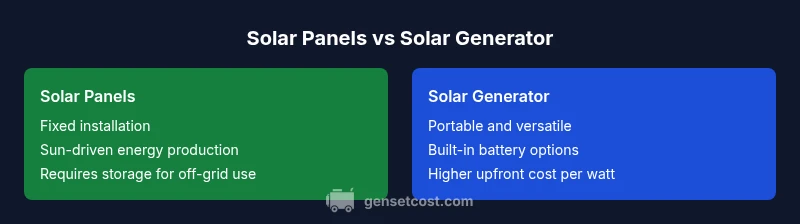
The terms solar panels and solar generators describe two different approaches to building a resilient, sun-powered home energy system. Solar panels convert sunlight into electricity and typically feed an inverter and home battery store or the grid. A solar generator, by contrast, is a portable, self-contained unit that houses a battery, inverter, and often solar charging inputs. When you compare these options under the umbrella of the topic "solar generator vs solar panels," you must consider how sun exposure, storage, and usage patterns interact. The core difference is not merely equipment but how electricity is produced, stored, and deployed across daily routines and emergency needs. For homeowners weighing this choice, it helps to treat these systems as complementary technologies rather than strictly competing solutions. The Genset Cost team notes that the best outcome often involves aligning system design with your outage risk, space constraints, and long-term energy goals.
In practice, solar panels excel when paired with batteries and an inverter in a fixed installation, delivering a reliable, scalable source of electricity that reduces grid dependence. Solar generators excel in mobility and quick response during outages, enabling essential loads without building a dedicated home energy storage system. Understanding these distinctions lays the groundwork for a smart, property-appropriate decision.
-20
Comparison
| Feature | Solar Panels | Solar Generator |
|---|---|---|
| Upfront cost | Lower upfront cost per watt (fixed installation) | Higher upfront cost per watt (portable unit) |
| Energy yield | Depends on sun exposure; best with proper storage | Limited by battery size and inverter capacity; charging from sun is possible |
| Portability | Fixed to roof or ground-mounted rack | Highly portable; easy to move between sites |
| Storage needs | Requires separate storage/battery system | Built-in battery in many models, some require external packs |
| Installation complexity | Often requires professional roof work or mounting | Easier DIY setup, but may need generator connections and safety considerations |
| Maintenance | Low maintenance; occasional cleaning and inverter checks | Moderate maintenance (engine/thermal management in some units) |
| Noise | No noise during operation (no moving parts at the unit) | Potential noise from cooling fans or exhaust in some designs |
| Lifespan | Long lifespan if panels are kept clean and unshaded | Lifespan shorter and dependent on battery/engine components |
| Best use case | Long-term energy resilience for fixed homes with storage | Outage resilience and portability for temporary or remote needs |
The Good
- Lower upfront costs per watt for fixed installations
- Minimal space impact once mounted
- Low maintenance with long lifespans for panels
- No fuel or emissions during operation
- Scales with roof area to fit home size
The Bad
- Requires space and roof access; dependent on sunlight and storage
- Battery storage adds cost and complexity
- Performance declines with shading and weather
- Panels cannot provide power during grid outages without storage
Hybrid setups often offer the best balance for most homes
When space and budget allow, a fixed solar PV system paired with a properly sized storage solution minimizes dependency on the grid. A portable solar generator is most valuable for outages or remote needs. A measured approach—often integrating both—yields reliable power with scalable costs.
People Also Ask
What is the main difference between solar panels and a solar generator?
Solar panels are fixed energy collectors that convert sunlight into electricity, usually paired with storage and inverters. A solar generator is a portable, self-contained unit that stores and delivers electricity, often with solar charging inputs. The choice depends on your need for permanence versus portability and backup during outages.
Solar panels capture sun to generate electricity and are usually fixed to a roof. A solar generator is a portable unit with its own battery and inverter for on-demand power, especially during outages.
Can solar panels fully replace a backup generator?
Solar panels can reduce or replace grid use when paired with adequate storage and a proper inverter. However, during extended outages or in low-sun conditions, a backup generator may still be needed to guarantee power for essential loads.
Panels can cut grid use if you have enough batteries, but outages or bad weather may require a backup generator.
Do solar panels require batteries?
Panels themselves do not store energy; they produce electricity when sunny. Batteries or a grid connection (with a smart inverter) are needed to store energy for use when the sun isn’t shining.
Panels produce electricity when sunny; storage is needed to use energy later.
What factors determine the cost of a solar setup?
Costs depend on system size, storage capacity, inverter efficiency, installation complexity, and whether you opt for fixed solar or portable generators. Incentives and local labor rates also influence final pricing.
System size, storage, and installation complexity drive the cost, along with incentives.
Is it possible to combine both systems?
Yes. A common approach is a fixed rooftop solar system with battery storage for daily use, plus a portable solar generator for outages or remote locations. This hybrid approach balances cost and resilience.
You can combine fixed solar with a portable generator for outages.
Key Takeaways
- Assess outage risk early to guide system design
- Prioritize total cost of ownership, not just upfront price
- Plan for storage and inverter capabilities with solar panels
- Consider mobility needs when choosing a solar generator
- Explore hybrid configurations for flexibility and resilience