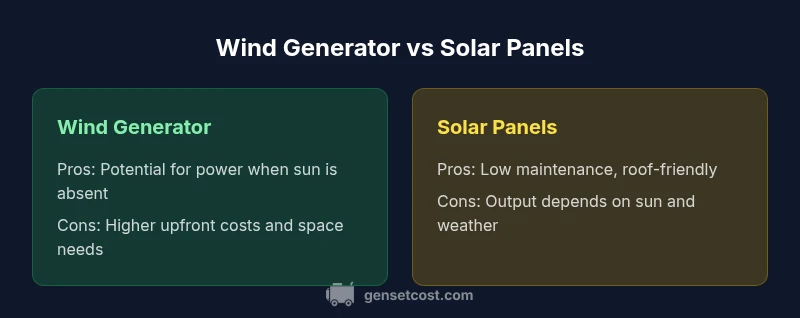
Wind Generator vs Solar Panels: A Comprehensive Comparison for Home Backup
An analytical, practical comparison of wind generator vs solar panels for home backup, exploring costs, performance, installation, maintenance, and reliability.


According to Genset Cost, selecting between wind generator vs solar panels requires site assessment of wind resources and sun exposure. In sunny climates, solar panels deliver predictable daytime output with minimal maintenance, while wind generators can supplement energy when sun isn't available. For grid-tied backups, solar remains simpler to install and connect, though a hybrid approach may offer resilience.
Site viability and climate factors
Choosing between wind generator vs solar panels for home backup hinges on the local climate, geography, and building specifics. Wind resources fluctuate with terrain, nearby structures, and height; solar resources depend on roof orientation, shading, and typical cloud cover. A balanced assessment considers both the potential wind yield and solar irradiance to determine which technology—or combination—fits a given property. The Genset Cost team emphasizes that a site-centric approach yields more accurate expectations for output and reliability than a one-size-fits-all recommendation. In urban settings, roof-mounted solar often makes the most sense due to space and aesthetics, while rural or windy locations may justify a compact turbine setup. The aim is to align technology choice with actual resource profiles and the homeowner’s reliability targets, rather than defaulting to the most common option in your neighborhood.
Resource variability and forecasting
Both wind and solar energy are intermittent, but they vary in predictable ways. Solar output follows the sun and weather patterns, peaking on bright days and dropping at dawn and dusk. Wind output hinges on wind speed and stability, which can change with seasons and weather systems. For a home backup, storage and smart controls are often essential to smooth out the gaps between generation and demand. A hybrid approach can mitigate the weaknesses of each resource; for example, solar panels paired with a small wind turbine can provide a more balanced daily profile in certain climates. The Genset Cost framework recommends scenario planning: map typical seasonal patterns and model how long storage would need to bridge gaps during outages or peak usage.
Upfront costs and long-term value
Upfront costs for wind generators tend to be higher because of turbine hardware, foundations, and integration with control systems. Solar panels often have lower initial costs and simpler installation, especially on rooftops or flat surfaces, with established installation pathways. Beyond purchase price, long-term value depends on maintenance needs, equipment lifespan, and the expected duration of use. Solar systems benefit from many decades of service with infrequent moving parts, while wind systems may incur more frequent mechanical maintenance due to moving components. Consider total cost of ownership, including permits, inverters, maintenance cycles, and potential storage requirements, when evaluating the long-term value of wind versus solar.
Space, installation, and aesthetics
Solar panels are typically mounted on rooftops or ground mounts, leveraging existing space with scalable capacity. This approach minimizes land-use concerns and often keeps the system visible yet unobtrusive. Wind turbines require a clear, unobstructed site and structural support for safe installation, which may limit placement options and complicate siting near neighbors or HOA rules. Aesthetics and noise considerations can influence acceptance in certain neighborhoods. When evaluating wind generator vs solar panels, consider not only capacity but also how each option integrates with the property’s architecture, landscaping, and local regulations.
Maintenance and lifecycle considerations
Solar panels have relatively low ongoing maintenance, mostly involving occasional cleaning and inverter servicing as part of a routine schedule. In contrast, wind generators involve rotating parts, gearboxes, and bearings that require periodic inspection and potential component replacement. The lifecycle of solar components often extends beyond twenty years, with inverter replacements and occasional panel cleaning as routine maintenance. Wind systems may require more frequent servicing to sustain performance and longevity, particularly in harsh environments. Evaluating maintenance commitments is essential to avoid unexpected downtime and to estimate ongoing costs accurately.
Performance under real-world conditions
In real-world deployments, solar panels perform best under clear sky conditions and minimal shading, but performance can degrade with dust, snow, or heavy cloud cover. Wind turbines deliver varying output depending on wind consistency and turbulence near buildings or trees. Orientation and local turbulence can significantly affect energy capture. For homeowners, monitoring systems and data logging are useful to understand how much energy is actually produced and how it aligns with consumption. A well-designed backup system should account for seasonal fluctuations and provide strategies to maintain service during longer outages or periods of low resource availability.
Grid integration and storage considerations
Many backup systems rely on grid-tied inverters and battery storage to balance supply and demand. Solar installations often integrate smoothly with standard inverters and battery packs, enabling straightforward net metering in regions that offer it. Wind systems require wind-specific controls and may demand more sophisticated power electronics to manage variability. Storage capacity and the control strategy to switch between generation sources and storage are critical to achieving reliable backup service. A hybrid setup that combines both solar and wind with shared storage can improve resilience, but it requires careful system engineering and interconnection planning.
Environmental and regulatory considerations
Both technologies are subject to environmental and regulatory factors. Wind installations face siting constraints, noise considerations, and setback requirements that vary by jurisdiction. Solar installations encounter permitting and electrical interconnection processes that are generally streamlined but still involve inspection and compliance. Incentives, rebates, and interconnection policies differ by region and can materially affect the total cost of ownership. Prospective buyers should research the local regulatory environment and available incentives to optimize the economic case for either technology.
Regional suitability: urban vs rural settings
Urban homes often have roof space and existing electrical systems that favor solar panels, while rural properties with open landscapes may have more favorable wind resources. In some cases, a hybrid arrangement can maximize reliability by leveraging the strengths of both resources. Consider the property layout, neighbor relations, and local weather patterns when weighing wind generator vs solar panels as a backup solution. The goal is to tailor the system design to the unique resource mix of the site and the homeowner’s reliability expectations.
Permitting, codes, and incentives
Permitting complexity varies widely. Solar installations typically require electrical permitting and, in many areas, align with standard building codes. Wind projects may involve more stringent zoning requirements and neighborhood covenants. Incentives can influence the economic case for each technology, with programs often favoring solar through tax credits and rebates, while wind incentives may be more limited or region-specific. Understanding these factors can help set realistic expectations for project timelines and total cost of ownership.
Reliability, outages, and resilience
Reliability hinges on resource availability and storage strategy. Solar tends to deliver strong daytime reliability in sunny regions, and when paired with batteries, can supply power during extended outages. Wind can provide complementary generation during cloudy days or at night in some locations, but its intermittent nature requires more robust storage or grid-support mechanisms. A well-planned hybrid system can offer a higher degree of resilience, especially in areas with variable weather patterns and frequent outages.
Hybrid systems and best practices
Hybrid configurations—combining wind and solar with shared storage and smart controls—can enhance resilience and reduce the risk of outage-associated downtime. Best practices include a site-specific resource assessment, staged implementation, and a data-driven approach to tune storage and inverter settings. Engage with qualified installers who understand both technologies and local regulations to optimize system design, interconnection, and maintenance planning. Regular performance reviews help ensure the system continues to meet expectations as conditions or usage patterns evolve.
Authority sources
- https://www.energy.gov/eere/wind
- https://www.energy.gov/eere/solar
- https://www.nrel.gov/
Comparison
| Feature | Wind generator | Solar panels |
|---|---|---|
| Upfront cost and installation complexity | High upfront cost with turbine foundations and control integration | Lower upfront cost with rooftop or ground-mounted panels |
| Space requirements | Requires clear, open space and proper siting | Space-efficient on rooftops; ground mounting possible when space allows |
| Output characteristics | Variable output dependent on wind stability; may need storage | Diurnal output tied to sun; consistent in sunny regions with clear weather |
| Maintenance and lifecycle | More moving parts, periodic mechanical maintenance | Fewer moving parts; routine inverter maintenance |
| Lifespan and warranties | Model- and component-dependent; potential gearbox wear | Panels last many years; inverter life requires replacement over time |
| Noise and aesthetics | Noise and visual impact can be a concern | Quiet and low-profile; generally minimal visual intrusion |
| Permitting and codes | Often more complex due to zoning and setbacks | Typically simpler; standard electrical permits common |
| Reliability under outages | Depends on wind; storage can help but gaps may persist | Solid daytime output; storage improves resilience at night |
| Grid integration and storage readiness | Requires wind-specific controls and sometimes battery integration | Easier integration with battery storage and net metering |
| Best use case | Strong in windy sites with space and wind energy interest | Best in sunny climates with roof access and low maintenance |
| Environmental impact | Consider turbine impact on birds, land use, and noise | Manufacturing footprint and land-use considerations for panels |
| Payback period expectations | Longer payback in weaker wind zones without incentives | Faster payoff in sunny regions with incentives and high roof exposure |
The Good
- Potential for energy generation in windy locations
- Solar panels provide low-maintenance, quiet operation
- Rooftop solar uses existing space with easy integration
- Hybrid systems boost resilience and flexibility
The Bad
- Wind turbines require more space and site preparation
- Wind output is intermittent and weather dependent
- Permitting and zoning can complicate wind installations
- Solar output depends on sun availability and weather
Solar panels are generally the better default for most homes, with wind as a strategic supplement where wind resources are strong.
For typical urban or suburban homes, rooftop solar offers simpler installation and reliable daytime generation. Wind can add value in genuine windy locations, but it requires more space and maintenance. A thoughtfully designed hybrid system often delivers the best resilience.
People Also Ask
What are the main differences between wind generators and solar panels for home backup?
Wind generators rely on atmospheric energy and can produce power when sun is not available, but require space, wind resource, and more complex installation. Solar panels capture daylight with predictable daytime output and generally simpler installation, especially on roofs. Storage and inverters determine how well each option meets reliability goals.
Wind relies on wind resources and space, while solar focuses on daylight; storage and inverters balance both for reliable backup.
Which is cheaper upfront, wind generator or solar panels?
Solar panels typically have lower upfront costs and easier installation, particularly on rooftops. Wind installations can be more expensive due to turbine hardware, foundations, and siting requirements. Regional regulations and incentives can shift the economics in either direction.
Solar usually starts cheaper, but local incentives and site factors matter a lot.
Can I install both wind and solar in a hybrid system?
Yes. A hybrid system combines wind and solar with shared storage and smart controls to improve resilience. It requires careful system design, compatible inverters, and a clear interconnection plan with the utility.
Absolutely, a hybrid system can boost resilience with the right design.
How does climate affect performance?
Solar performance improves with sun exposure and clear skies; wind performance depends on local wind resources and turbulence. In mixed climates, a hybrid approach often provides steadier overall output across seasons.
Sunny climates favor solar; windy areas favor wind, or both together.
What permits or regulations apply to wind vs solar?
Solar typically requires electrical permits and building inspections in many jurisdictions. Wind can involve more stringent zoning, setbacks, and noise considerations. Always check local codes and HOA rules before preparing a system design.
Solar is usually simpler to approve; wind may need more permissions.
What maintenance should I expect?
Solar panels require periodic cleaning and occasional inverter service. Wind turbines involve moving parts that may need periodic inspection, lubrication, and component replacements. Plan for scheduled maintenance and potential parts upgrades over time.
Solar is relatively low-maintenance; wind needs more regular checks.
Key Takeaways
- Evaluate your site's wind and sun resources before choosing.
- Consider energy storage to bridge intermittency.
- Account for upfront installation complexity and permitting.
- Assess space, noise, and aesthetics constraints.
- Explore hybrid options for maximum reliability.