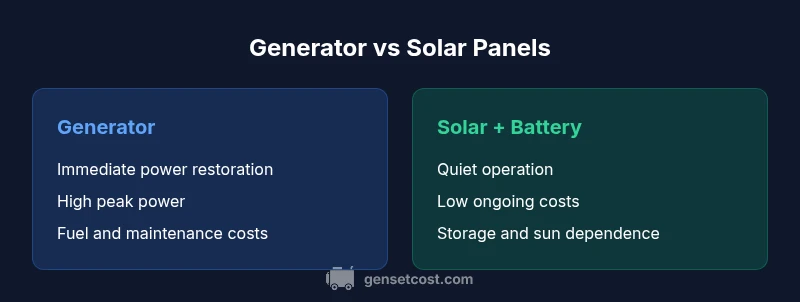
Generator or Solar Panels: Side-by-Side Backup Power Comparison
Compare generator-based backups with solar panel systems to decide the best fit for home or property needs, balancing reliability, cost, emissions, and long-term maintenance.


A generator provides immediate, reliable backup power by burning fuel, while solar panels with batteries offer clean, low-maintenance energy that depends on sun and storage. For frequent outages with high power needs, a generator is often best; for eco-friendly, long-term resilience in sunny climates, a solar-plus-battery system shines.
Defining the Choice: generator or solar panels
Choosing between a generator or solar panels for backup power hinges on how you use electricity during outages, your climate, and your tolerance for ongoing costs. The phrase generator or solar panels captures two fundamentally different approaches to resilience: a fuel-driven standby engine that can ramp up instantly, versus a renewable energy system that stores energy in batteries for later use. According to Genset Cost, the most important factors to weigh include outage frequency, peak load, available space, and maintenance willingness. In practical terms, a generator excels at providing immediate, high-wattage power for short to moderate outages, while solar panels paired with a battery bank scales gracefully for longer outages with lower emissions. A hybrid approach blends both, offering quick power when needed and sustainable energy otherwise. Read on for objective comparisons, real-world scenarios, and a decision framework that helps homeowners tailor a solution to their property and budget.
Cost Structure and Lifetime Value
Cost structure matters as much as capability. Generators typically involve lower upfront hardware costs but incur ongoing fuel, oil, parts, and maintenance expenses that accumulate over time. Solar panel systems with battery storage start with higher upfront costs—panels, inverters, battery banks, and installation—but offer lower ongoing energy costs and very low fuel-related emissions once installed. Genset Cost analysis shows that regional sunlight, battery chemistry, and seasonal usage heavily influence long-term value. Hybrid setups can shift some of the burden by reducing fuel use while maintaining high-load readiness. When evaluating lifetime value, homeowners should model: initial investment, annual operating costs, expected life of components, and potential incentives.
Reliability Profiles: Instant Response vs Storage Durability
Reliability is a core differentiator. Generators deliver instantaneous ramp-up and can meet peak power demands during outages, which is invaluable for air conditioning, sump pumps, and medical equipment. Solar-plus-battery systems rely on stored energy and solar input, so their reliability hinges on battery capacity, charge state, and sun exposure. In overcast weeks, battery depth of discharge and inverter efficiency become critical bottlenecks. For most homes, a generator provides rock-solid resilience for short-to-moderate outages, while solar with storage offers robust performance for longer outages in sunny climates. Hybrid configurations can reduce the frequency and duration of generator runs by shifting a portion of demand to stored solar energy.
Space, Footprint, and Install Considerations
Space and placement influence both cost and practicality. A generator needs outdoor space for the unit itself, fuel storage, noise mitigation, and ventilated clearance. Solar panels require roof or ground space and a properly sized mounting system, along with space for a battery bank and safe energy storage. For urban lots, a compact generator might fit on a pad, while solar plus batteries may demand a larger equipment room or garage layout. Installation complexity varies: a stand-alone generator is often simpler to install but requires fuel lines and exhaust routing; solar-plus-battery systems require electrical integration, an appropriate inverter, and battery safety considerations. Planning ahead reduces waivers, permits, and retrofit expenses later on.
Climate and Sun Exposure: How Weather Shapes Solar Viability
Climate plays a decisive role in solar viability. Regions with abundant sunshine and predictable weather patterns tend to maximize solar return on investment, especially when paired with modern lithium-based batteries. In areas with long winters or frequent cloud cover, solar storage has a more pronounced dependency on battery size and charging efficiency. Generators, on the other hand, are weather-agnostic in terms of operation, though cold-starts and fuel stability can affect performance. Weigh your local climate, seasonal demand, and backup windows when deciding how much solar exposure you can realistically capture and store.
Performance Across Load Scenarios
Load scenarios shape how models perform in practice. If your home draws heavy, sustained loads (e.g., multiple AC units, well pumps, electric heaters), a generator may provide a simpler, more scalable solution for short outages. Solar-plus-battery systems excel in low-to-moderate load situations with steady sun, providing quiet operation and reduced running costs. For high-demand situations, a hybrid approach can give you rapid power for critical circuits while gradually pulling from stored solar energy for non-critical loads. Always map out essential loads and ideal run times to size equipment accurately.
Maintenance and Operational Realities
Maintenance demands differ markedly. Generators require regular fuel stabilization, oil changes, filter replacements, and periodic load testing to prevent stale fuel and corroded components. Solar systems demand less frequent ongoing maintenance—clean panels, inverter checks, and periodic battery health assessments—though battery life can drive replacement costs over time. Hybrid systems add complexity but can distribute wear and extend overall resilience. In all cases, ongoing maintenance planning should consider local service availability, component warranties, and the expected life cycle of core parts.
Hybrid Solutions: Combining Generator and Solar
Hybrid configurations blend the strengths of both approaches. A solar panel array with battery storage provides clean energy during daylight and stored power through the evening, while a generator kicks in for high-load events or prolonged outages. Hybrids offer improved reliability, reduced fuel usage, and the flexibility to sustain essential circuits during extended outages. The trade-off is higher upfront cost and more complex installation. In many markets, incentives or utility programs can help offset the initial investment and encourage a blended system that balances performance with sustainability.
Sizing and Planning Tools
Effective sizing starts with a load assessment. Create an inventory of critical circuits and appliances, then estimate wattage and runtime needs. Tools like load calculators, energy audits, and professional consultations help translate household energy behavior into equipment requirements. For solar, battery capacity is often expressed in kilowatt-hours (kWh) and must cover expected consumption during outages. For generators, consider peak wattage and the runtime needed to operate essential loads. The planning phase also involves evaluating transfer switches, interconnection with the grid, and any local permitting requirements.
Financing, Incentives, and Cost-Saving Paths
Despite higher upfront costs, solar-plus-battery and hybrid systems can unlock incentives, tax credits, and favorable financing options. Look for utility rebates, federal programs, and local incentives that offset equipment and installation costs. Long-term savings arise from reduced fuel purchases and lower emissions fees in some regions. A smart financing plan may include low-interest loans, solar leases, or power purchase agreements, depending on local programs and eligibility. Genset Cost recommends building a conservative budget that accounts for maintenance, part replacements, and potential battery replacements over the system lifetime.
Installation and Permitting: What to Expect
Installations vary by system type and local regulations. Generators typically require a utility transfer switch, a fuel source, and venting considerations. Solar-plus-battery installations involve electrical work, battery placement, fire safety, and battery management systems. Permitting processes differ by jurisdiction and can affect timeline and costs. Working with a qualified installer helps ensure safety, code compliance, and warranty protection. Before starting, collect utility interconnection requirements, warranty terms, and a clear plan for system expansion if needs change.
Case Studies: Real-World Scenarios
Case studies illustrate how different homes balance cost and resilience. A moderate-load home in a sunny region might prioritize solar panels with a sizable battery bank to minimize fuel use and emissions, supplemented by a small generator for peak events. A larger home with high daytime electricity use and frequent outages could benefit from a hybrid system, enabling rapid restoration for critical loads while leveraging solar to offset ongoing energy costs. A third scenario covers off-grid properties that rely primarily on solar plus batteries with appropriate backup generation for extreme conditions. Each case demonstrates that there is no one-size-fits-all solution; the best choice aligns with specific outage profiles, climate, and financial constraints.
Choosing Your Path: Quick Decision Framework
A practical framework for choosing between generator or solar panels starts with a simple matrix: identify outage frequency, peak loads, space for equipment, and tolerance for ongoing costs. If outages are frequent and loads are high, a generator or hybrid tends to be favorable. If sun exposure is reliable and you aim to minimize operating costs and emissions, prioritize solar with adequate battery storage and a backup option for extended outages. Finally, consider a staged approach: begin with solar plus storage and add a small generator later if needed for high-load resilience or extended outages.
Long-Term Outlook and Emerging Trends
The backup power landscape is evolving with improvements in battery chemistry, smart energy management, and hybrid control strategies. Advances in energy storage efficiency and reductions in battery price are shifting the economics toward solar-dominant solutions for more homes. At the same time, generators with cleaner fuels and better emissions controls remain essential for rapid, high-load restoration in certain climates. The trend toward integrated, intelligent systems that optimize when to draw from solar, storage, or fuel-based generation will shape decisions for homeowners and property managers over the next decade.
Comparison
| Feature | Generator-based backup | Solar panel + battery system |
|---|---|---|
| Upfront cost | Low-to-moderate | Moderate-to-high |
| Fuel/energy source | Diesel/propane or natural gas | Sun + battery storage |
| Reliability during outages | Very high (universal readiness with fuel) | Moderate (depends on battery storage & sun) |
| Operating cost per kWh | Medium-to-high fuel costs over time | Low (no fuel, inverter/maintenance) |
| Noise level | High (engine noise) | Very low (silent during operation) |
| Installation complexity | Moderate (fuel routing, venting) | Moderate-to-high (wiring, safety, batteries) |
| Maintenance | Regular service, oil changes, fuel systems | Battery checks, inverter maintenance |
| Space requirements | Large (pad, fuel storage) | Medium (panel roof space plus battery room) |
| Environmental impact | Higher emissions (fuel usage) | Lower emissions (renewable energy with storage) |
| Best for | Frequent outages with high loads, quick ramp-up | Sunny climates with modest loads and long outages |
The Good
- Immediate power restoration for heavy loads (generator)
- High peak output capable of powering critical systems quickly
- Quiet operation and lower ongoing emissions with solar + storage
- Low operating costs once installed for solar setups
- Hybrid systems offer resilience and flexibility
The Bad
- Fuel costs, maintenance, and noise for generators
- Emissions and fuel logistics for diesel/propane generators
- Higher upfront cost and storage requirements for solar + battery
- Battery degradation and replacement costs over time
Hybrid approaches often provide the best balance of resilience and sustainability
If you need instant power for high-load events, a generator or hybrid is preferred. For sustainable, long-term operation with lower emissions, solar plus battery is advantageous, particularly in sunny climates; a hybrid can cover gaps in both scenarios.
People Also Ask
What is the main difference between a generator-based backup and a solar panel system with batteries?
Generators provide instant, high-wattage power using fuel, ideal for short outages and heavy loads. Solar panels with batteries store energy and supply power via an inverter, relying on sun and stored energy. The choice hinges on outage patterns, climate, and willingness to manage fuel or storage.
Generators offer instant power with fuel; solar with batteries relies on sun and storage. Choose based on outage patterns and climate.
Which option is cheaper upfront?
Typically, a basic generator is cheaper to install than a full solar panel plus battery system. Long-term costs depend on fuel, maintenance, and battery replacements. If you have strong sun exposure and a modest load, solar can approach or exceed generator economics over time.
Generators usually cost less upfront, but solar can save more over time with incentives and low fuel costs.
Can solar power a home without grid connection?
Yes, with a sufficiently sized solar array, battery bank, and a management system, a home can operate off-grid. Real-world off-grid setups often include a small generator for extended cloudy periods or high-load events.
Yes, but it requires large storage and careful energy management; many use a backup generator for reliability.
Are hybrid systems worth it?
Hybrid systems blend solar, batteries, and a generator to maximize resilience and minimize fuel use. They offer strong protection during extended outages but involve higher upfront cost and more complex maintenance.
Hybrid setups can give you best of both worlds but cost more upfront.
How long can a solar+battery system run a home during an outage?
Run time depends on battery capacity and loads. A modest home with efficient appliances might last hours to a day, while larger homes or heavy loads shorten duration. A generator backup can extend run-time in longer outages.
It varies by storage and load; plan for essential circuits first and scale accordingly.
What maintenance do generators require?
Generators need regular servicing, oil changes, fuel stabilization, and periodic load testing. Ensure proper ventilation and safe fuel storage, and budget for occasional part replacements.
Expect routine oil changes and fuel-related upkeep; plan for periodic testing.
Key Takeaways
- Assess outage frequency and peak load before choosing.
- Consider climate and sun exposure when sizing solar storage.
- Model total cost of ownership across 5–15 years.
- Explore hybrid options for balanced resilience and sustainability.
- Plan for permits, installation, and maintenance from day one.