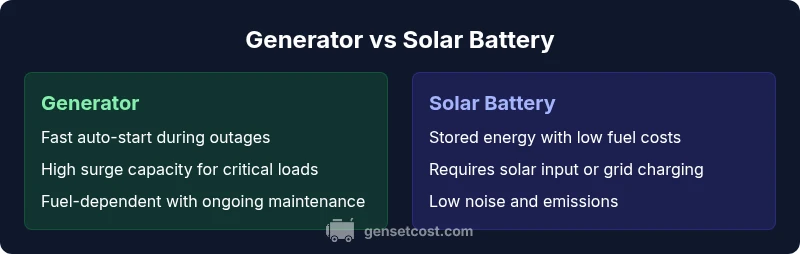
Generator vs Solar Battery: A Comprehensive Comparison
A rigorous, data-driven comparison of home backup options—generator vs solar battery—covering costs, reliability, installation, and long-term value for homeowners and property managers.


Understanding the landscape: generator vs solar battery
For homeowners evaluating backup power options, the question often centers on the core trade-offs between a traditional fuel-powered generator and a solar battery system. This guide treats generator vs solar battery as a spectrum rather than a single choice, because many properties benefit from having both—one to cover heavy, short outages and the other to reduce fuel use and emissions over time. According to Genset Cost, the decision should begin with your typical outage patterns, budget constraints, and readiness to integrate with future grid changes. By framing the decision around your property’s loads and space, you can identify which approach minimizes risk while aligning with long-term objectives. In practice, both solutions can play a role, and many homeowners and property managers choose a hybrid approach that leverages the strengths of each option.
The goal of this report is to demystify the generator vs solar battery decision and provide a clear framework for sizing, installation, and maintenance. You’ll see how reliability, cost of ownership, and sustainability trade off in real-world scenarios, with practical steps you can take today to begin your assessment.
How a generator works in a home backup scenario
A traditional backup generator runs on a fuel source (gas, propane, or diesel) and connects to the home through a transfer switch. When grid power fails, the generator starts automatically or on demand and delivers electricity to designated circuits. Key advantages include fast response and the ability to supply substantial power during extended outages, especially when paired with a robust fuel supply and regular maintenance. Practical limits include fuel logistics, emissions, and ongoing servicing needs. For property managers, a generator can be a reliable backbone for essential systems such as lighting, heating, and refrigeration during outages. However, you’ll want to account for fuel storage, refueling, and the potential for noise and maintenance downtime. This section anchors the generator side of the generator vs solar battery analysis by outlining performance expectations and common installation considerations.
How a solar battery system works
A solar battery stores energy generated by photovoltaic panels or drawn from the grid for later use. An inverter converts stored DC electricity into usable AC power for the home, while a battery management system protects cells and optimizes charging cycles. Solar battery systems are typically deployed as part of a broader solar installation and can be scaled with additional battery banks to extend usable energy during outages. The appeal lies in reduced fuel consumption and lower emissions, along with quiet operation. A caveat is that output during a long outage depends on stored energy and solar input, which can vary with weather and season. In the broader generator vs solar battery comparison, batteries shine when paired with solar and an efficient load strategy, but they may not fully replicate the peak power or instantaneous response of a dedicated generator without proper sizing.
Key performance differences: reliability, response time, and capacity
Reliability in outage conditions often determines the choice between generator vs solar battery. Generators deliver near-instant power once an outage is detected and can handle high surge loads, making them ideal for critical circuits and homes requiring robust back-up. Solar batteries deliver power from stored energy, improving resilience by reducing fuel dependence and emissions, but their effectiveness hinges on battery size, solar input, and charging cycles. Response time differs: generators start automatically within seconds, while battery-based systems provide power as soon as the storage is accessed, contingent on charge and inverter readiness. Capacity planning is essential for both: a generator’s capacity is tied to engine size and fuel supply, whereas batteries depend on storage capacity and the ability to replenish it. In practice, the best solution often blends both approaches to balance reliability with sustainability.
Sizing and load planning for generator vs solar battery
Sizing starts with a clear list of essential loads—fridge/freezer, heating or cooling controls, lights, and communication devices. For a generator, assess the surge capacity needed to start and run critical equipment during outages, and ensure there’s enough fuel and storage for the anticipated duration. For a solar battery system, evaluate the battery bank size, inverter capacity, and solar input to determine how long you can power essential circuits with a given weather pattern. A practical approach is to separate the planning into two tiers: essential loads that must stay on during outages and nonessential loads that can be shed when power is limited. This step clarifies whether a generator, a battery, or a hybrid solution best fits your outage duration expectations and daily energy usage, and it informs the next cost and installation planning steps.
Costs and total cost of ownership: upfront vs ongoing
The generator vs solar battery decision hinges on both upfront investment and ongoing operating costs. Generators typically have a lower upfront price tag than a complete solar-plus-storage setup, but fuel, maintenance, and potential generator replacements add ongoing costs over time. Solar battery systems incur higher upfront costs, reflecting the price of panels, battery banks, and inverters, yet they offer reduced fuel expenses and lower emissions, with long-term savings that improve the total cost of ownership. Hybrid configurations can complicate the financial picture, but they also provide greater resilience and flexibility. A practical way to compare long-term value is to project how fuel costs, maintenance needs, battery replacements, and potential incentives affect the total cost of ownership over the system’s lifespan. In the context of the generator vs solar battery analysis, a balanced plan often aligns better with long-term property goals and sustainability targets.
Installation considerations: space, wiring, permits
Installation implications differ notably between a generator and a solar battery system. A generator requires space for the unit, fuel storage, and a transfer switch, plus provisions for ventilation and noise mitigation. Wiring typically involves a professional installation with transfer-switch integration and proper exhaust clearance. A solar battery setup requires space for the battery bank (often indoors or in a protected outdoor enclosure), inverters, charge controllers, and a robust solar array or grid connection. Both solutions may require permits and professional electrical work to comply with safety codes. For property managers, planning for access, safety clearances, and future expansion is essential. This section highlights the practical differences in installation and how to approach permitting and contract work within the broader generator vs solar battery decision framework.
Environmental impact and sustainability
From an environmental perspective, generators produce emissions and consume finite fossil fuels, contributing to carbon footprint and fuel logistics. Solar batteries paired with a PV system offer a path to lower emissions and reduced fuel consumption, particularly when the grid draws electricity from cleaner sources or when solar generation is abundant. Batteries enable energy storage and peak-shaving without combustion, aligning with sustainability goals and potential incentives. However, battery manufacturing, lifecycle, and recycling considerations are part of the environmental equation. The generator vs solar battery discussion should weigh these factors alongside energy independence and grid resilience to shape a strategy that respects local regulations and environmental commitments.
Maintenance and service expectations
Maintenance is a critical factor in the generator vs solar battery decision. Generators require regular oil changes, filter replacements, spark plug checks, and fuel stabilization to stay reliable, especially after long periods of inactivity. Solar battery systems demand battery health checks, inverter maintenance, and periodic software updates for energy management. Both options benefit from scheduled inspections and a well-planned replacement strategy; batteries have finite cycle life, and engines degrade over time. For property managers, maintenance planning should include service windows, access to technicians, and clear expectations for downtime during servicing. A proactive maintenance routine helps maximize uptime and the long-term value of either solution in a home backup strategy.
Hybrid configurations: when to pair systems
Hybrid approaches blend the strengths of both technologies. A common pattern is to use a generator for high-power, long-duration outages and a solar battery for daily energy management and backup of essential loads. Hybrid configurations can smooth energy costs, reduce fuel dependence, and provide rapid response when outages occur. The decision to pair systems often depends on available space, incentives, and the scale of loads to be supported. In the generator vs solar battery framework, a thoughtful hybrid can deliver robust reliability while supporting sustainability goals and cost control over time.
Real-world scenario planning: homeowners vs property managers
For homeowners, the choice might favor a compact, affordable generator with selective battery storage for critical circuits or a modest solar-plus-storage system to reduce fuel use. Property managers, especially in multifamily settings, may opt for larger-scale solar-plus-storage to cover common areas and critical systems, supplemented by a generator for peak demand or extended outages. Scenario planning should consider typical outage length, climate, and utility pricing structures. By mapping real-world needs to generator vs solar battery capabilities, you can design a backup power strategy that aligns with risk tolerance, budget, and long-term goals while staying adaptable to future grid changes.