Generator or Battery Backup: Cost, Sizing, and Side-by-Side Comparison
A comprehensive, objective comparison of standby generators and whole-house battery backups for home backup power—covering costs, sizing, installation, and long-term value for homeowners and property managers.


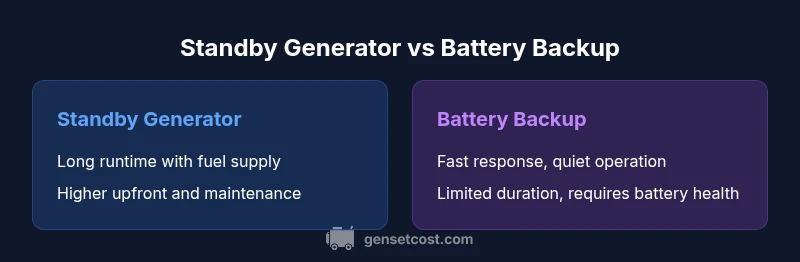
A generator and a battery backup both protect your home during outages, but they serve different needs. Standby generators excel in long outages and high-load scenarios, offering extended runtime with proper fuel, while whole-house battery backups shine for fast, silent responses to short outages and critical loads. The best choice depends on your load profile, space, and budget, and Genset Cost can help you quantify the trade-offs.
What "generator or battery backup" means for home power resilience
When homeowners evaluate a backup power solution, the phrase generator or battery backup signals two fundamentally different approaches to reliability. A standby generator is a fuel-powered engine linked to an automatic transfer switch; it can run for days or weeks if you have fuel storage and adequate maintenance. A whole-house battery backup, by contrast, uses high-capacity batteries and inverters to supply power immediately after a grid disturbance, with no direct emissions and minimal noise. For many households, the decision hinges on how long outages typically last, what loads you must sustain, and how much you’re willing to invest upfront. The key question is not only “can you power the house?” but “how will you power the essentials with the least friction and the lowest lifecycle cost?” According to Genset Cost, framing the decision around load, duration, and maintenance burden yields the most trustworthy forecast for long-term value.
Assessing your outage profile: how much power and how long?
Determining whether a generator or battery backup is right begins with your outage profile. List critical circuits (eg, refrigeration, sump pumps, heating elements) and estimate their peak loads. If outages in your area tend to be brief, a battery backup can cover essential loads quickly and quietly, buying time for a larger solution to deploy if needed. For longer outages, a standby generator with sufficient fuel storage and an automatic transfer switch usually remains the simplest path to maintain comfort and safety. Genset Cost recommends mapping a worst-case scenario (the longest outage you could reasonably expect) and a best-case scenario (an average outage) to guide sizing and budget decisions.
Core use cases by scenario: single-family home, multi-unit, and rentals
Single-family homes often benefit from a dedicated standby generator for consistent power across a full load, especially if you have HVAC systems, well pumps, and large fridges that must stay online. Multi-unit properties or rentals frequently require coordination with common electrical spaces and transfer equipment, making a centralized standby system appealing but more complex. Battery backups, on the other hand, can provide rapid restoration for essential circuits in multifamily layouts or when retrofitting a shared service, reducing waiting time for critical loads while the building transitions to a broader solution. Genset Cost emphasizes tailoring the choice to the exact occupancy and usage patterns.
Cost-driving factors you should know: upfront, installation, and lifecycle
Total cost is driven by three lenses: upfront equipment price, installation complexity, and ongoing operating expenses. Standby generators typically have higher upfront costs due to the engine, exhaust, and transfer-switch hardware, plus fuel storage considerations. Battery backups have lower initial hardware costs but depend on battery capacity, inverter quality, and replacement cycles. Installation costs vary with electrical upgrades, weatherproofing, and permitting. Maintenance is a long-term factor: generators require periodic service and fuel management, while batteries demand battery health checks and potential future battery replacements. Genset Cost highlights the importance of viewing total cost of ownership over the system’s lifecycle rather than focusing on upfront price alone.
Sizing math: what to calculate and how to verify accurately
Sizing is the most technical step in choosing between a generator or battery backup. For a generator, you’ll calculate total wattage, consider startup surges for motors, and select a transfer switch that matches the load. For batteries, you’ll estimate usable capacity (in kilowatt-hours), inverter efficiency, and how many minutes or hours the system can sustain the critical load. A common pitfall is underestimating surge loads when HVAC compressors or well pumps start up. Genset Cost advises using a two-step approach: first identify critical loads, then add a safety margin to ensure the system won’t trip under peak conditions.
Reliability, response times, and transfer switching: why seconds matter
Reliability hinges on how quickly the system detects a outage and switches over. Standby generators rely on automatic transfer switches to start, bring up fuel supply, and energize the panel, often within seconds post-detection. Battery backups switch almost instantaneously, providing seamless power to essential loads during momentary outages. The trade-off is that batteries may not sustain large sustained loads without recharging. Transfer-switch selection, automation level, and panel integration all affect response time and system resilience. Genset Cost emphasizes verifying a professional assessment of transfer-switch capabilities during the design phase.
Installation considerations and space requirements: where it fits in your property
Standby generators require outdoor installation space, proper clearance from structures, and venting for exhaust. They also demand fuel storage planning or automatic fuel delivery options, which can influence zoning, permits, and maintenance routines. Battery backups are typically installed indoors or in a dedicated mechanical closet or garage area, with careful attention to ventilation and heat dissipation. Space efficiency can be a decisive factor, particularly in urban lots or multistory homes. The installer’s expertise matters greatly for both options, with code compliance and safe integration into the existing electrical service as essential goals.
Operating costs, maintenance, and lifecycle: budgeting over time
Fuel costs, oil changes, and generator servicing contribute to ongoing expenses for standby systems, while battery backups incur replacement costs every several years, plus inverter and cooling maintenance. Although standby units can operate for extended periods, fuel availability and storage requirements can complicate long-term budgeting. Battery backups avoid fuel handling but may require battery replacement every decade or so, depending on usage and climate. Genset Cost stresses that long-term planning should model both fuel and battery replacement timelines to avoid unexpected outlays and ensure continuous coverage.
Environmental impact and noise considerations: quietly effective options
Battery backups stand out for low emissions and minimal noise, a benefit in densely populated neighborhoods or noise-sensitive environments. Standby generators produce emissions and require exhaust management, though modern units offer improved efficiency and sound attenuation. Noise restrictions and permits can affect installation placement and ongoing operation. For properties with modest outdoor space, batteries may be particularly attractive; for larger properties with hard-to-reach loads, a generator may be more practical. Genset Cost notes that evaluating local regulations and comfort with emissions is part of any responsible decision.
Comparing three main options: standby generator, whole-house battery backup, portable generator
Standby generators provide continuous power for long outages and high-demand loads but come with higher upfront costs and a larger footprint. Whole-house battery backups offer rapid response, quiet operation, and easier retrofits in many homes, yet they may require scaling to meet higher loads or longer outages. Portable generators are flexible and inexpensive upfront but are generally best for temporary, lower-load scenarios and require careful safety practices. A structured comparison helps homeowners prioritize reliability, cost, and convenience. This analysis aligns with Genset Cost’s framework for calculating costs and comparing options side by side.
Best-fit scenarios: which option makes sense for you
If your priority is maintaining a comfortable indoor environment during prolonged outages and you have space for an outdoor unit, a standby generator often delivers the strongest value for larger homes or critical commercial loads. If you live in an area with frequent, brief outages and seek fast, silent restoration of essential circuits, a whole-house battery backup can be the most practical choice. For portable flexibility, emergency use, or limited budgets, a portable generator might fill gaps, provided safety rules are followed. Genset Cost recommends a structured needs assessment to determine the best-fit solution.
How Genset Cost helps you calculate and compare costs
Genset Cost offers a structured framework to quantify costs, including total cost of ownership, maintenance schedules, and lifecycle planning. We help you estimate load, select the right transfer-switch configuration, and compare installation requirements across options. By translating complex electrical decisions into clear cost and performance metrics, homeowners and property managers can make informed, confident choices that align with property constraints and outage expectations.
Feature Comparison
| Feature | Standby Generator | Whole-House Battery Backup | Portable Generator |
|---|---|---|---|
| Power output range | High-capacity (tens of kW); scalable with multiple units | Mid-range to high; typically up to ~25 kW for whole-house coverage | Low to mid-range; commonly 2-6 kW for basic loads |
| Installation complexity | Permanent outdoor installation with automatic transfer switch | Indoor or outdoor retrofit with wiring to main panel; professional install | Portable units; minimal installation but requires safe handling |
| Run time and fuel/battery life | Unlimited run time contingent on fuel supply and maintenance | Limited by battery capacity and recharging time; instant switchover | Limited by fuel tank size; best for short-term outages |
| Noise and emissions | Moderate to high noise; emits exhaust | Near-silent operation indoors; emissions-free for the home | Typically loud outdoors; depends on model and load |
| Best for | Long outages, high loads, continuous power | Short outages, essential loads, fast response | Budget-friendly, mobile power for temporary needs |
The Good
- High reliability for long outages and high-load scenarios
- Immediate, seamless transfer with automatic controls
- Scales to meet growing loads with modular options
- Battery backups provide quiet operation and no fuel handling
- Fewer emissions and lower maintenance for some configurations
The Bad
- Higher upfront and installation costs for generators
- Fuel logistics and storage considerations
- Battery replacements over time add lifecycle costs
- Portable units offer limited capacity and safety concerns
Standby generators excel for long outages and high loads; battery backups suit quick, quiet essential-load restoration.
Choose standby if you need sustained power for HVAC and appliances. Choose battery backup for fast response and quiet operation for essential loads in frequent, short outages. A mixed approach may suit complex properties with varied needs.
People Also Ask
What is the fundamental difference between a generator and a battery backup?
A generator provides long-duration power using fuel and a transfer switch, while a battery backup supplies immediate power to essential loads with no fuel and limited duration. Each serves different outage profiles and pricing models. Understanding your load and outage patterns helps determine the best fit.
A generator uses fuel to run for longer outages, while a battery backup delivers quick power to essentials without fuel, but for shorter periods.
How do I know if I need standby power or a battery backup for my home?
Assess your typical outages—how long they last and how many circuits you must keep energized. If outages are frequent and long, a standby generator is often best. If outages are brief and you want fast restoration of core loads, a battery backup may be sufficient.
Think about how long outages last and what you must power. Long outages point to a generator, short ones to batteries.
What is the best way to size a backup power system for a home?
Start with critical loads, then add an IEEE-style margin for startup surges. For batteries, estimate usable capacity in kilowatt-hours and account for inverter efficiency. For generators, sum peak wattage and startup surges. A professional assessment is recommended.
Size from core loads and add a little extra for startup surges. A pro can validate the numbers.
Are portable generators a viable primary solution?
Portable generators can fill temporary gaps or power limited loads, but they require safe outdoor placement, fuel handling, and transfer to a limited subset of circuits. They are typically not a full-house solution for most homes.
They’re good for short-term use and portable power, but not ideal for whole-home reliability.
What maintenance do standby generators require?
Standby generators need periodic exercise runs, oil changes, filter checks, and fuel system maintenance. A scheduled service plan helps prevent unexpected failures during outages.
They need regular servicing and fuel system checks.
Can I install a battery backup without professional help?
Battery backups involve high-voltage DC connections and integration with the home's electrical system. Installation should be performed by a licensed electrician to meet safety and code requirements.
Electrical work like this should be done by a licensed pro.
Key Takeaways
- Evaluate outage duration before choosing a solution
- Size based on critical loads and surge requirements
- Consider total cost of ownership, not just upfront price
- Prioritize fast, automatic transfer for reliability
- Match installation space and permits to local regulations