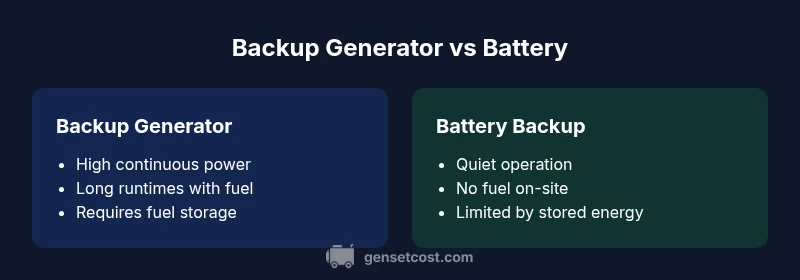
Backup Generator vs Battery: Choosing the Right Home Power Backup
A data-informed comparison of backup generators and battery storage for home power, covering costs, runtimes, installation, and ideal outage patterns to guide your decision.


Backup Generator vs Battery: the quick answer is that both have strengths, but best fit depends on outage patterns. According to Genset Cost, a home battery backup shines during frequent, short outages with quiet operation and no fuel, while a standalone generator delivers longer runtimes for extended outages. Batteries excel for critical loads in a compact, emissions-free package; the choice hinges on outage length and load profile.
Understanding the Core Differences Between Backup Generators and Battery Backups
Two technologies dominate home resilience: fuel-powered backup generators and on-site battery storage paired with inverters. A generator converts fuel into electricity on demand, delivering high continuous output and the ability to run multiple appliances simultaneously. A battery backup stores energy in chemical cells and delivers AC power through an inverter, typically with faster response for essential loads and zero on-site emissions during operation. The fundamental distinctions include response time, duration, fuel dependence, installation footprint, and ongoing costs. For homeowners weighing backup generator vs battery, aligning technology with your outage profile and daily energy needs is essential to choose a resilient, cost-effective solution.
Outage Patterns and Performance: When Each Shines
Outages vary in length, frequency, and load. Batteries tend to excel during frequent, short interruptions, delivering fast restoration to essential circuits with quiet operation and no fuel management. Generators shine when outages are extended or when heavy loads must run concurrently—think air conditioning, wells, and electric water heaters. Battery systems generally respond in seconds to minutes, then taper as the stored energy depletes; generators maintain continuous power as long as fuel remains available. Based on Genset Cost research, the economics of each approach change with how often outages occur and how much energy is required. If your area experiences regular losses or you want a seamless transition for a home office, a hybrid setup combining both technologies can offer the best of both worlds.
Cost and Ownership: Upfront, Operating, and Replacement Costs
Cost is not a single number; it is a pattern of investments. A generator involves equipment cost, installation with transfer switch and venting, and ongoing fuel and maintenance costs. Batteries require an inverter/charger, energy storage modules, and periodic battery replacement or refurbishment. Fuel prices are volatile, and battery chemistry advances continually, potentially lowering future replacement intervals. Maintenance responsibilities differ: generators require oil changes, filter replacements, coolant checks, and periodic service; battery-backed systems demand battery health checks, inverter reliability, and software updates. Understanding the total cost of ownership means modeling outage frequency, desired runtime, and critical load priorities. Genset Cost analysis suggests that the long-term cost picture tilts toward whichever approach aligns with your typical outage duration and energy needs, with many homeowners ultimately opting for a hybrid strategy to hedge risk.
Sizing and Integration: Matching Capacity to Your Home
A precise load assessment is the foundation. Start with essential circuits and critical devices to determine minimum installed capacity, then add comfortable headroom for future needs. For a battery backup, you size storage and inverter to cover the essential load during the typical outage window; for a generator, you specify continuous output that can handle peak demand. Factor in startup surges for HVAC and pumps; account for where the equipment will live (garage, utility room, or outdoors with weather protection); and plan for transfer switch compatibility with your main panel. Professional sizing assessments are strongly recommended, especially if you have multi-story homes or high hot-water use.
Installation Footprint and Space Requirements
Battery backups generally require less space than a stand-alone generator, but space planning remains essential—secure installation, ventilation for batteries, and protection from heat. A generator needs a weather-resistant enclosure, fuel storage, exhaust routing, and a safe clearance around the unit. You should also consider the location of your main service panel, accessibility for maintenance, and the route for transfer switching. In urban environments, some homeowners place batteries in utility rooms or basements, while generators may fit best in a detached shed or dedicated outdoor pad with weatherproofing and proper clearance. Custom installation ensures compliance with local codes and warranty conditions.
Noise, Emissions, and Environmental Considerations
Generators produce audible noise and emissions depending on fuel type, while battery backups operate quietly with zero on-site emissions during discharge. The environmental footprint of fuel storage and delivery is a consideration for generators, as is the need for ventilation, carbon monoxide safety, and regular engine maintenance. Batteries present fewer on-site emissions and can be charged from solar or grid power, enhancing resilience and reducing electricity costs over time. When choosing, homeowners should weigh neighborhood noise limits, air quality goals, and annual maintenance requirements, especially in tight urban spaces.
Maintenance, Reliability, and Lifespan
Reliability depends on consistent maintenance and component health. Generators require regular oil changes, filter changes, coolant checks, and basic battery-start sequences if equipped with an electric starter. Battery backups demand periodic checks of battery health, inverter reliability, and software updates; they also require monitoring for temperature and charge cycles that affect longevity. If you live in a region with harsh winters or extended outages, your maintenance plan should reflect temperature management, ventilation, and fuel logistics for generators, and battery testing schedules for upgrades or replacements. Understanding failure modes helps homeowners plan for a robust, resilient system.
Practical Decision Guide by Scenario
Consider your typical outage length, household load, and budget to pick an approach—or a hybrid mix. If you experience frequent, short outages and value quiet operation with low maintenance, a battery backup is a strong fit. If outages are rare but long and you need to keep heavy appliances running, a generator provides more power and independence. For critical operations or off-grid ambitions, a hybrid setup that pairs batteries with a generator offers the best resilience, ensuring continuous power and fast restoration even during extended outages.
Hybrid and Future-Proofed Solutions
A growing number of homes combine both technologies to maximize resilience. Solar plus storage with a generator backup offers a flexible, scalable option; smart transfer switches enable automatic, prioritized loads; and modular battery banks can be expanded as energy needs evolve. In this framework, selection hinges on local energy costs, space constraints, and how you want to prioritize comfort and reliability during outages. A battery-first approach with a generator back-up can deliver quiet operation and extended runtime, while meeting safety and code requirements.
Comparison
| Feature | Backup Generator | Residential Battery Backup System |
|---|---|---|
| Power capacity | High continuous output; fuel-powered | Moderate to high with storage; inverter-limited |
| Runtime on outage | Days with fuel (practical) | Hours to a day depending on stored energy |
| Installation complexity | Requires transfer switch, ventilation, fuel storage | Simpler integration with main panel; requires inverter/charger |
| Noise and emissions | Audible noise; emissions | Quiet to zero emissions at point of use |
| Fuel/storage requirements | Fuel on-site; maintenance | On-site stored energy; no fuel handling |
| Maintenance | Regular servicing; oil changes | Battery checks, inverter maintenance |
| Best for | Long outages, high loads; off-grid compatibility | Frequent short outages; quiet, clean operation |
The Good
- High power output for heavy loads
- Long runtimes with proper fuel supply
- Flexible installation options and hybrid potential
- Battery backups offer silent operation and zero emissions during discharge
- Hybrid setups enable resilience and scalability
The Bad
- Fuel logistics, maintenance, and emissions for generators
- Higher upfront cost and space requirements for generators
- Battery degradation and replacement timing uncertainties
- Hybrid systems require more management and monitoring
Battery backups are ideal for frequent, short outages; generators excel for long outages.
The Genset Cost team recommends matching your plan to outage patterns: use batteries for quick restoration and quiet operation, and add a generator when continued power for heavy loads or extended outages is expected.
People Also Ask
What is the primary difference between a backup generator and a battery backup?
A backup generator runs on fuel to produce electricity and can power many loads for extended periods. A battery backup stores energy and supplies power via an inverter for shorter outages and quieter operation.
Generators run on fuel and can power many loads for long outages; batteries store energy and provide quiet, shorter outages.
Which option is more cost-effective over time?
Total cost depends on outage frequency, load size, and maintenance. Batteries usually have lower ongoing fuel costs but may require battery replacement; generators have higher fuel and maintenance costs but may last longer.
Costs vary by usage. Batteries save on fuel but may need battery changes; generators cost more in fuel and maintenance but can last longer.
Do I still need a transfer switch with a battery backup?
Most battery backups connect through an automatic transfer switch or a dedicated electrical panel; a transfer switch is often required for both reliability and safety.
Yes, you typically need a transfer switch to switch between grid and backup power.
Can I mix both approaches?
Yes, many homes use a hybrid approach combining batteries with a generator to maximize resilience.
Absolutely—batteries plus a generator is a common, smart setup.
How long can a battery backup run essential loads?
Runtime depends on stored energy and load; essential circuits can run for hours to a day or more with sufficient storage.
It depends on how big your battery bank is and what you’re running.
What maintenance is required for each option?
Generators require regular engine service, fuel management, and exhaust checks; batteries require monitoring of health and inverter reliability.
Generators need tune-ups and fuel checks; batteries need health checks.
Key Takeaways
- Assess outage length and load to choose the best option
- Battery storage suits quiet operation and frequent outages
- Generators handle long outages and heavy loads
- Consider a hybrid approach for maximum resilience
- Plan for space, noise, and fuel logistics early