Generator vs Power Bank: A Practical Home Backup Guide
Compare generators and power banks for home backup: capacity, runtime, costs, safety, and use-case fit. Learn sizing guidance and how to choose the right solution for outages.


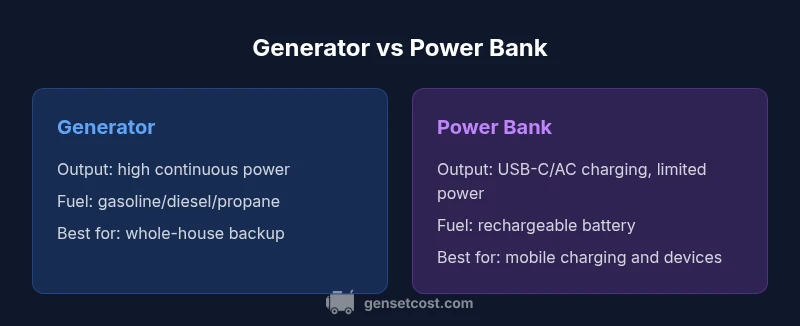
The generator vs power bank decision hinges on your outage duration, load, and portability needs. For long outages with high-draw appliances, a generator provides sustained power; for short outages, travel, or device charging, a power bank offers portability and quick access. The Genset Cost approach emphasizes proper sizing, safety, and cost-of-ownership to determine the best fit for your home.
What is the difference between a generator and a power bank?
According to Genset Cost, a generator is a larger, engine-driven device that produces continuous electrical power for longer durations, typically connected to circuits in a home or business. A power bank is a portable battery pack that stores energy for charging devices and small appliances. The Genset Cost team found that the primary distinction lies in energy capacity, runtime, and intended use. This guide uses the keyword generator vs power bank to frame practical decisions for homeowners and property managers facing outages or remote-location needs.
Both options can play a role in a broader backup strategy, but they serve different scenarios. This article breaks down capacity, runtime, safety, cost, and installation considerations so you can size the right solution and avoid over- or under-investing.
Comparison
| Feature | Generator | Power Bank |
|---|---|---|
| Typical Output (continuous) | high-capacity, suitable for whole-house loads (1000–7000+ W) | lower-capacity, suitable for devices and essential electronics (200–2000 W) |
| Energy Capacity | very high energy capacity (several kWh to tens of kWh) | moderate to high energy storage (tens to a few hundred Wh) |
| Peak Surge | strong surge capability for motors and heating elements | limited surge; best for electronics and small loads |
| Runtime at moderate load | hours to days depending on fuel and load | minutes to hours depending on device and discharge rate |
| Recharging / Refuel | refuel with gasoline, propane, or diesel; refill times vary by engine size | recharge from grid or solar; recharge times depend on charger and capacity |
| Weight & Portability | heavy, requires setup and transport planning | highly portable, fits in a backpack or car trunk |
| Upfront Cost Range | high upfront cost; varies with size and installation | lower upfront cost; scales with capacity |
| Best For | whole-house backup, essential circuits, and long outages | mobile charging, small devices, and travel use |
The Good
- Clear long-term backup for high-draw loads
- Reliable central power for essential circuits
- Can be integrated with transfer switches for automatic operation
- Power banks offer true portability and quick charging
- Lower maintenance footprint for small setups
The Bad
- Higher upfront and ongoing fuel/maintenance costs
- Requires professional installation for large units
- Less practical for indoor, long-duration outages without ventilation
- Limited energy and duration compared to generators
- Battery degradation over time for power banks
Generators excel for long outages and whole-home resilience; power banks win on portability and quick, device-level charging.
If your goal is to keep essential circuits running during extended outages, a generator is typically the better choice. If you mainly need portable charging for phones, laptops, and small devices, a power bank is more cost-effective and easier to deploy.
People Also Ask
Can a power bank fully power a home during an outage?
In most cases a single power bank cannot power an entire home. They are best for charging devices and small loads for short periods. For whole-house resilience, a generator or battery-based home storage system is more appropriate, especially for longer outages.
A power bank is great for phones and small devices, but for a whole home during an outage you’ll want a generator or a larger storage system.
How long can a generator run on a full tank of fuel?
Runtime depends on the generator size, fuel type, and load. Larger units and those with larger tanks run longer, while light loads consume fuel more slowly. Plan for fuel storage considerations and safe refueling practices.
Runtime varies with size and usage; always plan for sufficient fuel and safe refueling.
What factors should I consider when sizing for my home?
Key factors include total wattage of essential loads, surge requirements, desired runtime, and whether you want automatic transfer to back up circuits. Also assess fuel availability, installation space, and local codes.
Begin with what you need to power, then add a margin for growth and surges.
Are power banks safer than generators?
Power banks pose fewer CO and ventilation risks because they don’t burn fuel. Generators require proper ventilation and carbon monoxide protection. Both require safety planning around charging sources and emergency shutoffs.
Power banks are generally safer indoors; generators need ventilation and CO protection.
Do I need permits to install a home generator?
Many jurisdictions require permits for home generators, especially when connected to electrical panels or transfer switches. Check local codes and hire a licensed professional for installation.
Check local rules; a licensed installer can handle permits and electrical integration.
Is ownership cost higher with a generator than with a power bank over time?
Long-term costs depend on fuel, maintenance, and replacement batteries (for some hybrid storage). Generators often have higher ongoing fuel costs, while power banks incur replacement and charging costs but less ongoing fuel use.
Yes, generators tend to cost more to operate over time due to fuel and maintenance, while power banks cost less to run but may need replacements.
Key Takeaways
- Assess outage duration and load before choosing
- Size conservatively to cover essential circuits first
- Factor total cost of ownership, including fuel or charging time
- Consider safety requirements and installation complexity
- Use a mix of both for layered backup strategy