Battery-Run Generators: A Side-by-Side Comparison for Home Backup
Compare battery-run generators with traditional fuel-powered units for home backup. Learn runtimes, costs, safety, and installation tips to pick the right system.


Battery-run generators offer clean, quiet backup power for moderate outages and indoor-use scenarios. They rely on charged batteries or storage systems and can be recharged by the grid, solar, or a charging generator. In this comparison, battery-run generators are weighed against traditional gas/diesel units to help homeowners decide what fits best.
Why battery-run generators are gaining traction
The shift toward battery-run generators reflects a growing demand for reliable, low-emission backup power that can operate in living spaces with minimal disruption. For homeowners facing frequent outages or unpredictable power curves, these systems offer a practical alternative to noisy fossil-fuel units. Battery-powered options store energy in lithium-based chemistries and can be replenished via the grid, solar panels, or dedicated charging stations. The result is a modular, scalable approach to resilience that avoids the cost and clutter of fuel storage. According to Genset Cost, many households prioritize quiet operation, indoor safety, and predictable energy supply when evaluating backup power. This section outlines the fundamental reasons these systems are becoming mainstream and what shoppers should expect in terms of performance, compatibility, and long-term value.
Core differences: battery-run vs traditional generators
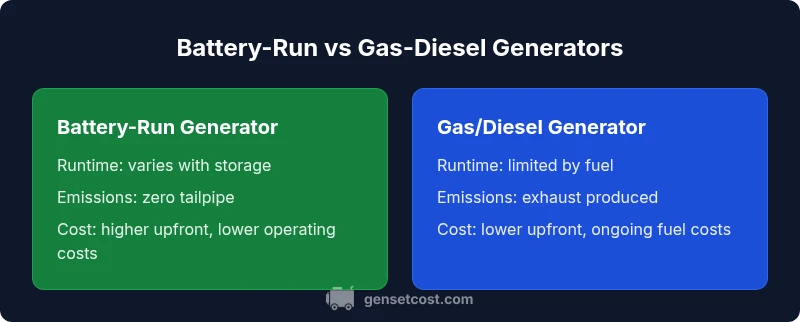
The core distinction rests on energy storage versus continuous fuel burning. A battery-run generator stores energy in a pack and uses an inverter to create AC power, with no tailpipe emissions during operation. In contrast, a traditional gas/diesel generator burns fuel to generate electricity, producing exhaust and requiring regular fuel storage and maintenance for the engine. Battery solutions generally offer smoother startup behavior and eliminated odor and odor-related concerns, especially in apartments or homes with limited ventilation. However, peak power delivery and runtime under heavy loads are often more constrained by battery capacity and inverter rating. Most buyers appreciate the predictable charging cycles and the ability to pair with home solar or grid recharging, a combination that strengthens resilience without the noise or hassle of fuel management. From a decision standpoint, the choice often hinges on how you plan to use the unit and the type of outages you face.
Battery chemistries and how they affect performance
Battery chemistry drives durability, safety, and cycle life. Lithium iron phosphate (LFP) chemistries are common in residential backup systems due to longer cycle life and improved thermal stability. NMC chemistries offer higher energy density, which can translate to more usable capacity in the same footprint but may experience different aging characteristics. Battery packs also include management systems that monitor temperature, voltage, and state of charge to maximize longevity. For homeowners, this means selecting a chemistry that matches your expected cycle frequency and climate. When evaluating candidates, look for warranties that cover both the battery cells and the battery management system (BMS). The Genset Cost team notes that a well-matched battery chemistry, an appropriate inverter, and a robust thermal design are central to long-term reliability and performance in real-world outages.
Runtime, recharge, and grid-tie capabilities
Runtime is the product of battery capacity and the load you place on the system. At light loads, a battery-run setup may provide hours of operation, while larger homes with higher essential loads will require more large-capacity storage. Recharging pathways are a key differentiator: direct AC charging from the grid, solar photovoltaic charging, or specialized charging docks can restore energy between outages. Some systems support grid-tied operation, enabling seamless recharging when the utility is available and preventing backfeeding. For property managers, this flexibility is valuable for minimizing downtime between events. Timing and availability of charging sources influence how often you can use the system, so plan around typical outage patterns and seasonal solar availability. This is where careful sizing and energy modeling pay dividends, reducing the risk of a nuisance outage that leaves critical circuits unpowered.
Noise, emissions, and indoor-use safety
One of the strongest selling points for battery-run generators is their quiet operation and absence of combustion emissions, making them suitable for indoor or semi-indoor spaces. Compared with gas/diesel units that can produce steady engine noise and fumes, battery systems typically operate at low decibel levels, especially at partial loads. Indoor-use safety also benefits from the lack of exhaust byproducts, but users must still follow manufacturer guidelines for ventilation and ventilation-related safety features like CO monitoring. In addition, many jurisdictions require proper installation with a transfer switch and safe enclosure for any backup power setup. Overall, the noise, emissions, and safety profile of battery-run generators generally outperform traditional engines in day-to-day use, particularly in urban or mixed-use properties.
Sizing and power planning for home backup
Sizing a battery-run backup begins with a precise load assessment. Start by listing essential circuits (refrigeration, lighting, communications, medical devices) and estimate total wattage. Then match this load to the inverter capacity and battery energy storage (kWh). It’s common to target 2–6 kWh of usable capacity for modest essential loads, with higher-capacity systems needed for larger homes or core critical loads. Consider peak demand periods, charging times, and the availability of solar or grid charging to replenish energy during outages. A robust sizing process reduces the risk of short outages or insufficient backup during prolonged events. Property managers should incorporate seasonal load variations and potential future expansions when selecting capacity and modular configurations.
Cost considerations: upfront, installation, and long-term costs
Cost considerations for battery-run generators vary widely with capacity, chemistry, and integration needs. Upfront costs cover the battery pack, inverter/charger, enclosure, and any smart controls. Installation expenses depend on the complexity of the electrical panel integration and the need for a transfer switch or a service disconnect. While the initial investment may be higher than a basic gas unit, operating costs tend to be lower over time due to minimal fuel purchases and potential solar charging. Battery degradation and eventual replacement are predictable long-term costs to factor in, along with warranty terms on the battery, inverter, and control electronics. Genset Cost emphasizes evaluating total cost of ownership over the system’s life rather than focusing solely on upfront price.
Maintenance, warranty, and service expectations
Maintenance for battery-run generators focuses on battery health, inverter cooling, and software/Firmware updates. Unlike combustion engines, there are fewer mechanical moving parts, reducing routine maintenance. Warranty structures typically cover the battery for a specified number of cycles or years, plus separate coverage for the inverter and control electronics. Service networks for battery storage and backups are expanding, but availability varies by region. When planning, confirm what is included in the warranty (e.g., battery replacement terms, conditions for degradation, and service response times) and whether extended service plans are offered. Regular inspections help catch thermal anomalies or pack health issues early, preserving reliability during outages.
Real-world scenarios: apartments, homes, and rental properties
For renters and high-density living spaces, battery-run generators offer advantages such as compact form factors, indoor suitability, and compliance with strict noise limits. In single-family homes, a properly sized system can support essential loads through typical outages and allows you to maintain critical appliances like refrigeration and communications. In multi-tenant buildings, shared-generation options or shared energy storage can distribute resilience more evenly while respecting individual electrical codes and building policies. When evaluating options for a rental portfolio, prioritize modular scalability, ease of installation, and non-intrusive integration with existing electrical infrastructure to minimize landlord and tenant friction during outages.
Installation and transfer-switch considerations
Installation requires careful planning around building electrical codes and panel configurations. A professional installer typically coordinates with the electrical panel, installer grounding, and any required transfer switch to isolate backup power from the grid. Transfer switches are essential for safety, preventing backfeeding and protecting both the generator and utility workers. For battery-run systems, the installer should verify venting and heat management for enclosures and ensure there is adequate clearance for service access. In some jurisdictions, permits may be required for the installation, and inspections should occur after commissioning. The goal is a seamless, code-compliant setup that provides reliable backup without compromising safety.
The role of solar and hybrid systems
Solar-ready designs enable continuous recharging of battery storage during and after outages, enhancing resilience. Hybrid configurations combine solar generation with battery storage and grid charging to minimize fuel dependence and maximize uptime. This approach is particularly effective for properties with good sun exposure or existing PV installations. For property managers evaluating options, a hybrid system can reduce peak electricity costs and improve outage duration, but it requires careful design to balance charge sources, inverter limits, and battery aging profiles. Funding and incentives in your area can influence feasibility, so assess program availability when planning.
Choosing between battery-run vs fuel-powered: decision framework
To decide between a battery-run and a traditional fuel-powered generator, start with your outage profile: frequency, duration, and load. If outages are moderate and you value quiet operation, low maintenance, indoor usability, and lower emissions, a battery-run system is a strong fit. If outages are long, loads are heavy, or you need instant, stretch-power for entire homes, a gas/diesel unit may be more appropriate, possibly in a hybrid setup with battery storage for efficiency. Consider total cost of ownership, space, and climate; ensure you can safely install with a transfer switch. The framework from Genset Cost recommends mapping loads, validating charging options, and evaluating reliability requirements before making a final choice.
Authority Sources
- Energy.gov: https://www.energy.gov/eere/renewable-energy-grid-integration
- EIA: https://www.eia.gov/energyexplained/electricity-and-energy-use/domestic-use.php
- NREL: https://www.nrel.gov/grid/backup-power.html
Comparison
| Feature | Battery-run generator | Gas/diesel generator |
|---|---|---|
| Runtime at typical load | Depends on battery capacity; hours to days at light loads | Depends on fuel tank size and engine efficiency; hours at rated load |
| Noise level | Low to moderate; quieter in lighter loads | Higher; motor and engine noise are noticeable |
| Emissions | Zero tailpipe emissions during operation | Produces exhaust and requires ventilation |
| Refueling / recharging | Recharge via grid, solar, or dedicated charger | Refuel with gasoline/diesel; requires supply inventory |
| Power output range | Moderate loads; modular scalability | High loads; suitable for whole-house power |
| Upfront cost range | Moderate to high; depends on storage capacity | Lower upfront for basic units; fuel and maintenance add up |
| Maintenance needs | Battery health checks; inverter updates; minimal mechanical upkeep | Engine maintenance; oil, filters, cooling, parts wear |
| Installation complexity | Often simpler; may need a transfer switch | Moderate to complex; venting and panel integration required |
The Good
- Quiet operation suitable for indoor and apartment use
- Zero emissions at point of use and no fuel storage risk
- Can pair with solar or grid charging for resilience
- Lower ongoing fuel costs than gas/diesel units
The Bad
- Higher upfront cost for storage and inverter
- Battery degradation and eventual replacement costs
- Limited runtime under heavy loads without larger storage
- Requires proper charging sources and potential grid dependence
Battery-run wins for quiet, emissions-free backup with moderate loads; gas/diesel remains better for long outages and high-demand scenarios
Choose battery-run if you prioritize low noise, indoor safety, and minimal maintenance for essential loads. Choose gas/diesel when you need long runtimes and the ability to power many circuits during extended outages. A hybrid approach can blend the strengths of both.
People Also Ask
What is a battery-run generator and how does it work?
A battery-run generator stores energy in batteries and uses an inverter to supply AC power. It’s designed to avoid exhaust and can be recharged from the grid, solar, or a dedicated charger. This setup supports quiet, indoor-friendly backup for essential loads.
A battery-run generator stores energy in batteries and uses an inverter to power your essentials quietly, often recharge-ready from grid or solar.
How long can a battery-run generator run during an outage?
Runtime depends on battery capacity and the loads you place on the system. For essential circuits, you may get several hours; with larger storage, a full day under light loads is possible. Always size for worst-case outage patterns.
Runtime varies with load and capacity—plan for hours to a day under lighter use.
Is it safe to use indoors?
Indoor-safe operation is possible when the unit is designed for indoor use and equipped with proper ventilation and CO monitoring. Always follow manufacturer guidelines and local codes to ensure safe operation.
Yes, with proper ventilation and following safety guidelines.
What factors affect the total cost?
Total cost includes the battery storage, inverter, installation, and ongoing battery maintenance or replacement. Fuel costs and servicing for gas/diesel units add to long-term expenses. Compare total cost of ownership rather than upfront price alone.
Battery and inverter costs plus installation determine upfront price; ongoing maintenance matters too.
Can a battery-run generator power the whole home?
Most battery-run systems are designed for essential circuits rather than complete home power. Achieving whole-home backup typically requires very large storage and high-capacity inverters, plus careful panel integration.
Usually best for essential loads, not every appliance in the home.
Do I need a transfer switch for a battery-run backup?
A transfer switch is typically recommended to safely connect the backup to your panel and prevent backfeeding into the grid. It protects both your system and utility workers.
Yes, a transfer switch is usually required for safe operation.
Key Takeaways
- Assess your essential-load profile before choosing
- Factor recharge options (grid/solar) into your plan
- Plan for transfer-switch safety and professional installation
- Expect higher upfront costs but lower ongoing fuel costs
- Consider solar-ready or hybrid setups for maximum resilience