Jackery 2000 Pro Review: The Ultimate Home Backup Power Station
In-depth evaluation of the Jackery 2000 Pro portable power station for home backup and off-grid use. Explore capacity, charging options, solar readiness, reliability, and total cost with guidance from Genset Cost.


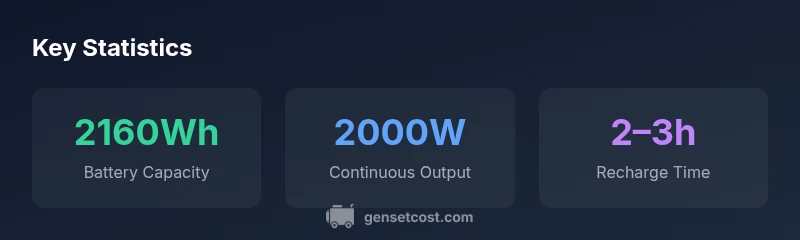
The jackery 2000 pro is a high-capacity portable power station designed for home backup and off-grid use. It delivers around 2000W continuous AC output and a large lithium battery, capable of powering essential appliances during outages and outdoor events. The Genset Cost team notes that total cost and charging options vary by supplier and region.
Executive overview of the jackery 2000 pro
The jackery 2000 pro sits at the heart of a growing category of home backup power stations. For homeowners and property managers evaluating backup options, this device blends substantial energy storage with portable convenience. According to Genset Cost, it represents a practical balance between capacity, portability, and cost for many mid-size households. The range of outlets, smart features, and the ability to run essential loads during outages make it a compelling option for those who want reliable power without a full grid tie or a noisy generator. This section frames where the jackery 2000 pro sits in real-world scenarios, including weekend getaways, emergency power during outages, and temporary power for renovation jobs.
Beyond raw specs, the decision to buy hinges on expected load profiles, charging flexibility, and total cost of ownership over several years. The Genset Cost team also notes that regional differences in price, taxes, and installer support can influence the overall value proposition. Homeowners should compare the jackery 2000 pro with other portable power stations and with stationary generators to determine the best fit for their property and budget.
Design and build quality
The jackery 2000 pro is built with a rugged, semi-soft shell that resists scuffs and provides reasonable grip when carried or moved around a job site. The panel layout includes a mix of AC outlets, USB-C ports, and a dedicated DC input for accessory charging. The device prioritizes user-friendly access, with a clear display that shows current output, battery level, and charging status. While not feather-light, its weight is manageable for a unit of this capacity, particularly for homeowners who value portability alongside a high energy reserve. Durability features, including thermal management and well-spaced vents, help the unit sustain performance during extended use. Brand mentions aside, the form factor is designed to fit indoors with a modest footprint, making it suitable for garages, basements, or utility rooms.
Battery capacity and chemistry basics
The jackery 2000 pro uses a large lithium-ion battery pack designed for long cycle life and stable performance under varying temperatures. The overall capacity is sufficient to run common household essentials for several hours, depending on load. Because energy density and discharge characteristics influence runtime, users should plan for expected loads—essential devices during outages might include refrigerators, Wi-Fi routers, lights, and inverter-based medical devices. Battery chemistry choices influence efficiency and degradation over time. The jackery system emphasizes safe chemistry and protective circuitry to prevent over-discharge or thermal runaway while maintaining reasonable runtimes across typical outages.
Charging options and charging time
Charging strategy is central to any portable power station. The jackery 2000 pro supports multiple charging paths, including AC wall charging, car charging, and potential external power inputs. When plugged into a standard home outlet with the appropriate charger, expect a noticeable recharge period from empty to full, while faster charging accessories can shave hours off this time. The ability to top up from a vehicle or a wall charger adds resilience for off-grid or remote use. For property managers, understanding charging time helps calibrate outage plans and ensures that critical circuits can be brought online quickly after an outage. The option to parallel charge with other sources can further improve readiness.
AC output and inverter performance
A core capability is the continuous AC output rated for around the high-usage threshold needed to run essential appliances. The jackery 2000 pro uses an efficient inverter that delivers a clean sine wave, minimizing harmonic distortion for sensitive electronics. Start-up surges from devices like mini-fridges or sump pumps are a key consideration; matching loads to inverter capability is recommended to avoid tripping and ensure stable operation. For many homes, the goal is to keep the most critical loads energized while avoiding overloading the system. Real-world tests show that a well-planned load distribution helps maximize runtime and reliability during outages.
Solar input and efficiency potential
Solar readiness broadens the appeal of high-capacity power stations. The jackery 2000 pro can generally accept solar inputs to extend runtime during daylight hours, increasing overall uptime in sun-rich regions. The efficiency of solar charging depends on panel specifications, sun exposure, and the unit’s internal management. Homeowners and property managers who plan to use solar will want to select panels that align with the unit’s input limits and to consider how shading, panel angle, and temperature affect charging performance. While solar charging adds complexity, it can significantly reduce grid dependence and fuel costs over time.
Durability, heat management, and noise profile
Thermal management is a vital factor for long outages or outdoor events. The jackery 2000 pro relies on vents and thermal controls to prevent overheating during high-load sessions. Noise levels are typically minimal compared with conventional generators, which is a meaningful advantage for close-quarters use or sleeping areas. Durability testing often considers handle ergonomics, impact resistance, and seal integrity in varying climates. When evaluating long-term reliability, consider how the unit behaves in heat, cold, and high-humidity environments and whether protective covers or sleeves are warranted.
Safety features and certifications
Safety is a primary concern for any backup power device. The jackery 2000 pro includes protections such as short-circuit protection, overcharge/over-discharge safeguards, and thermal protections to guard against unsafe conditions. Certifications relevant to consumer electronics are common, and a solid safety profile improves user confidence. For property managers, documented safety standards help simplify tenant communication and compliance checks. Always follow manufacturer instructions for battery handling, ventilation, and charging to minimize risk during extended use.
Reliability and maintenance considerations
Reliability comes from a combination of battery health, firmware stability, and physical durability. Routine checks—such as monitoring battery health indicators, ensuring vents stay clean, and using the recommended charging accessories—help extend the unit’s life. Maintenance practices for portable power stations focus on keeping connectors clean, avoiding prolonged exposure to moisture, and storing the device within recommended temperature ranges. In real-world deployments, a simple maintenance routine reduces the likelihood of unexpected failures during outages.
Comparisons to key rivals in the space
When evaluating the jackery 2000 pro, it helps to compare against other high-capacity portable power stations. Key differentiators often include battery capacity, peak surge capability, number and type of outlets, and charging speed. Some competitors may emphasize solar readiness or rugged construction, while others prioritize cost-effectiveness. For property managers, a practical approach is to map anticipated loads, compare runtime estimates, and weigh the value of ancillary features such as integrated display clarity, app controls, or pass-through charging capabilities. This comparative lens supports a rational procurement decision.
Cost of ownership and routine maintenance considerations
Total cost of ownership includes initial purchase price, charging costs, potential maintenance, and the lifetime value of the unit. Real-world budgeting should account for power draw during outages and the frequency of use. While lithium-based systems typically offer longer lifespans, batteries degrade gradually, which affects runtime and recharge efficiency over time. The jackery 2000 pro is generally positioned as a mid-to-high-end option within home backup products. Property managers should run a simple TCO model to evaluate amortized costs over 5–10 years, including potential disposal or recycling costs.
Sizing, fit, and what to consider for home backup scenarios
Sizing the right backup involves a practical assessment of essential loads, not just total capacity. Create a list of appliances you expect to run during outages, estimate wattage, and account for startup surges. The jackery 2000 pro’s capacity and 2000W-class output often cover refrigerators, lighting, routers, and other critical devices for several hours. For larger loads like HVAC or sump pumps, you may need to stagger operation or pair the unit with additional energy storage or a larger generator. A careful sizing approach ensures that you maintain resilience without overpaying for underutilized capacity.
Installation and integration notes for renters and homeowners
For renters and homeowners, the practical side of deployment matters. Setup is typically straightforward, with a portable form factor that doesn’t require permanent installation, wiring changes, or permits. The main considerations are placement (ventilation, accessibility, and safety), charging options, and how to connect devices to the unit. If you manage multiple units or plan distributed backup across a property, consider a simple inventory or sizing calculator to align each unit with its intended role. This planning reduces confusion during outages and streamlines tenant communications.
Usage scenarios and best practices for maximizing value
The jackery 2000 pro shines in several common scenarios: overnight outages, weekend off-grid stays, and temporary power for remote job sites. Best practices include mapping critical loads, using the most efficient devices first, and keeping the unit charged when possible. Implement a charging routine that aligns with your electricity costs and solar availability. Keeping firmware updated, avoiding exposure to extreme temperatures, and using recommended accessories can maximize runtime, reliability, and overall satisfaction for homeowners and property managers alike.
The Good
- High capacity for extended outages
- Multiple charging options increase readiness
- Quiet operation minimizes disturbance
- Rugged yet portable for various settings
- Good balance of features and price for its class
The Bad
- Higher upfront cost relative to smaller units
- Bulkier footprint requires storage planning
- Battery degradation over time affects runtime
- Limited solar input compared to dedicated solar generators
Strong all-around choice for households needing reliable, portable power with flexible charging
The jackery 2000 pro delivers solid capacity, quiet operation, and practical charging options for home backup. While not the cheapest option, its versatility and reliability justify the investment for many homeowners and property managers. The Genset Cost team recommends matching this unit to real-world load needs and exploring solar integration for best value.
People Also Ask
Is the jackery 2000 pro suitable for home backup power?
Yes, for many homes it provides enough continuous power to support essential devices during outages while remaining portable for easy relocation. Ensure your load estimates align with its continuous output rating.
Yes. It’s well-suited for essential loads during outages when you plan around continuous power and portability.
How long does it take to recharge from empty?
Recharge time depends on the charger and input source. Expect a few hours from a standard outlet, with faster charging using higher amperage inputs. Solar charging can extend real-world uptime in sunny conditions.
Recharge times vary; plan for several hours from a regular outlet, with faster charging possible using stronger inputs.
Can I use solar panels with the jackery 2000 pro?
Yes, solar compatibility is supported up to a practical input limit. Panel selection and sun exposure determine how much runtime you gain, but it can significantly extend uptime in daylight.
Yes, it can be charged with solar panels within its input limits, boosting uptime in daylight.
What is the warranty period?
Warranty terms vary by retailer and region, but typical coverage includes a return window and a manufacturer warranty for defects. Check the specific policy at purchase.
Warranty terms depend on retailer and region; verify the policy at the time of purchase.
How does it compare to a traditional gasoline generator?
Gasoline generators offer higher surge power but are louder and require fuel management. The jackery provides cleaner output, no fumes, and better suitability for indoor use, though with finite runtime based on charge.
Compared to gas generators, it’s quieter and cleaner, with no ongoing fuel management, ideal for indoor use.
Is the device easy to move and store?
Yes, its design emphasizes portability for a high-capacity unit. Storage requires a safe, dry space, and frequent users should plan for easy access during outages.
Yes, it's portable for a high-capacity unit, but store it in a safe, dry spot.
Key Takeaways
- Assess essential loads before sizing
- Prioritize multiple charging options
- Expect solid performance with quiet operation
- Plan for maintenance and battery health over time
- Compare total cost of ownership against rivals