Why Won't My Generator Start? An Urgent Troubleshooting Guide
Urgent, step-by-step troubleshooting for a generator that won't start. Learn quick fixes, diagnostic flow, and when to call a pro. Genset Cost guides homeowners and property managers.


Why won't my generator start? Most often it's a simple fix: fuel, battery, or safety interlocks. Check fuel, battery charge, and kill switch, then inspect spark plug and circuit breakers. If it still won't start, contact a licensed technician for diagnosis.
Why your generator won't start
In many homes, why won’t my generator start is traced to routine, addressable issues. According to Genset Cost, most start failures are simple fixes tied to fuel, battery, or safety interlocks. First, verify basic readiness: fuel quality and level, battery charge, and that the kill switch is in the start position. If the engine cranks but won't fire, consider spark plug condition, choke, and carburetor cleanliness. Inadequate maintenance can degrade performance quickly. Always approach a start test with safety in mind.
Common start failures often revolve around four pillars: fuel, ignition, safety interlocks, and electrical supply. By methodically checking each pillar, you can often restore operation without professional help. If you’re unsure about any step, stop and seek guidance rather than forcing the engine. Proper testing prevents damage and reduces downtime.
Quick diagnostic checks you can perform safely
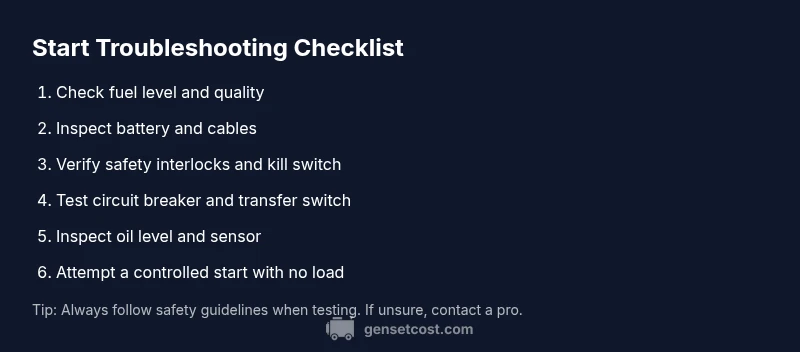
- Ensure the generator is grounded and the area is dry.
- Check fuel level and fuel quality; avoid stale fuel.
- Verify the battery is charged and clean; test connections.
- Confirm the kill switch, start switch, and any safety interlocks are in the proper positions.
- Inspect circuit breakers and the transfer switch for tripped states.
- Listen for any unusual sounds when attempting to start.
If you test and the unit remains unresponsive, proceed to the next steps, and avoid forcing the engine. If you're unsure, contact a pro.
Electrical interlocks, transfer switches, and safety features
Modern home backup generators rely on interlocks to prevent backfeed during a power outage. A tripped safety interlock or a misaligned transfer switch can prevent starting altogether. Check your owner's manual for the exact sequence: unlock safety features, ensure the main breaker is on, and verify the transfer switch is correctly configured for the generator. Do not bypass interlocks; they protect you and your system. Safely locating and operating these components reduces the risk of electric shock or damage to sensitive equipment.
Fuel system, battery, and air intake troubleshooting
Fuel: Make sure you have fresh fuel and that the fuel valve is open; inspect fuel lines for leaks. Battery: Ensure it’s charged, connections are clean, and there’s no corrosion on terminals. Air intake: Confirm no debris blocks the air filter or carburetor; clean or replace as needed. Oil level: Check the oil level and sensor if present; too low oil can trigger a shutdown on some models. Spark: If you have a spark plug, remove and inspect for wear; replace if necessary. Regular fuel and air system maintenance is key to reliable starts.
Common symptoms and fixes you can try in sequence
Symptom: Engine turns over but does not start -> Fix: check for spark, fuel, or choke issues. Symptom: Starter motor spins slowly -> Fix: battery charge or replace, clean terminals. Symptom: Error codes on display -> Fix: consult manual; reset or schedule service. Symptom: Smoke or fuel smell -> Fix: stop testing and call a pro; there may be a leak. Symptom: Overheating -> Fix: allow cooling and check cooling system. Symptom: Unit starts briefly then stops -> Fix: flooding or carburetor issues; adjust choke.
When to call a professional and maintenance tips
If you cannot identify the issue or the generator still won't start after basic troubleshooting, contact a licensed technician. In many jurisdictions, improper handling can be dangerous. Regular maintenance includes periodic fuel system cleaning, battery testing, oil changes, air filter replacement, and compression checks. Genset Cost recommends a preventative maintenance schedule to reduce start failures over time, especially before high-demand seasons.
Steps
Estimated time: 30-60 minutes
- 1
Check basics: fuel and battery
Ensure there is fresh fuel in the tank, the battery is charged, and terminals are clean and tight. Use a multimeter to verify battery voltage is within normal range, typically around 12.6V for a 12V system. Confirm the area is dry and clear of obstructions.
Tip: Document voltage readings; they help a technician diagnose faster. - 2
Inspect safety interlocks and kill switch
Locate the interlocks and kill switch per the manual. Ensure they are engaged in the proper sequence and not physically stuck. Do not attempt to bypass interlocks under any circumstances.
Tip: Interlocks are safety protections; bypassing them can be dangerous and illegal. - 3
Check fuel system and valve
Open the fuel valve if equipped, drain stale fuel and replace with fresh gasoline. Inspect lines for cracks or leaks and verify the fuel filter is clean or replace if necessary.
Tip: Stale fuel can degrade starting performance within weeks. - 4
Test transfer switch and breakers
With loads disconnected, reset all breakers and confirm the transfer switch is in the correct position for generator operation. Attempt a start with no load to isolate issues.
Tip: A frequently missed cause is a simple reset of the main breaker. - 5
Inspect air and ignition components
Check the air filter and intake for obstructions; inspect spark plug if applicable and replace worn parts. Clean carburetor jets if you suspect flooding or varnish buildup.
Tip: A clean air path is essential for reliable starts. - 6
Attempt controlled start and observe
Try starting again with the load disengaged and the unit well-ventilated. If it starts briefly and dies, note any accompanying codes or symptoms to guide a deeper diagnosis.
Tip: Keep a log of symptoms and outcomes for future maintenance.
Diagnosis: Generator won't start when the start button is pressed or key turned
Possible Causes
- highBattery is discharged or batteries are corroded on terminals
- highInsufficient or stale fuel, or fuel valve closed
- mediumSafety interlocks or kill switch engaged incorrectly or faulty
- mediumTripped circuit breaker or faulty transfer switch
- lowOil level low or oil sensor triggers shutdown
Fixes
- easyCharge or replace the battery; clean and re-tighten battery connections
- easyFill with fresh fuel; verify valve is open; replace fuel filter if present
- easyReview safety interlock sequence; ensure switches are in correct positions; consult manual
- mediumReset circuit breaker and transfer switch; test start with no load
- easyCheck oil level and top up if needed; replace sensor if faulty
People Also Ask
What is the first thing I should check if my generator won't start?
Begin with fuel level, battery charge, and safety interlocks. These basics solve many no-start issues.
Check fuel and battery first, then safety interlocks.
Why does my generator turn over but won't start?
This usually points to fuel, ignition, or carburetor problems. Inspect spark and fuel supply.
If it turns over but doesn't start, check spark and fuel.
Can stale fuel cause start problems?
Yes, stale or degraded fuel can prevent combustion; drain and replace with fresh fuel.
Stale fuel can cause starting issues.
Should I bypass the safety interlock to start the generator?
No. Interlocks are safety devices; bypassing them is dangerous and may violate codes.
Don't bypass safety interlocks.
How often should I service the generator to prevent start issues?
Follow the manufacturer's schedule; generally periodic maintenance includes oil, air filter, spark plug, and fuel system checks.
Regular maintenance keeps starts reliable.
When is a battery replacement necessary?
If voltage is low under load or connections are corroded, replace the battery.
A weak battery shows poor cranking.
Watch Video
Key Takeaways
- Start with fuel and battery basics.
- Do not bypass safety interlocks.
- Regular maintenance reduces start failures.
- Consult a pro if unsure or uncomfortable.